< ARCHIVE

> FILE / B72C759C

NASA-UAP-D5, APOLLO 17 CREW DEBRIEFING, HOUSTON, JANUARY 1973

This document is a transcript of the Apollo 17 scientific crew debriefing conducted at the Manned Spacecraft Center. It details astronomical observations made during the mission, including analysis of the Coma cluster, X-ray backgrounds, and UV radiation measurements. The discussion focuses on interpreting interstellar phenomena and potential extragalactic radiation sources.

AGENCY
NASA
TYPE
TRANSCRIPT
INCIDENT DATE
1973-01-08
LOCATION
HOUSTON, TEXAS
PAGES
3
EXTRACTED
3 / 3
STATUS
READY

> PAGES INDEXED [003]

OPEN A PAGE BELOW

  1. Page 1P.1
  2. Page 2P.2UNCLASSI
  3. Page 3P.3UNCLASSI

> PAGE TEXT

PAGE 1

cover-page

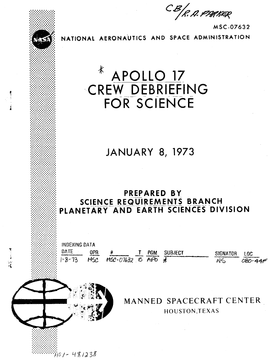
This is the cover page for the Apollo 17 Crew Debriefing for Science report, dated January 8, 1973, prepared by the Science Requirements Branch at the Manned Spacecraft Center.

[HANDWRITTEN: CB/R.A. PARKER]
MSC-07632
NATIONAL AERONAUTICS AND SPACE ADMINISTRATION

* APOLLO 17
CREW DEBRIEFING
FOR SCIENCE

JANUARY 8, 1973

PREPARED BY
SCIENCE REQUIREMENTS BRANCH
PLANETARY AND EARTH SCIENCES DIVISION

INDEXING DATA
DATE OPR # T PGM SUBJECT SIGNATOR LOC
1-8-73 MSC MSC-07632 B APO * NS 080-44F

MANNED SPACECRAFT CENTER
HOUSTON, TEXAS
[HANDWRITTEN: HS1-481238]

PAGE 2

transcript

This page is a transcript of a scientific debriefing, likely involving Dr. Henry, discussing astronomical observations including the Coma cluster, X-ray backgrounds, and UV radiation measurements.

119

HENRY
(CONT'D) gravitationally holding it together. We though it might be
in the form of ionized hydrogen. We looked for Lyman-alpha
radiation, red shifted from the ionized hydrogen, and we
didn't see any. We set a lower limit, which certainly ex-
cludes the possibility that the Coma cluster is held together
by this ionized hydrogen. I think that may leave a real
mystery as to what is holding the thing together.

The fourth point may turn out to be the most interesting
thing of all. When you look in the Milky Way, you see a
lot of UV coming from the stars, but the question is, what
do you see when you look up to the North Galactic Pole or
down to the South Galactic Pole. One of the most exciting
results of X-ray astronomy was the fact that an X-ray back-
ground was observed over the sky that nobody had expected,
and part of this is the gamma-ray background that Dr. Trombka
talked about. In the UV, nobody knows, but you never know
until you look. You do have to deal with this background
of stars that we know is there. So we did look at a large
number of different points at high galactic latitudes, both
north and south. The spectrum that we see is above this
dark count. In other words, this abnormally high dark
current did not, in fact, interfere with that experiment.
The spectrum that we see looks like the spectrum of the hot
PAGE 3

transcript

This transcript page features a discussion by Henry regarding astronomical observations, specifically light reflection from interstellar dust, Lyman-alpha hydrogen radiation, and observations of Earth from space.

120

HENRY
(CONT'D)
star; however, we know that there were no hot stars within
our field of view. Therefore, the most conservative inter-
pretation, I think, is that what we're seeing is light from
hot stars in the galactic plane going up out of the plane
and reflecting off interstellar dust. There are certain
characteristics of the spectrum, though, that don't fit that
theory, and it's at least possible that this is extragalactic
radiation. I'm looking forward very much to the detailed
computer study of this, but it's going to take a long time.

Fifth point: Lyman-alpha hydrogen radiation is a completely
separate problem, and Gary Thomas at the University of
Colorado and Charles Barthum [?] observed this from OGO-5.
We obtained just an enormous amount of data on the Apollo
that's going to straighten out this picture and clarify it
considerably. This is hydrogen that is inside our solar
system. It's sunlight reflecting off this. The hydrogen,
Gary Thomas thinks, is hydrogen from interstellar space
streaming through the solar system, and he is looking for-
ward with great anticipation to getting detailed analyses
of that.

One more thing: the spectrum of the Earth. I keep saying
"we," but these were the guys that were there. We looked
at the Earth from outside. A lot of people have observed