< ARCHIVE

> FILE / 80C68A3E

NASA-UAP-D2, MISSION TRANSCRIPT, APOLLO 17, DECEMBER 1972

This transcript documents communications between the Apollo 17 crew and Mission Control regarding the observation of unidentified bright, tumbling fragments and light phenomena outside the spacecraft. The crew provides detailed descriptions of the objects' appearance, motion, and potential relationship to the S-IVB stage. The document also includes routine mission communications regarding lunar surface observations and weather tracking.

AGENCY
NASA
TYPE
TRANSCRIPT
INCIDENT DATE
1972-12-07
LOCATION
EARTH ORBIT
PAGES
16
EXTRACTED
16 / 16
STATUS
READY

> PAGES INDEXED [016]

OPEN A PAGE BELOW

  1. Page 1P.1UNCLASSI
  2. Page 2P.2
  3. Page 3P.3UNCLASSI
  4. Page 4P.4UNCLASSI
  5. Page 5P.5UNCLASSI
  6. Page 6P.6
  7. Page 7P.7UNCLASSI
  8. Page 8P.8UNCLASSI
  9. Page 9P.9UNCLASSI
  10. Page 10P.10UNCLASSI
  11. Page 11P.11UNCLASSI
  12. Page 12P.12UNCLASSI
  13. Page 13P.13UNCLASSI
  14. Page 14P.14
  15. Page 15P.15UNCLASSI
  16. Page 16P.16UNCLASSI

> PAGE TEXT

PAGE 1

transcript

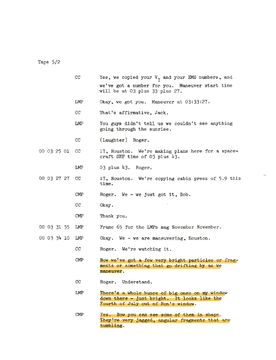
A transcript from the Apollo 17 mission where crew members report observing bright, jagged, tumbling particles or fragments drifting outside their spacecraft window during a maneuver.

Tape 5/2

CC Yes, we copied your VI and your EMS numbers, and we've got a number for you. Maneuver start time will be at 03 plus 33 plus 27.

LMP Okay, we got you. Maneuver at 03:33:27.

CC That's affirmative, Jack.

LMP You guys didn't tell us we couldn't see anything going through the sunrise.

CC (Laughter) Roger.

00 03 25 01 CC 17, Houston. We're making plans here for a spacecraft SEP time of 03 plus 43.

LMP 03 plus 43. Roger.

00 03 27 27 CC 17, Houston. We're copying cabin press of 5.9 this time.

CMP Roger. We - we just got it, Bob.

CC Okay.

CMP Thank you.

00 03 31 55 LMP Frame 65 for the LMPs mag November November.

00 03 34 10 LMP Okay. We - we are maneuvering, Houston.

CC Roger. We're watching it.

CMP Now we've got a few very bright particles or fragments or something that go drifting by as we maneuver.

CC Roger. Understand.

LMP There's a whole bunce of big ones on my window down there - just bright. It looks like the Fourth of July out of Ron's window.

CMP Yes. Now you can see some of them in shape. They're very jagged, angular fragments that are tumbling.

PAGE 2

transcript

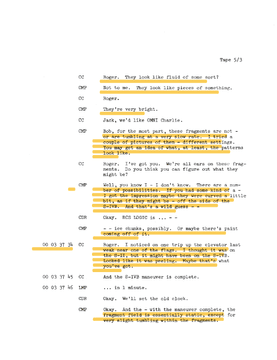
A transcript of communications between Apollo 17 crew members and Mission Control regarding the observation of unidentified fragments near the S-IVB stage.

Tape 5/3

CC Roger. They look like fluid of some sort?
CMP Not to me. They look like pieces of something.
CC Roger.
CMP They're very bright.
CC Jack, we'd like OMNI Charlie.
CMP Bob, for the most part, these fragments are not - or are tumbling at a very slow rate. I tried a couple of pictures of them - different settings. You may get an idea of what, at least, the patterns look like.
CC Roger. I've got you. We're all ears on these fragments. Do you think you can figure out what they might be?
CMP Well, you know I - I don't know. There are a number of possibilities. If you had some kind of a - I got the impression maybe they were curved a little bit, as if they might be - off the side of the S-IVB. And that's a wild guess - -
CDR Okay. RCS LOGIC is ... - -
CMP - - ice chunks, possibly. Or maybe there's paint coming off of it.
00 03 37 34 CC Roger. I noticed on one trip up the elevator last weak near one of the flags. I thought it was on the S-II, but it might have been on the S-IVB. Looked like it was peeling. Maybe that's what you've got.
00 03 37 45 CC And the S-IVB maneuver is complete.
00 03 37 46 LMP ... in 1 minute.
CDR Okay. We'll set the old clock.
CMP Okay. And the - with the maneuver complete, the fragment field is essentially static, except for very slight tumbling within the fragments.

PAGE 3

transcript

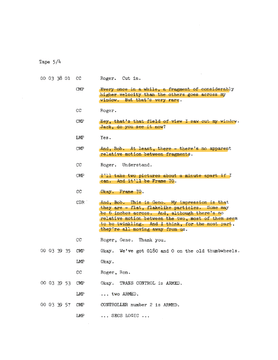
Transcript of Apollo 17 mission communications regarding the observation of unidentified particles outside the spacecraft window.

Tape 5/4

00 03 38 01 CC Roger. Cut in.

CMP Every once in a while, a fragment of considerably higher velocity than the others goes across my window. But that's very rare.

CC Roger.

CMP Hey, that's that field of view I saw out my window. Jack, do you see it now?

LMP Yes.

CMP And, Bob. At least, there - there's no apparent relative motion between fragments.

CC Roger. Understand.

CMP I'll take two pictures about a minute apart if I can. And it'll be Frame 70.

CC Okay. Frame 70.

CDR And, Bob. This is Geno. My impression is that they are - flat, flakelike particles. Some may be 6 inches across. And, although there's no relative motion between the two, most of them seem to be twinkling. And I think, for the most part, they're all moving away from us.

CC Roger, Gene. Thank you.

00 03 39 35 CMP Okay. We've got 0180 and 0 on the old thumbwheels.

LMP Okay.

CC Roger, Ron.

00 03 39 53 CMP Okay. TRANS CONTROL is ARMED.

LMP ... two ARMED.

00 03 39 57 CMP CONTROLLER number 2 is ARMED.

LMP ... SECS LOGIC ...

PAGE 4

transcript

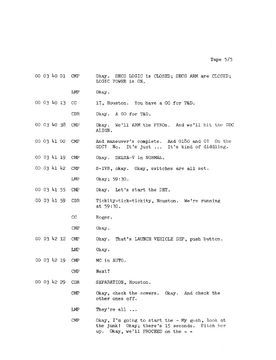
A transcript of communications between the Apollo 17 crew and Houston Mission Control during the T&D (Transposition and Docking) phase, including a brief mention of unidentified debris.

Tape 5/5

00 03 40 01 CMP Okay. SECS LOGIC is CLOSED; SECS ARM are CLOSED; LOGIC POWER is ON.

LMP Okay.

00 03 40 13 CC 17, Houston. You have a GO for T&D.

CDR Okay. A GO for T&D.

00 03 40 38 CMP Okay. We'll ARM the PYROs. And we'll hit the GDC ALIGN.

00 03 41 00 CMP And maneuver's complete. And 0180 and 0? On the GDC? No. It's just ... It's kind of diddling.

00 03 41 19 CMP Okay. DELTA-V in NORMAL.

00 03 41 42 CMP S-IVB, okay. Okay, switches are all set.

LMP Okay; 59:30.

00 03 41 55 CMP Okay. Let's start the DET.

00 03 41 59 CDR Tickity-tick-tickity, Houston. We're running at 59:30.

CC Roger.

CMP Okay.

00 03 42 12 CMP Okay. That's LAUNCH VEHICLE SEP, push button.

LMP Okay.

00 03 42 19 CMP MC in AUTO.

CMP Next?

00 03 42 29 CDR SEPARATION, Houston.

CMP Okay, check the covers. Okay. And check the other ones off.

LMP They're all ...

CMP Okay, I'm going to start the - My gosh, look at the junk! Okay; there's 15 seconds. Pitch her up. Okay, we'll PROCEED on the - -

PAGE 5

transcript

Apollo 17 crew members discuss observations of light phenomena (streaks and flashes) seen from the spacecraft with Mission Control.

Tape 46/4

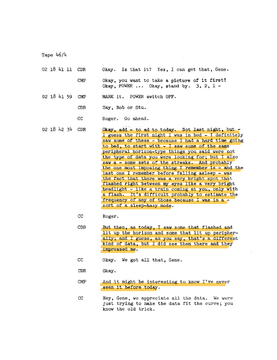
02 18 41 11 CDR Okay. Is that it? Yes, I can get that, Gene.

CMP Okay, you want to take a picture of it first?
Okay, POWER ... Okay, stand by. 3, 2, 1 -

02 18 41 59 CMP MARK it. POWER switch OFF.

CDR Say, Bob or Stu.

CC Roger. Go ahead.

02 18 42 34 CDR Okay, add - to ad to today. Not last night, but -
I guess the first night I was in bed - I definitely
saw some of these - because I had a hard time going
to bed, to start with - I saw some of the same
peripheral horizon-type things you said were not
the type of data you were looking for; but I also
saw a - some sets of the streaks. And probably
the one most imposing thing I remember is - and the
last one I remember before falling asleep - was
the fact that there was a very bright spot that
flashed right between my eyes like a very bright
headlight - like a train coming at you, only with
a flash. It's difficult probably to estimate the
frequency of any of those because I was in a -
sort of a sleep-hazy mode.

CC Roger.

CDR But then, as today, I saw some that flashed and
lit up the horizon and some that lit up peripher-
ally; and I guess, as you say, that's a different
kind of data, but I did see them there and they
impressed me.

CC Okay. We got all that, Gene.

CDR Okay.

CMP And it might be interesting to know I've never
seen it before today.

CC Hey, Gene, we appreciate all the data. We were
just trying to make the data fit the curve; you
know the old trick.

PAGE 6

transcript

A transcript of communications between the Apollo 17 crew (CDR and LMP) and Mission Control (CC) regarding observations of objects in space and the tracking of the S-IVB stage.

Tape 46/5

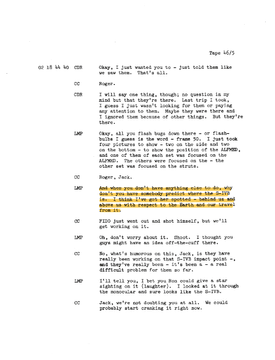
02 18 44 40 CDR Okay, I just wanted you to - just told them like we saw them. That's all.

CC Roger.

CDR I will say one thing, though; no question in my mind but that they're there. Last trip I took, I guess I just wasn't looking for them or paying any attention to them. Maybe they were there and I ignored them because of other things. But they're there.

LMP Okay, all you flash bugs down there - or flash-bulbs I guess is the word - frame 50. I just took four pictures to show - two on the side and two on the bottom - to show the position of the ALFMED, and one of them of each set was focused on the ALFMED. The others were focused on the - the other set was focused on the struts.

CC Roger, Jack.

LMP And when you don't have anything else to do, why don't you have somebody predict where the S-IVB is. I think I've got her spotted - behind us and above us with respect to the Earth and our travel from it.

CC FIDO just went out and shot himself, but we'll get working on it.

LMP Oh, don't worry about it. Shoot. I thought you guys might have an idea off-the-cuff there.

CC No, what's humorous on this, Jack, is they have really been working on that S-IVB impact point -, and they've really been - it's been a - a real difficult problem for them so far.

LMP I'll tell you, I bet you Ron could give a star sighting on it (laughter). I looked at it through the monocular and sure looks like the S-IVB.

CC Jack, we're not doubting you at all. We could probably start cranking it right now.

PAGE 7

transcript

A transcript from the Apollo 17 mission where the crew discusses stowing equipment and the Commander reports observing a bright, rotating object in the distance that is distinct from nearby particles.

Tape 46/6

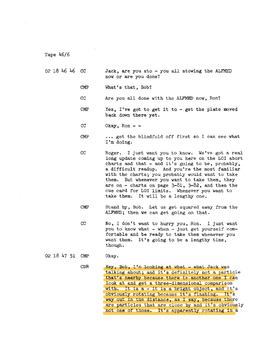
02 18 46 46 CC Jack, are you sto - you all stowing the ALFMED now or are you done?

CMP What's that, Bob?

CC Are you all done with the ALFMED now, Ron?

CMP Yes, I've got to get it to - get the plate moved back down there yet.

CC Okay, Ron - -

CMP ... get the blindfold off first so I can see what I'm doing.

CC Roger. I just want you to know. We've got a real long update coming up to you here on the LOI abort charts and that - and it's going to be, probably, a difficult readup. And you're the most familiar with the charts; you probably would want to take them. But whenever you want to take them, they are on - charts on page 3-81, 3-82, and then the cue card for LOI limits. Whenever you want to take them. It will be a lengthy one.

CMP Stand by, Bob. Let us get squared away from the ALFMED; then we can get going on that.

CC No, I don't want to hurry you, Ron. I just want you to know what - when - just get yourself comfortable and be ready to take them whenever you want them. It's going to be a lengthy time, though.

02 18 47 51 CMP Okay.

CDR Hey, Bob, I'm looking at what - what Jack was talking about; and it's definitely not a particle that's nearby because there is another one I can look at and get a three-dimensional comparison with. It is a - it is a bright object, and it's obviously rotating because it's flashing. It's way out in the distance, as I say, because there are particles that are close by and it's obviously not one of those. It's apparently rotating in a

PAGE 8

transcript

Transcript of Apollo 17 mission communications regarding the observation of an unidentified object in space, with ground control attempting to coordinate tracking of the object.

Tape 46/7

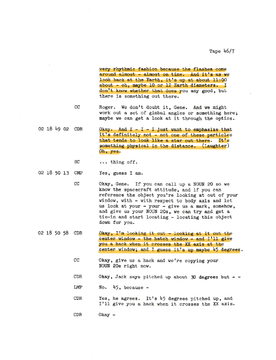
very rhythmic fashion because the flashes come around almost - almost on time. And it's as we look back at the Earth, it's up at about 11:00 about - oh, maybe 10 or 12 Earth diameters. I don't know whether that does you any good, but there is something out there.

CC Roger. We don't doubt it, Gene. And we might work out a set of gimbal angles or something here; maybe we can get a look at it through the optics.

02 18 49 02 CDR Okay. And I - I - I just want to emphasize that it's definitely not - not one of these particles that tends to look like a star out there. It's something physical in the distance. (Laughter) Oh, yes.

SC ... thing off.

02 18 50 13 CMP Yes, guess I am.

CC Okay, Gene. If you can call up a NOUN 20 so we know the spacecraft attitude, and if you can reference the object you're looking at out of your window, with - with respect to body axis and let us look at your - your - give us a mark, somehow, and give us your NOUN 20s, we can try and get a tie-in and start locating - locating this object down for you.

02 18 50 58 CDR Okay, I'm looking it out - looking at it out the center window - the hatch window - and I'll give you a hack when it crosses the XX axis at the center window; and I guess it's up maybe 45 degrees.

CC Okay, give us a hack and we're copying your NOUN 20s right now.

CDR Okay, Jack says pitched up about 30 degrees but - -

LMP No. 45, because -

CDR Yes, he agrees. It's 45 degrees pitched up, and I'll give you a hack when it crosses the XX axis.

CDR Okay - -

PAGE 9

transcript

Apollo 17 crew members discuss observations of an unidentified object, initially speculating on its nature and relationship to the S-IVB stage.

Tape 46/8

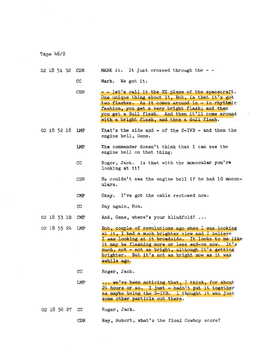
02 18 51 32 CDR MARK it. It just crossed through the - -

CC Mark. We got it.

CDR - - let's call it the XZ plane of the spacecraft. One unique thing about it, Bob, is that it's got two flashes. As it comes around in - in rhythmic fashion, you get a very bright flash; and then you get a dull flash. And then it'll come around with a bright flash, and then a dull flash.

02 18 52 18 LMP That's the side and - of the S-IVB - and then the engine bell, Gene.

LMP The commander doesn't think that I can see the engine bell on that thing.

CC Roger, Jack. Is that with the monocular you're looking at it?

CDR He couldn't see the engine bell if he had 10 monoculars.

CMP Okay. I've got the cable restowed now.

CC Say again, Ron.

02 18 53 10 CMP And, Gene, where's your blindfold? . . .

02 18 55 24 LMP Bob, couple of revolutions ago when I was looking at it, I had a much brighter view and I believe I was looking at it broadside. It looks to me like it may be flashing more or less end-on now. It's much, not - not as bright, although it's getting brighter. But it's not as bright now as it was awhile ago.

CC Roger, Jack.

LMP . . . we've been noticing that, I think, for about 24 hours or so. I just - hadn't put it together as maybe being the S-IVB. I thought it was just some other particle out there.

02 18 56 27 CC Roger, Jack.

CDR Hey, Robert, what's the final Cowboy score?

PAGE 10

transcript

A transcript of communications between the Apollo 17 crew and Mission Control, discussing weather observations over Hawaii and updates to flight documentation.

Tape 46/9

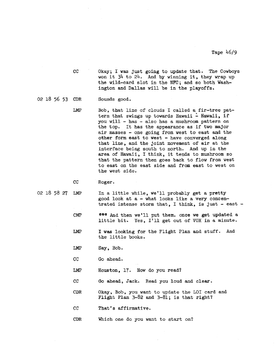
CC		Okay; I was just going to update that. The Cowboys
		won it 34 to 24. And by winning it, they wrap up
		the wild-card slot in the NFC; and so both Wash-
		ington and Dallas will be in the playoffs.

02 18 56 53 CDR	Sounds good.

LMP		Bob, that line of clouds I called a fir-tree pat-
		tern that swings up towards Hawaii - Hawaii, if
		you will - has - also has a mushroom pattern on
		the top. It has the appearance as if two major
		air masses - one going from west to east and the
		other form east to west - have converged along
		that line, and the joint movement of air at the
		interface being south to north. And up in the
		area of Hawaii, I think, it tends to mushroom so
		that the pattern then goes back to flow from west
		to east on the east side and from east to west on
		the west side.

CC		Roger.

02 18 58 27 LMP	In a little while, we'll probably get a pretty
		good look at a - what looks like a very concen-
		trated intense storm that, I think, is just - east -

CMP		*** And then we'll put them. once we get updated a
		little bit. Yes, I'll get out of VOX in a minute.

LMP		I was looking for the Flight Plan and stuff. And
		the little books.

LMP		Say, Bob.

CC		Go ahead.

LMP		Houston, 17. How do you read?

CC		Go ahead, Jack. Read you loud and clear.

CDR		Okay, Bob, you want to update the LOI card and
		Flight Plan 3-82 and 3-81; is that right?

CC		That's affirmative.

CDR		Which one do you want to start on?

PAGE 11

transcript

A transcript from the Apollo 17 mission where crew members discuss weather observations, personal messages, and report sightings of unidentified flashing objects outside the spacecraft.

Tape 47/14

And I'll just confirm that the - that disturbance
over the So - Solomon Islands is an awfully tightly
wound little storm system. And right now, I finally
have see New Zealand for the first time in a couple
of days, for sure. And the South Island's got some,
probably high cirrus over it. North Island looks
pretty clear. That's the end that I can get right
now.

CC Roger. We saw you looking at Regulus there; we
didn't realize you were looking at the Earth
instead.

LMP Ron's been looking for the booster. And he called
me down and asked me to look at the Earth. He's
been holding out on me.

CC Roger.

LMP Pass the torch of weather forecasting to Ron.

02 20 55 22 CC Hey, Jack. I also have some words for you and
Gene. Got some advice from the home front. The
thing to do with Ron in the future is to hook up
a Baby Ben and a metal dishpan. It works every
time, if you want to wake him up.

CMP No. I think that's not a good way.

CC Ron, everybody's fine over at El Lago. They are
doing great. Listening to every word.

CMP Very good, Bob. Thank you very much.

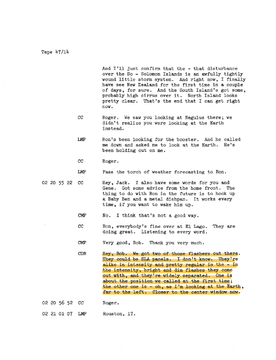
CDR Hey, Bob. We got two of those flashers out there.
They could be SLA panels. I don't know. They're
alike in intensity and pretty regular in the - in
the intensity, bright and dim flashes they come
out with, and they're widely separated. One is
about the position we called at the first time;
the other one is - oh, as I'm looking at the Earth,
far to the left. Closer to the center window now.

02 20 56 52 CC Roger.

02 21 01 07 LMP Houston, 17.

PAGE 12

transcript

A transcript of communications between the Apollo 17 Lunar Module Pilot (LMP) and Mission Control (CC) regarding weather observations over the Pacific, specifically near Hawaii and the Solomon Islands.

Tape 47/15

CC Go ahead.

LMP Yes, Bob, what is your - analysis chart, if you have it - surface terms analysis chart show for Hawaii today?

CC Stand by on that.

CC Jack, according to the - -

LMP The reason I ask is that for using your term - Go ahead.

CC No, go ahead on that, Jack.

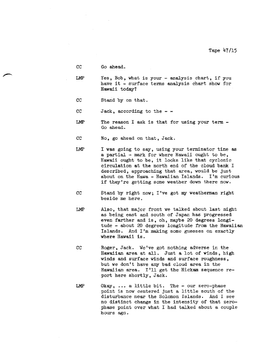
LMP I was going to say, using your terminator time as a partial - mark for where Hawaii ought to be, Hawaii ought to be, it looks like that cyclonic circulation at the north end of the cloud bank I described, approaching that area, would be just about on the Hawa - Hawaiian Islands. I'm curious if they're getting some weather down there now.

CC Stand by right now; I've got my weatherman right beside me here.

LMP Also, that major front we talked about last night as being east and south of Japan has progressed even farther and is, oh, maybe 20 degrees longitude - about 20 degrees longitude from the Hawaiian Islands. And I'm making some guesses on exactly where Hawaii is.

CC Roger, Jack. We've got nothing adverse in the Hawaiian area at all. Just a lot of winds, high winds and surface winds and surface roughness, but we don't have any bad cloud area in the Hawaiian area. I'll get the Hickam sequence report here shortly, Jack.

LMP Okay, ... a little bit. The - our zero-phase point is now centered just a little south of the disturbance near the Solomon Islands. And I see no distinct change in the intensity of that zero-phase point over what I had talked about a couple hours ago.

PAGE 13

transcript

A transcript of communications between Mission Control (CC) and the Lunar Module Pilot (LMP) regarding weather observations over the Solomon Islands, Vietnam, Australia, and the Hawaii area (Hickam and Hilo).

Tape 47/16

02 21 04 23 CC Roger, Jack. The Solomon Islands disturbance and everything is confirmed on this chart that I've got. It's very definitely confirmed in there.

LMP Okay. Well, it's a lot more obvious today than it was yesterday; but even then it was showing pretty strong circulation. It is starting to wrap up, look very much like Therese did yesterday.

CC Roger. I'm sure of that. The one right off of Vietnam is also pretty tight, isn't it still?

LMP Well, we can't see that one yet.

CC Okay.

LMP Australia in general is still very clear except in the northeastern portions where it looks like they have got scattered clouds; but it looks like a pretty night - over Australia.

CC Roger. Looks that way from the satellite photo from the last couple days. Looks pretty nice down there.

02 21 05 34 LMP Right.

02 21 07 05 CC Jack, in looking at the sequence reports for Hickam and Hilo and that area, it looks like they just got their standard 3500 scattered, 4500 broken clouds, maybe a rain shower or two. But just their standard tropical fluffy clouds.

END OF TAPE

PAGE 14

transcript

A transcript from the Apollo 17 mission where the crew discusses the appearance of the lunar surface, specifically Oceanus Procellarum, Grimaldi, and Tsiolkovsky, and the age of basalt flows.

Tape 59/19

mare. Still looking at Oceanus Procellarum. And now, out window 3, up to the northwest, Grimaldi is starting to show up - a very obvious dark area within the highlands of that part of the Moon - and one of the darkest mare regions that we have seen on the - on the Moon. It's comparable, at least in the photographs, to that of Tsiolkovsky.

CC Roger.

03 15 33 25 LMP Normally, of course, we think of the dark mare as being the younger basalt flows that - on the Moon, but in our case, of course, young means something on the order of 3 billion years or older.

END OF TAPE

PAGE 15

transcript

Apollo 17 air-to-ground voice transcript covering lunar observations, technical instrument status, and geological features.

Tape 60/1

APOLLO 17 AIR-TO-GROUND VOICE TRANSCRIPTION

03 15 33 44 CC Roger.

LMP For our interp - If we can extrapolate from the samples returned by other missions.

LMP Amazing how far over - now the highlands to the west of Procellarum are - still are bright, and the contrast between fresh craters and the normal highland are very - are very obvious still in earthlight, particularly along the zero phase point with respect to the Earth. Rima Gamma now is - is coming a little bit closer to our oval track in the horseshoe in the - larger and more western end of it; the dark horseshoe is quite clear in this light. It's a west - or northwest-pointing horseshoe, as is the complete trend of that strange feature. I think Ron is going to have an excellent chance to study these light-colored swirls within the mare and other parts of the Moon. We had some good views of them and Mare Marginis and to the east of Crisium - Mare Crisium, and he should - if there is anything to be seen, he should be able to see it for - during the next few days.

CC Okeydoke.

03 15 35 50 CDR Say, Gordo, something I just noticed here in working with the GDC what-have-you. I - looked at the Pc gage, and in the Pz - Pc position, there is a continuous bias on it now of about, oh, 7 percent, and if I switch to ALPHA, it goes to zero. We never saw that bias before this last burn.

CC Roger, Gene.

03 15 36 35 LMP Hey, Gordy, I'm looking right up the western edge of the Procellarum mare where it contacts the - the - the high - western highlands of the Moon, and we're just about to fly a little bit south of Grimaldi. That edge is very irregular. There is no obvious indications that it - there are large basins that have been flooded by mare that have formed that edge, but, again, the topographic distinction's possible in this lighter small. Now I'm starting to see that there are shadows in the craters.

PAGE 16

transcript

Transcript of Apollo 17 lunar surface communications where the Lunar Module Pilot (LMP) reports observing a flash on the lunar surface near the Grimaldi crater.

Tape 60/2

CC Roger.

LMP That's the small craters. There, in the Mare Procellarum closest to Grimaldi, there are two arcuate rilles. Look like they are probably V-shaped in their cross section. I'm sure we've seen those on the photographs much better than I can see them here. Those - the rille patterns, though, do seem to project over into the highlands.

CC Okay.

LMP To the north of that - to the north of that bay of mare. Just interrupt.

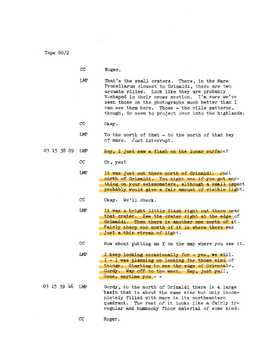
03 15 38 09 LMP Hey, I just saw a flash on the lunar surface!

CC Oh, yes?

LMP It was just out there north of Grimaldi. Just north of Grimaldi. You might see if you got anything on your seismometers, although a small impact probably would give a fair amount of visible light.

CC Okay. We'll check.

LMP It was a bright little flash right out there near that crater. See the crater right at the edge of Grimaldi. Then there is another one north of it. Fairly sharp one north of it is where there was just a thin streak of light.

CC How about putting an X on the map where you saw it.

LMP I keep looking occasionally for - yes, we will. I - I was planning on looking for those kind of things. Starting to see the edge of Orientale, Gordy. Way off to the west. Hey, just yell, Gene, anytime you - -

03 15 39 46 LMP Gordy, to the north of Grimaldi there is a large basin that is about the same size but only incompletely filled with mare in its northeastern quadrant. The rest of it looks like a fairly irregular and hummocky floor material of some kind.

CC Roger.