

< ARCHIVE

> FILE / 374F65D5

NASC-UAP-1963, POLICY MEMORANDUM, SPACE ALIEN INTELLIGENCE, WASHINGTON DC

This memorandum addresses the policy implications of potential contact with extraterrestrial intelligence. It evaluates scientific perspectives on planetary systems and life in the galaxy while critiquing the lack of a unified diplomatic framework for such an event. The document concludes with a warning that current policy is inadequate and risks a reactive, panic-driven response to future discoveries.

AGENCY
NATIONAL AERONAUTICS AND SPACE COUNCIL
TYPE
MEMO
INCIDENT DATE
N/A
LOCATION
WASHINGTON, D.C.
PAGES
6
EXTRACTED
6 / 6
STATUS
READY

> PAGES INDEXED [006]

OPEN A PAGE BELOW

  1. Page 1P.1UNCLASSI
  2. Page 2P.2UNCLASSI
  3. Page 3P.3UNCLASSI
  4. Page 4P.4UNCLASSI
  5. Page 5P.5UNCLASSI
  6. Page 6P.6UNCLASSI

> PAGE TEXT

PAGE 1

memo

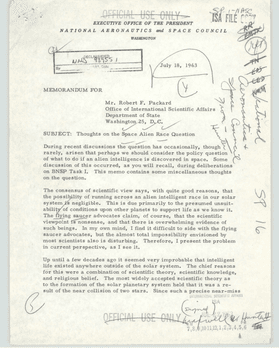
A memorandum from the National Aeronautics and Space Council to the Department of State regarding the policy implications of discovering alien intelligence, noting the scientific consensus on the improbability of alien life in the solar system versus the claims of flying saucer advocates.

OFFICIAL USE ONLY
EXECUTIVE OFFICE OF THE PRESIDENT
NATIONAL AERONAUTICS and SPACE COUNCIL
WASHINGTON

[HANDWRITTEN: SP-1-NASC ISA FILE COPY RR EMJR] [HANDWRITTEN: (circled symbol)] [HANDWRITTEN: (circled symbol)] [HANDWRITTEN: National Aeronautics + Space Council from Hunter]

July 18, 1963

MEMORANDUM FOR

Mr. Robert F. Packard
Office of International Scientific Affairs
Department of State
Washington 25, D.C.

SUBJECT: Thoughts on the Space Alien Race Question

During recent discussions the question has occasionally, though rarely, arisen that perhaps we should consider the policy question of what to do if an alien intelligence is discovered in space. Some discussion of this occurred, as you will recall, during deliberations on BNSP Task I. This memo contains some miscellaneous thoughts on the question.

The consensus of scientific view says, with quite good reasons, that the possibility of running across an alien intelligent race in our solar system is negligible. This is due primarily to the presumed unsuitability of conditions upon other planets to support life as we know it. The flying saucer advocates claim, of course, that the scientific viewpoint is nonsense, and that there is overwhelming evidence of such beings. In my own mind, I find it difficult to side with the flying saucer advocates, but the almost total impossibility envisioned by most scientists also is disturbing. Therefore, I present the problem in current perspective, as I see it.

Up until a few decades ago it seemed very improbable that intelligent life existed anywhere outside of the solar system. The chief reasons for this were a combination of scientific theory, scientific knowledge, and religious belief. The most widely accepted scientific theory as to the formation of the solar planetary system held that it was a result of the near collision of two stars. Since such a precise near-miss [HANDWRITTEN: (circled symbol)] [HANDWRITTEN: Signed JUL 22 1963] [HANDWRITTEN: Hunter]

OFFICIAL USE ONLY
INTERNATIONAL SCIENTIFIC AFFAIRS
ISA

PAGE 2

report

This page discusses the scientific and theological perspectives on the prevalence of planetary systems, the potential for life in the galaxy, and the historical speculation regarding intelligent life on Mars, specifically referencing the 'Canali' markings.

OFFICIAL USE ONLY
- 2 -

of two stars would be an extremely rare event, it followed that there would be very few other planetary systems in the universe and, indeed, perhaps this was the only one. Religious belief said, furthermore, that life was a gift bestowed by God. This was a relatively undisputed point since no scientific data existed to bridge the gap between non-living and living materials.

The situation today is vastly changed in these respects. The most widely held theory of stellar formation would predict the formation of planetary systems to be a natural consequence of stellar evolution. On this basis, most stars would possess planetary systems, and the number of habitable planets in our galaxy would be tremendous. Our biggest telescopes cannot resolve planets at the distances even of the nearest stars, so no direct confirmation is yet available. In my own mind, however, the wide prevalence of multiple stars is an overwhelming hint in support of this theory. In addition, the biological sciences have almost completely traced a series of natural occurrences which lead from inanimate molecules to elementary living viruses. Thus, we have the current scientific theory and data not only that there are a huge number of planets in the galaxy, but that life is quite likely to arise spontaneously on a large number of these. This, of course, does not necessarily imply intelligent life. Modern theology is not necessarily incompatible with this. The description in Genesis of the Creation certainly is a better picture of the current theory than of a stellar collision, and since God only spent seven days on this system, He has clearly had lots of time to create many more systems.

Even granting a probable existence of much life in the galaxy, there is still the question of whether another intelligent race exists in our solar system. There are, of course, two methods of its establishment in our system. One of these is that it originated on some other planet, for instance, Mars. Some of the spectacular markings of Mars have been interpreted as indicating intelligence. In particular, the famous "Canali" are rather narrow, and always run from one prominent marking to another, frequently with round splotches at intersections. As far as I know, no one has discovered a "Canali" which goes nowhere. This has quite understandably stimulated much conversation. In fact, a number of decades ago, when scientists thought that any life on other stellar systems was very remote, they seemed to feel that intelligent life

OFFICIAL USE ONLY

PAGE 3

report

This page discusses theoretical perspectives on extraterrestrial life, specifically addressing claims by 'flying saucer advocates' regarding Martian mining on the moon and the interpretation of lunar phenomena like the crater Alphonsus.

OFFICIAL USE ONLY
- 3 -

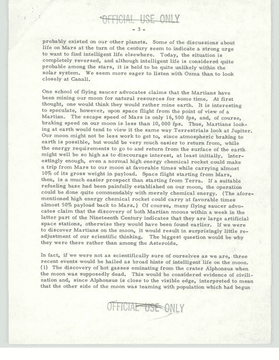
probably existed on our other planets. Some of the discussions about life on Mars at the turn of the century seem to indicate a strong urge to want to find intelligent life elsewhere. Today, the situation is completely reversed, and although intelligent life is considered quite probable among the stars, it is held to be quite unlikely within the solar system. We seem more eager to listen with Ozma than to look closely at Canali.

One school of flying saucer advocates claims that the Martians have been mining our moon for natural resources for some time. At first thought, one would think they would rather mine earth. It is interesting to speculate, however, upon space flight from the point of view of a Martian. The escape speed of Mars is only 16, 500 fps, and, of course, braking speed on our moon is less than 10, 000 fps. Thus, Martians looking at earth would tend to view it the same way Terrestrials look at Jupiter. Our moon might not be less work to get to, since atmospheric braking to earth is possible, but would be very much easier to return from, while the energy requirements to go to and return from the surface of the earth might well be so high as to discourage interest, at least initially. Interestingly enough, even a normal high energy chemical rocket could make a trip from Mars to our moon at favorable times while carrying almost 10% of its gross weight in payload. Space flight starting from Mars, then, is a much easier prospect than starting from Terra. If a suitable refueling base had been painfully established on our moon, the operation could be done quite commendably with merely chemical energy. (The aforementioned high energy chemical rocket could carry at favorable times almost 50% payload back to Mars.) Of course, many flying saucer advocates claim that the discovery of both Martian moons within a week in the latter part of the Nineteenth Century indicates that they are large artificial space stations, otherwise they would have been found earlier. If we were to discover Martians on the moon, it would result in surprisingly little readjustment of our scientific thinking. The biggest question would be why they were there rather than among the Asteroids.

In fact, if we were not as scientifically sure of ourselves as we are, three recent events would be hailed as broad hints of intelligent life on the moon. (1) The discovery of hot gasses eminating from the crater Alphonsus when the moon was supposedly dead. This would be considered evidence of civilization and, since Alphonsus is close to the visible edge, interpreted to mean that the other side of the moon was teaming with population which had begun

OFFICIAL USE ONLY

PAGE 4

report

This page discusses the possibility of extraterrestrial life, the limitations of space travel, and the potential for colonization of the solar system by other races.

OFFICIAL USE ONLY
- 4 -

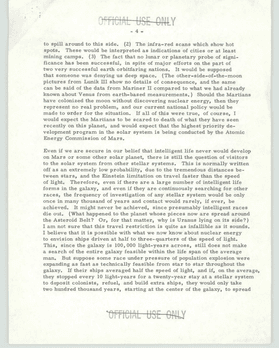
to spill around to this side. (2) The infra-red scans which show hot spots. These would be interpreted as indications of cities or at least mining camps. (3) The fact that no lunar or planetary probe of significance has been successful, in spite of major efforts on the part of two very successful earth orbitfaring nations. It would be supposed that someone was denying us deep space. (The other-side-of-the-moon pictures from Lunik III show no details of consequence, and the same can be said of the data from Mariner II compared to what we had already known about Venus from earth-based measurements.) Should the Martians have colonized the moon without discovering nuclear energy, then they represent no real problem, and our current national policy would be made to order for the situation. If all of this were true, of course, I would expect the Martians to be scared to death of what they have seen recently on this planet, and would expect that the highest priority development program in the solar system is being conducted by the Atomic Energy Commission of Mars.

Even if we are secure in our belief that intelligent life never would develop on Mars or some other solar planet, there is still the question of visitors to the solar system from other stellar systems. This is normally written off as an extremely low probability, due to the tremendous distances between stars, and the Einstein limitation on travel faster than the speed of light. Therefore, even if there are a large number of intelligent life forms in the galaxy, and even if they are continuously searching for other races, the frequency of investigation of any stellar system would be only once in many thousand of years and contact would rarely, if ever, be achieved. It might never be achieved, since presumably intelligent races die out. (What happened to the planet whose pieces now are spread around the Asteroid Belt? Or, for that matter, why is Uranus lying on its side?) I am not sure that this travel restriction is quite as infallible as it sounds. I believe that it is possible with what we now know about nuclear energy to envision ships driven at half to three-quarters of the speed of light. This, since the galaxy is 100,000 light-years across, still does not make a search of the entire galaxy feasible within the life span of the average man. But suppose some race under pressure of population explosion were expanding as fast as technically feasible from star to star throughout the galaxy. If their ships averaged half the speed of light, and if, on the average, they stopped every 10 light-years for a twenty-year stay at a stellar system to deposit colonists, refuel, and build extra ships, they would only take two hundred thousand years, starting at the center of the galaxy, to spread

OFFICIAL USE ONLY

PAGE 5

report

This page discusses theoretical scenarios regarding contact with extraterrestrial intelligence, including the implications of their technological capabilities and the necessity for a unified human diplomatic response.

OFFICIAL USE ONLY
- 5 -
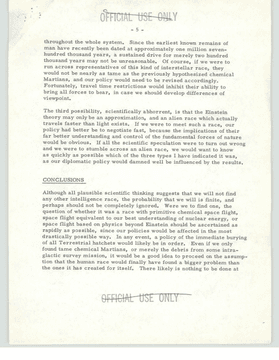
throughout the whole system. Since the earliest known remains of man have recently been dated at approximately one million seven-hundred thousand years, a sustained drive for merely two hundred thousand years may not be unreasonable. Of course, if we were to run across representatives of this kind of interstellar race, they would not be nearly as tame as the previously hypothesized chemical Martians, and our policy would need to be revised accordingly. Fortunately, travel time restrictions would inhibit their ability to bring all forces to bear, in case we should develop differences of viewpoint.

The third possibility, scientifically abhorrent, is that the Einstein theory may only be an approximation, and an alien race which actually travels faster than light exists. If we were to meet such a race, our policy had better be to negotiate fast, because the implications of their far better understanding and control of the fundamental forces of nature would be obvious. If all the scientific speculation were to turn out wrong and we were to stumble across an alien race, we would want to know as quickly as possible which of the three types I have indicated it was, as our diplomatic policy would damned well be influenced by the results.

CONCLUSIONS

Although all plausible scientific thinking suggests that we will not find any other intelligence race, the probability that we will is finite, and perhaps should not be completely ignored. Were we to find one, the question of whether it was a race with primitive chemical space flight, space flight equivalent to our best understanding of nuclear energy, or space flight based on physics beyond Einstein should be ascertained as rapidly as possible, since our policies would be affected in the most drastically possible way. In any event, a policy of the immediate burying of all Terrestrial hatchets would likely be in order. Even if we only found tame chemical Martians, or merely the debris from some intra-galactic survey mission, it would be a good idea to proceed on the assumption that the human race would finally have found a bigger problem than the ones it has created for itself. There likely is nothing to be done at

OFFICIAL USE ONLY

PAGE 6

memo

This is the final page of a document where Maxwell W. Hunter, II, argues that current policy regarding a specific subject is inadequate and will only be addressed in a state of panic if an emergency occurs.

OFFICIAL USE ONLY
- 6 -
the moment to prepare for these possibilities (the only body of writing on the subject available in an emergency is science fiction), because no one of consequence is going to take this rubbish seriously unless it happens. At that point, our policy will be determined in the traditional manner of grand panic.

[HANDWRITTEN: Maxwell W. Hunter II]
Maxwell W. Hunter, II
Member, Professional Staff

OFFICIAL USE ONLY