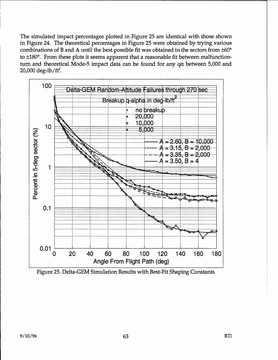
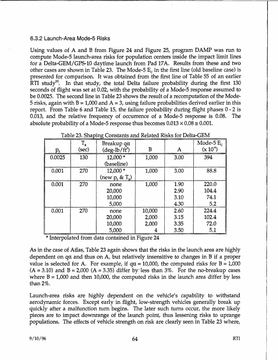
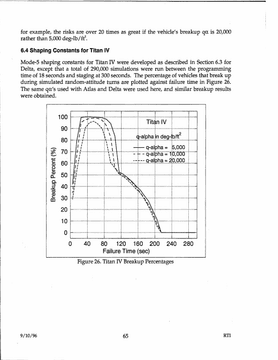
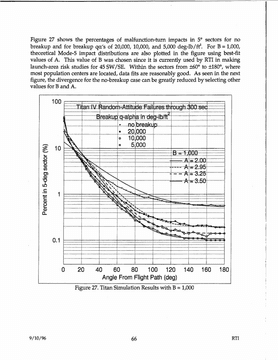
< ARCHIVE

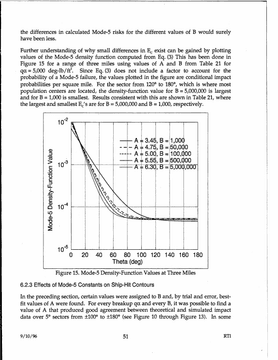
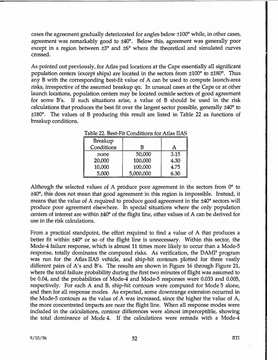
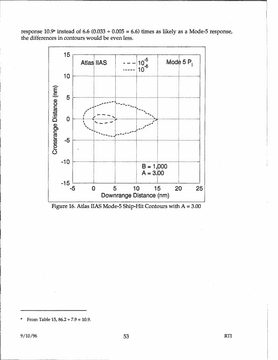
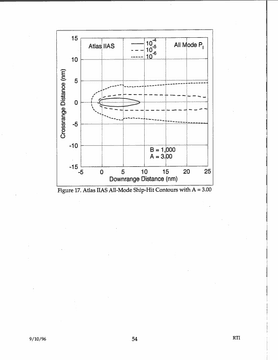
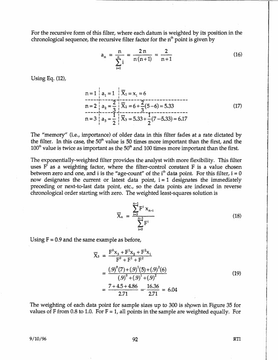
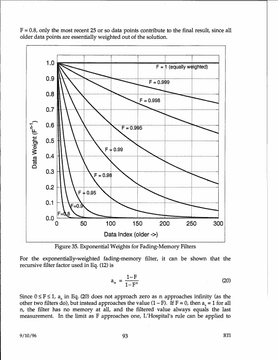
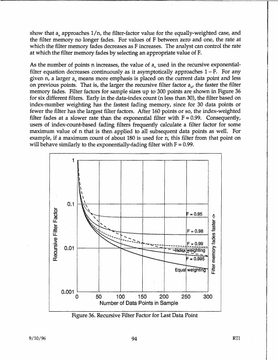
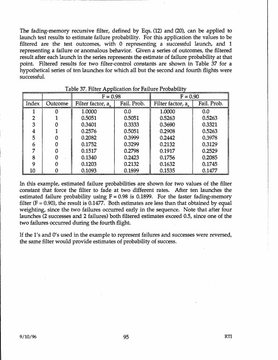
> FILE / 056ABAF1

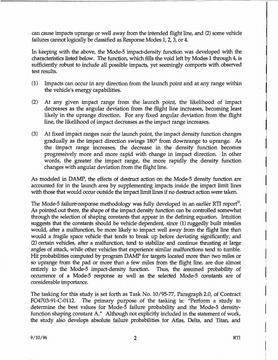
DOW-UAP-D48, TECHNICAL REPORT, SPACE-BOOSTER FAILURE MODELING, 1996

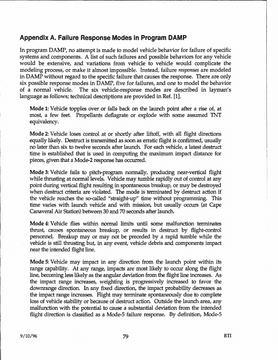
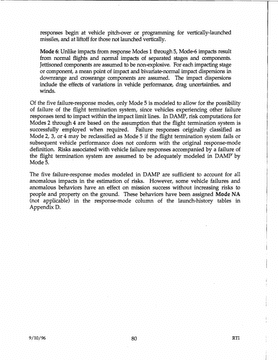
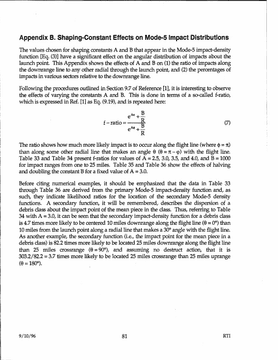
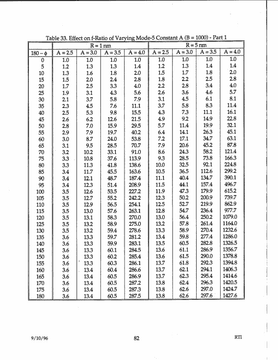
This technical report details the DAMP risk-analysis program developed by the Research Triangle Institute for the U.S. Air Force. It provides mathematical models for predicting failure responses, debris impact density, and reliability probabilities for Atlas, Delta, Titan, and LLV1 launch vehicles. The document focuses on Mode-5 failure responses to improve ground safety and risk assessment during space-booster operations.

AGENCY
AIR FORCE
TYPE
REPORT
INCIDENT DATE
N/A
LOCATION
PATRICK AFB, FLORIDA; VANDENBERG AFB, CALIFORNIA
PAGES
181
EXTRACTED
181 / 181
STATUS
READY

> PAGES INDEXED [181]

OPEN A PAGE BELOW

  1. Page 1P.1UNCLASSI
  2. Page 2P.2UNCLASSI
  3. Page 3P.3UNCLASSI
  4. Page 4P.4
  5. Page 5P.5UNCLASSI
  6. Page 6P.6
  7. Page 7P.7
  8. Page 8P.8
  9. Page 9P.9
  10. Page 10P.10
  11. Page 11P.11
  12. Page 12P.12UNCLASSI
  13. Page 13P.13
  14. Page 14P.14
  15. Page 15P.15UNCLASSI
  16. Page 16P.16
  17. Page 17P.17
  18. Page 18P.18
  19. Page 19P.19
  20. Page 20P.20
  21. Page 21P.21
  22. Page 22P.22
  23. Page 23P.23
  24. Page 24P.24
  25. Page 25P.25
  26. Page 26P.26
  27. Page 27P.27
  28. Page 28P.28
  29. Page 29P.29
  30. Page 30P.30
  31. Page 31P.31
  32. Page 32P.32UNCLASSI
  33. Page 33P.33UNCLASSI
  34. Page 34P.34
  35. Page 35P.35
  36. Page 36P.36UNCLASSI
  37. Page 37P.37
  38. Page 38P.38UNCLASSI
  39. Page 39P.39UNCLASSI
  40. Page 40P.40
  41. Page 41P.41UNCLASSI
  42. Page 42P.42UNCLASSI
  43. Page 43P.43UNCLASSI
  44. Page 44P.44
  45. Page 45P.45
  46. Page 46P.46UNCLASSI
  47. Page 47P.47
  48. Page 48P.48UNCLASSI
  49. Page 49P.49
  50. Page 50P.50UNCLASSI
  51. Page 51P.51UNCLASSI
  52. Page 52P.52
  53. Page 53P.53
  54. Page 54P.54
  55. Page 55P.55
  56. Page 56P.56
  57. Page 57P.57
  58. Page 58P.58
  59. Page 59P.59UNCLASSI
  60. Page 60P.60
  61. Page 61P.61UNCLASSI
  62. Page 62P.62
  63. Page 63P.63
  64. Page 64P.64
  65. Page 65P.65UNCLASSI
  66. Page 66P.66
  67. Page 67P.67
  68. Page 68P.68UNCLASSI
  69. Page 69P.69UNCLASSI
  70. Page 70P.70UNCLASSI
  71. Page 71P.71
  72. Page 72P.72
  73. Page 73P.73UNCLASSI
  74. Page 74P.74
  75. Page 75P.75UNCLASSI
  76. Page 76P.76
  77. Page 77P.77
  78. Page 78P.78UNCLASSI
  79. Page 79P.79UNCLASSI
  80. Page 80P.80
  81. Page 81P.81
  82. Page 82P.82
  83. Page 83P.83
  84. Page 84P.84UNCLASSI
  85. Page 85P.85UNCLASSI
  86. Page 86P.86UNCLASSI
  87. Page 87P.87
  88. Page 88P.88
  89. Page 89P.89
  90. Page 90P.90UNCLASSI
  91. Page 91P.91
  92. Page 92P.92
  93. Page 93P.93
  94. Page 94P.94
  95. Page 95P.95
  96. Page 96P.96UNCLASSI
  97. Page 97P.97
  98. Page 98P.98
  99. Page 99P.99
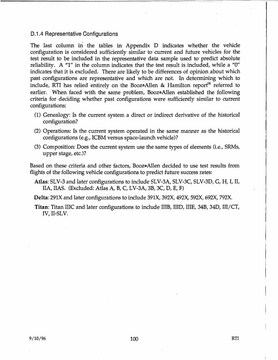
  100. Page 100P.100UNCLASSI
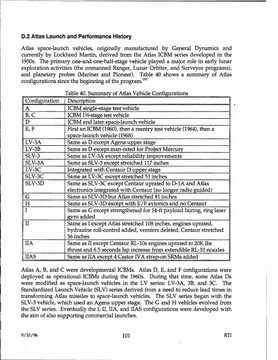
  101. Page 101P.101
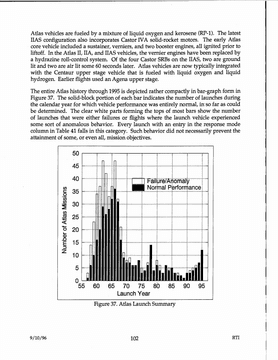
  102. Page 102P.102UNCLASSI
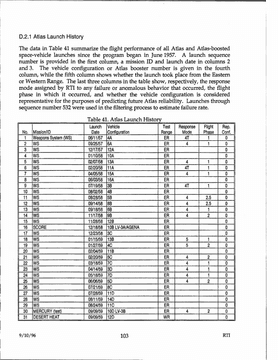
  103. Page 103P.103UNCLASSI
  104. Page 104P.104UNCLASSI
  105. Page 105P.105UNCLASSI
  106. Page 106P.106UNCLASSI
  107. Page 107P.107
  108. Page 108P.108UNCLASSI
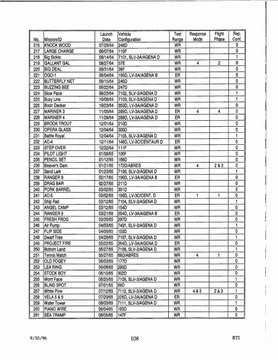
  109. Page 109P.109UNCLASSI
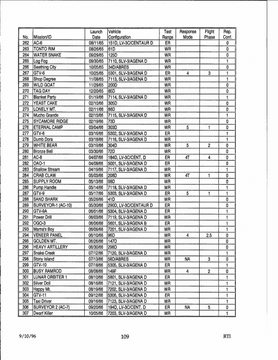
  110. Page 110P.110UNCLASSI
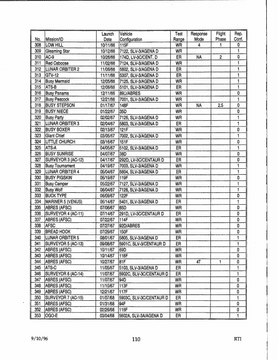
  111. Page 111P.111UNCLASSI
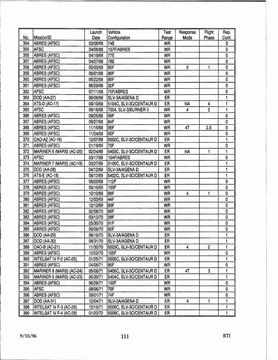
  112. Page 112P.112UNCLASSI
  113. Page 113P.113UNCLASSI
  114. Page 114P.114
  115. Page 115P.115
  116. Page 116P.116
  117. Page 117P.117
  118. Page 118P.118
  119. Page 119P.119UNCLASSI
  120. Page 120P.120
  121. Page 121P.121
  122. Page 122P.122UNCLASSI
  123. Page 123P.123UNCLASSI
  124. Page 124P.124
  125. Page 125P.125
  126. Page 126P.126
  127. Page 127P.127UNCLASSI
  128. Page 128P.128
  129. Page 129P.129UNCLASSI
  130. Page 130P.130UNCLASSI
  131. Page 131P.131
  132. Page 132P.132
  133. Page 133P.133
  134. Page 134P.134
  135. Page 135P.135UNCLASSI
  136. Page 136P.136UNCLASSI
  137. Page 137P.137UNCLASSI
  138. Page 138P.138
  139. Page 139P.139
  140. Page 140P.140
  141. Page 141P.141
  142. Page 142P.142UNCLASSI
  143. Page 143P.143
  144. Page 144P.144
  145. Page 145P.145UNCLASSI
  146. Page 146P.146
  147. Page 147P.147
  148. Page 148P.148
  149. Page 149P.149
  150. Page 150P.150
  151. Page 151P.151
  152. Page 152P.152UNCLASSI
  153. Page 153P.153
  154. Page 154P.154
  155. Page 155P.155
  156. Page 156P.156
  157. Page 157P.157
  158. Page 158P.158UNCLASSI
  159. Page 159P.159
  160. Page 160P.160
  161. Page 161P.161
  162. Page 162P.162
  163. Page 163P.163
  164. Page 164P.164
  165. Page 165P.165
  166. Page 166P.166UNCLASSI
  167. Page 167P.167
  168. Page 168P.168UNCLASSI
  169. Page 169P.169
  170. Page 170P.170UNCLASSI
  171. Page 171P.171UNCLASSI
  172. Page 172P.172
  173. Page 173P.173UNCLASSI
  174. Page 174P.174
  175. Page 175P.175
  176. Page 176P.176
  177. Page 177P.177
  178. Page 178P.178UNCLASSI
  179. Page 179P.179UNCLASSI
  180. Page 180P.180
  181. Page 181P.181

> PAGE TEXT

PAGE 1

cover-page

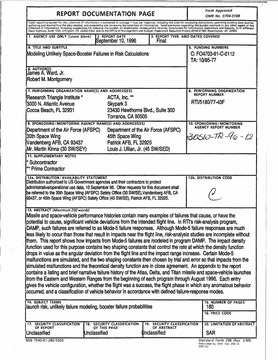
This is the cover page for a final report titled 'Modeling Unlikely Space-Booster Failures in Risk Calculations' prepared by the Research Triangle Institute for the 45th and 30th Space Wings of the U.S. Air Force.

RESEARCH TRIANGLE INSTITUTE

Contract No. FO4703-91-C-0112
RTI Report No. RTI/5180/77-43F
September 10, 1996

Modeling Unlikely Space-Booster
Failures in Risk Calculations

Final Report

Prepared for

Department of the Air Force
45th Space Wing (AFSPC)
Safety Office - 45 SW/SE
Patrick AFB, FL 32925

and

Department of the Air Force
30th Space Wing (AFSPC)
Safety Office - 30 SW/SE
Vandenberg AFB, CA 93437

19961025 122

Distribution authorized to US Government agencies and their contractors to protect administrative/
operational use data, 10 September 96. Other requests for this document shall be referred to the 30th Space
Wing (AFSPC) Safety Office (30 SW/SE), Vandenberg AFB, CA 93437, or 45th Space Wing (AFSPC)
Safety Office (45 SW/SE), Patrick AFB, FL 32925.

DTIC QUALITY INSPECTED 2

3000 N. Atlantic Avenue • Cocoa Beach, Florida 32931-5029 USA

PAGE 2

report

This is the title page for a technical report titled 'Modeling Unlikely Space-Booster Failures in Risk Calculations' prepared by the Research Triangle Institute for the 45th and 30th Space Wings of the U.S. Air Force.

[HANDWRITTEN: 30SW-TR-96-12]

Contract No. FO4703-91-C-0112
Task No. 10/95-77, Subtask 2.0

RTI Report No. RTI/5180/77-43F
September 10, 1996

Modeling Unlikely Space-Booster
Failures in Risk Calculations

Final Report

Prepared by

James A. Ward, Jr.
Robert M. Montgomery

of

Research Triangle Institute
Center for Aerospace Technology
Launch Systems Safety Department

Prepared for

Department of the Air Force
45th Space Wing (AFSPC)
Safety Office - 45 SW/SE
Patrick AFB, FL 32925

and

Department of the Air Force
30th Space Wing (AFSPC)
Safety Office - 30 SW/SE
Vandenberg AFB, CA 93437

Distribution authorized to US Government agencies and their contractors to protect administrative/
operational use data, 10 September 96. Other requests for this document shall be referred to the 30th Space
Wing (AFSPC) Safety Office (30 SW/SE), Vandenberg AFB, CA 93437, or 45th Space Wing (AFSPC)
Safety Office (45 SW/SE), Patrick AFB, FL 32925.

PAGE 3

form

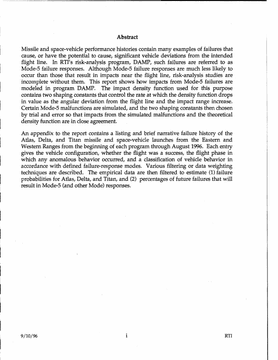
This is a Standard Form 298 Report Documentation Page for a technical report titled 'Modeling Unlikely Space-Booster Failures in Risk Calculations' dated September 10, 1996.

REPORT DOCUMENTATION PAGE
Form Approved
OMB No. 0704-0188
Public reporting burden for this collection of information is estimated to average 1 hour per response, including the time for reviewing instructions, searching existing data sources, gathering and maintaining the data needed, and completing and reviewing the collection of information. Send comments regarding this burden estimate or any other aspect of this collection of information, including suggestions for reducing this burden, to Washington Headquarters Services, Directorate for Information Operations and Reports, 1215 Jefferson Davis Highway, Suite 1204, Arlington, VA 22202-4302, and to the Office of Management and Budget, Paperwork Reduction Project (0704-0188), Washington, DC 20503.
1. AGENCY USE ONLY (Leave blank) 2. REPORT DATE September 10, 1996 3. REPORT TYPE AND DATES COVERED Final
4. TITLE AND SUBTITLE
Modeling Unlikely Space-Booster Failures in Risk Calculations
5. FUNDING NUMBERS
C: FO4703-91-C-0112
TA: 10/95-77
6. AUTHOR(S)
James A. Ward, Jr.
Robert M. Montgomery
7. PERFORMING ORGANIZATION NAME(S) AND ADDRESS(ES)
Research Triangle Institute *
3000 N. Atlantic Avenue
Cocoa Beach, FL 32931
ACTA, Inc. **
Skypark 3
23430 Hawthorne Blvd., Suite 300
Torrance, CA 90505
8. PERFORMING ORGANIZATION
REPORT NUMBER
RTI/5180/77-43F
9. SPONSORING/MONITORING AGENCY NAME(S) AND ADDRESS(ES)
Department of the Air Force (AFSPC)
30th Space Wing
Vandenberg AFB, CA 93437
Mr. Martin Kinna (30 SW/SEY)
Department of the Air Force (AFSPC)
45th Space Wing
Patrick AFB, FL 32925
Louis J. Ullian, Jr. (45 SW/SED)
10. SPONSORING/MONITORING
AGENCY REPORT NUMBER
30SW-TR-96-12
11. SUPPLEMENTARY NOTES
* Subcontractor
** Prime Contractor
12a. DISTRIBUTION/AVAILABILITY STATEMENT
Distribution authorized to US Government agencies and their contractors to protect
administrative/operational use data, 10 September 96. Other requests for this document shall
be referred to the 30th Space Wing (AFSPC) Safety Office (30 SW/SE), Vandenberg AFB, CA
93437, or 45th Space Wing (AFSPC) Safety Office (45 SW/SE), Patrick AFB, FL 32925.
12b. DISTRIBUTION CODE
[HANDWRITTEN: e]
13. ABSTRACT (Maximum 200 words)
Missile and space-vehicle performance histories contain many examples of failures that cause, or have the
potential to cause, significant vehicle deviations from the intended flight line. In RTI's risk-analysis program,
DAMP, such failures are referred to as Mode-5 failure responses. Although Mode-5 failure responses are much
less likely to occur than those that result in impacts near the flight line, risk-analysis studies are incomplete without
them. This report shows how impacts from Mode-5 failures are modeled in program DAMP. The impact density
function used for this purpose contains two shaping constants that control the rate at which the density function
drops in value as the angular deviation from the flight line and the impact range increase. Certain Mode-5
malfunctions are simulated, and the two shaping constants then chosen by trial and error so that impacts from the
simulated malfunctions and the theoretical density function are in close agreement. An appendix to the report
contains a listing and brief narrative failure history of the Atlas, Delta, and Titan missile and space-vehicle launches
from the Eastern and Western Ranges from the beginning of each program through August 1996. Each entry
gives the vehicle configuration, whether the flight was a success, the flight phase in which any anomalous behavior
occurred, and a classification of vehicle behavior in accordance with defined failure-response modes.
14. SUBJECT TERMS
launch risk, unlikely failure modeling, booster failure probabilities
15. NUMBER OF PAGES
180
16. PRICE CODE
17. SECURITY CLASSIFICATION
OF REPORT
Unclassified
18. SECURITY CLASSIFICATION
OF THIS PAGE
Unclassified
19. SECURITY CLASSIFICATION
OF ABSTRACT
Unclassified
20. LIMITATION OF ABSTRACT
SAR
NSN 7540-01-280-5500
Standard Form 298 (Rev. 2-89)
Prescribed by ANSI Std. Z39-18
298-102

PAGE 4

report

This page provides an abstract for a report on the DAMP risk-analysis program, which models Mode-5 failure responses for missile and space-vehicle launches.

Abstract

Missile and space-vehicle performance histories contain many examples of failures that cause, or have the potential to cause, significant vehicle deviations from the intended flight line. In RTI's risk-analysis program, DAMP, such failures are referred to as Mode-5 failure responses. Although Mode-5 failure responses are much less likely to occur than those that result in impacts near the flight line, risk-analysis studies are incomplete without them. This report shows how impacts from Mode-5 failures are modeled in program DAMP. The impact density function used for this purpose contains two shaping constants that control the rate at which the density function drops in value as the angular deviation from the flight line and the impact range increase. Certain Mode-5 malfunctions are simulated, and the two shaping constants then chosen by trial and error so that impacts from the simulated malfunctions and the theoretical density function are in close agreement.

An appendix to the report contains a listing and brief narrative failure history of the Atlas, Delta, and Titan missile and space-vehicle launches from the Eastern and Western Ranges from the beginning of each program through August 1996. Each entry gives the vehicle configuration, whether the flight was a success, the flight phase in which any anomalous behavior occurred, and a classification of vehicle behavior in accordance with defined failure-response modes. Various filtering or data weighting techniques are described. The empirical data are then filtered to estimate (1) failure probabilities for Atlas, Delta, and Titan, and (2) percentages of future failures that will result in Mode-5 (and other Mode) responses.

9/10/96 i RTI

PAGE 5

report

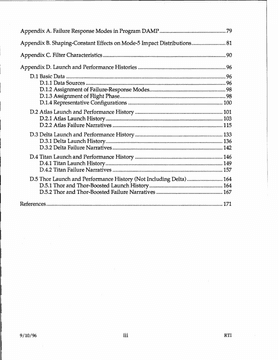
This page is the Table of Contents for a technical report regarding failure probabilities and shaping constants for various launch vehicles.

Table of Contents

1. Introduction....................................................................................................................... 1

2. Examples Showing Need for Mode 5 ............................................................................. 3

3. Understanding the Mode-5 Failure Response.................................................................. 7
3.1 Effects of Mode-5 Shaping Constants....................................................................... 9
3.2 Effects of Shaping Constant on DAMP Results......................................................... 9

4. Methodology for Assessing Failure Probabilities............................................................ 13
4.1 The Parts-Analysis Approach.................................................................................... 13
4.2 The Empirical Approach............................................................................................ 15

5. Computation of Failure Probabilities............................................................................... 16
5.1 Overall Failure Probability......................................................................................... 16
5.2 Relative and Absolute Probabilities for Response Modes......................................... 24
5.3 Relative Probability of Tumble for Response-Modes 3 and 4.................................... 30

6. Shaping Constants Through Simulation........................................................................... 31
6.1 Malfunction Turn Simulations.................................................................................... 31
6.1.1 Random-Attitude Failures....................................................................................... 31
6.1.2 Slow-Turn Failures.................................................................................................. 32
6.1.3 Factors Affecting Malfunction-Turn Results .......................................................... 33
6.1.4 Malfunction-Turn Results for Atlas IIAS ............................................................... 35
6.2 Shaping Constants for Atlas IIAS ............................................................................. 37
6.2.1 Optimum Mode-5 Shaping Constants.................................................................... 37
6.2.2 Launch-Area Mode-5 Risks.................................................................................... 49
6.2.3 Effects of Mode-5 Constants on Ship-Hit Contours .............................................. 51
6.2.4 Range Distributions of Theoretical and Simulated Impacts................................... 58
6.3 Shaping Constants for Delta-GEM ............................................................................ 60
6.3.1 Optimum Mode-5 Shaping Constants.................................................................... 61
6.3.2 Launch-Area Mode-5 Risks.................................................................................... 64
6.4 Shaping Constants for Titan IV................................................................................. 65
6.5 Shaping Constants for LLV1 .................................................................................... 69
6.6 Shaping Constants for Other Launch Vehicles.......................................................... 72

7. Potential Future Investigations......................................................................................... 73

8. Summary........................................................................................................................... 74

9/10/96                                                                 ii                                                                    RTI

PAGE 6

other

This page is a table of contents for Appendix D of the report, detailing various launch and performance histories for Atlas, Delta, Titan, and Thor rockets.

Appendix A. Failure Response Modes in Program DAMP .................................................... 79
Appendix B. Shaping-Constant Effects on Mode-5 Impact Distributions ............................... 81
Appendix C. Filter Characteristics .............................................................................................. 90
Appendix D. Launch and Performance Histories ..................................................................... 96
D.1 Basic Data ........................................................................................................................ 96
D.1.1 Data Sources ............................................................................................................. 96
D.1.2 Assignment of Failure-Response Modes.................................................................. 98
D.1.3 Assignment of Flight Phase...................................................................................... 98
D.1.4 Representative Configurations ............................................................................... 100
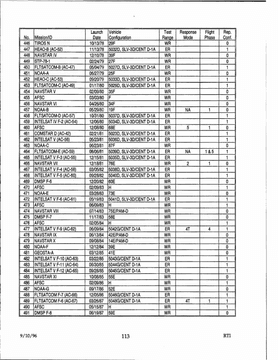
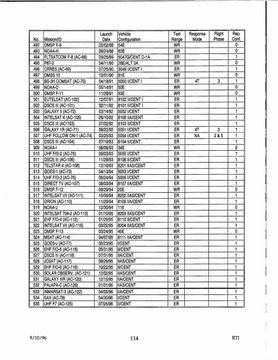
D.2 Atlas Launch and Performance History ......................................................................... 101
D.2.1 Atlas Launch History............................................................................................... 103
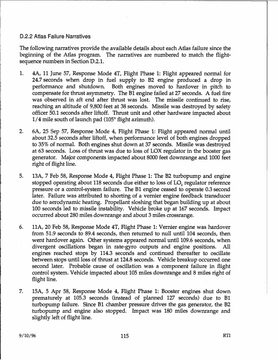
D.2.2 Atlas Failure Narratives .......................................................................................... 115
D.3 Delta Launch and Performance History ......................................................................... 133
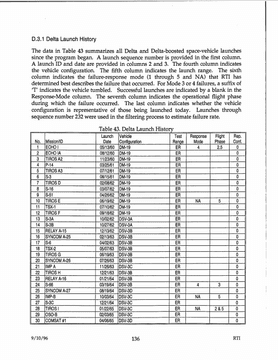
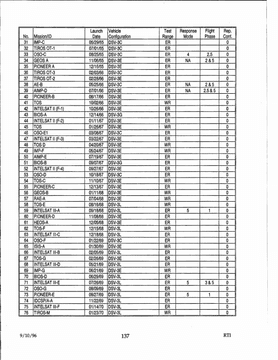
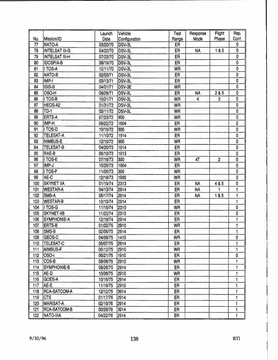
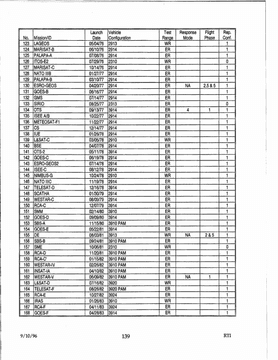
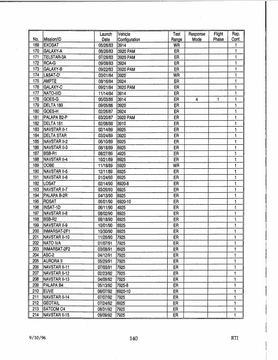
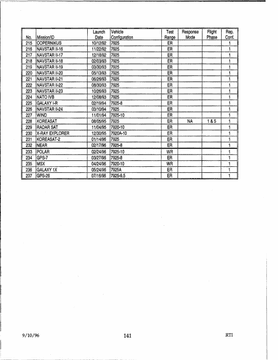
D.3.1 Delta Launch History............................................................................................... 136
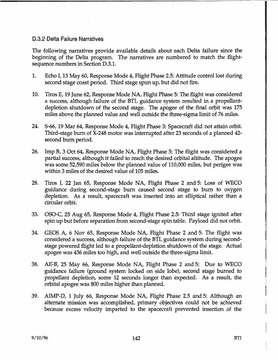
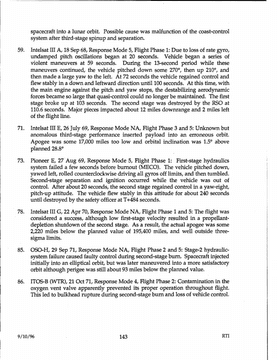
D.3.2 Delta Failure Narratives .......................................................................................... 142
D.4 Titan Launch and Performance History ......................................................................... 146
D.4.1 Titan Launch History............................................................................................... 149
D.4.2 Titan Failure Narratives .......................................................................................... 157
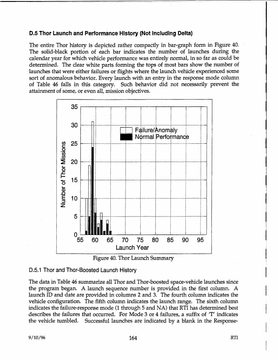
D.5 Thor Launch and Performance History (Not Including Delta) ..................................... 164
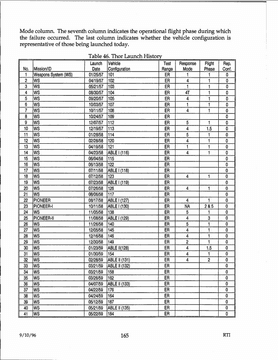
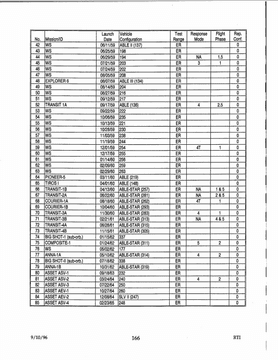
D.5.1 Thor and Thor-Boosted Launch History ................................................................ 164
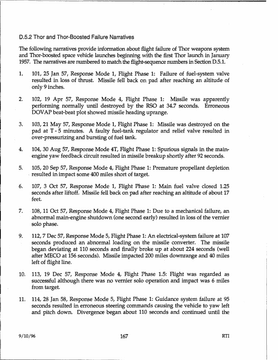
D.5.2 Thor and Thor-Boosted Failure Narratives ............................................................ 167
References................................................................................................................................ 171

9/10/96                                                                 iii                                                                 RTI

PAGE 7

other

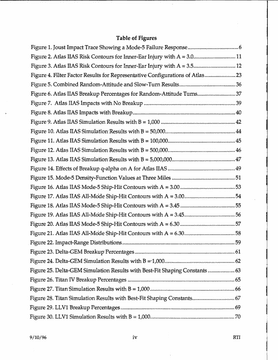
This page is a Table of Figures for a technical report, listing 30 figures related to Atlas IIAS, Delta-GEM, Titan, and LLV1 simulation results and impact analysis.

Table of Figures
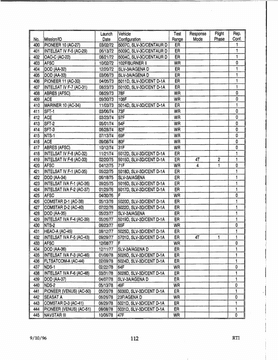
Figure 1. Joust Impact Trace Showing a Mode-5 Failure Response .................................... 6
Figure 2. Atlas IIAS Risk Contours for Inner-Ear Injury with A = 3.0................................ 11
Figure 3. Atlas IIAS Risk Contours for Inner-Ear Injury with A = 3.5................................ 12
Figure 4. Filter Factor Results for Representative Configurations of Atlas......................... 23
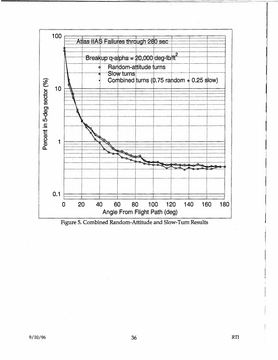
Figure 5. Combined Random-Attitude and Slow-Turn Results............................................ 36
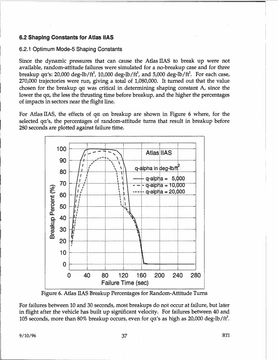
Figure 6. Atlas IIAS Breakup Percentages for Random-Attitude Turns............................... 37
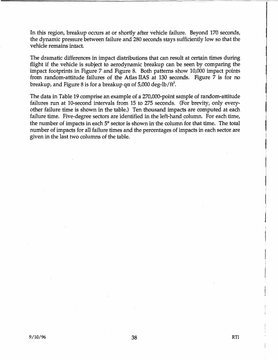
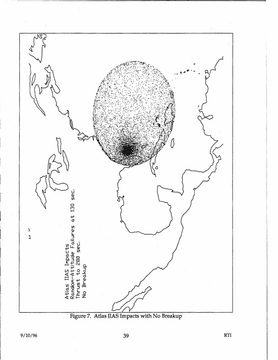
Figure 7. Atlas IIAS Impacts with No Breakup ................................................................... 39
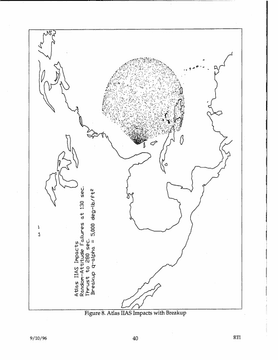
Figure 8. Atlas IIAS Impacts with Breakup.......................................................................... 40
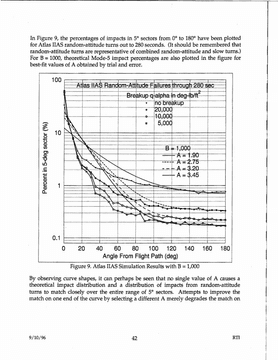
Figure 9. Atlas IIAS Simulation Results with B = 1,000 ..................................................... 42
Figure 10. Atlas IIAS Simulation Results with B = 50,000.................................................. 44
Figure 11. Atlas IIAS Simulation Results with B = 100,000................................................ 45
Figure 12. Atlas IIAS Simulation Results with B = 500,000................................................ 46
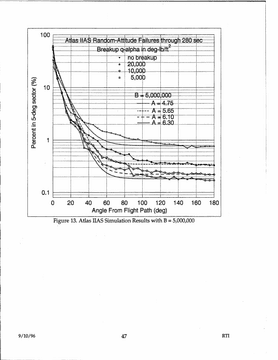
Figure 13. Atlas IIAS Simulation Results with B = 5,000,000............................................. 47
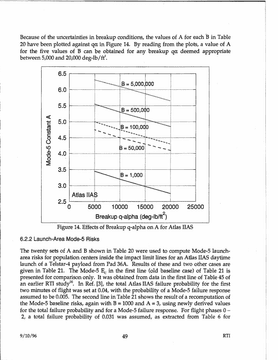
Figure 14. Effects of Breakup q-alpha on A for Atlas IIAS .................................................. 49
Figure 15. Mode-5 Density-Function Values at Three Miles .............................................. 51
Figure 16. Atlas IIAS Mode-5 Ship-Hit Contours with A = 3.00 ........................................ 53
Figure 17. Atlas IIAS All-Mode Ship-Hit Contours with A = 3.00....................................... 54
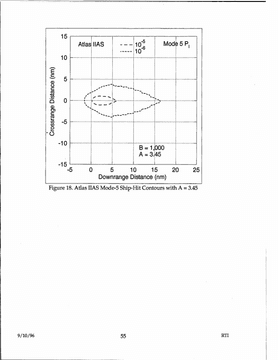
Figure 18. Atlas IIAS Mode-5 Ship-Hit Contours with A = 3.45 ........................................ 55
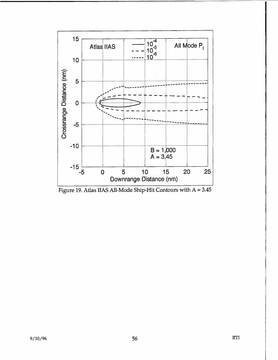
Figure 19. Atlas IIAS All-Mode Ship-Hit Contours with A = 3.45....................................... 56
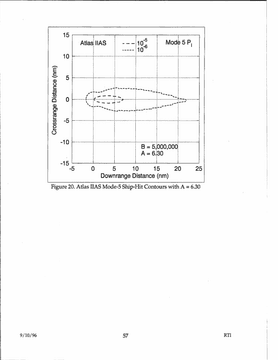
Figure 20. Atlas IIAS Mode-5 Ship-Hit Contours with A = 6.30 ........................................ 57
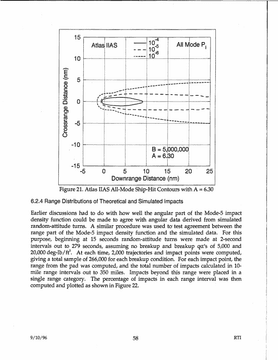
Figure 21. Atlas IIAS All-Mode Ship-Hit Contours with A = 6.30....................................... 58
Figure 22. Impact-Range Distributions................................................................................ 59
Figure 23. Delta-GEM Breakup Percentages ....................................................................... 61
Figure 24. Delta-GEM Simulation Results with B =1,000................................................... 62
Figure 25. Delta-GEM Simulation Results with Best-Fit Shaping Constants ...................... 63
Figure 26. Titan IV Breakup Percentages ............................................................................ 65
Figure 27. Titan Simulation Results with B = 1,000 ............................................................ 66
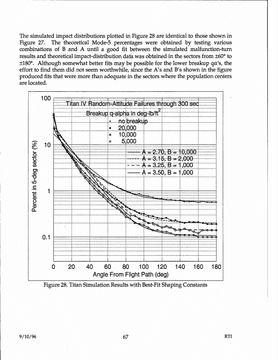
Figure 28. Titan Simulation Results with Best-Fit Shaping Constants................................ 67
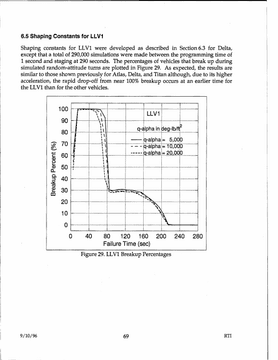
Figure 29. LLV1 Breakup Percentages ................................................................................ 69
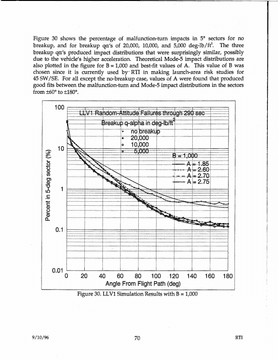
Figure 30. LLV1 Simulation Results with B = 1,000............................................................ 70

9/10/96                                            iv                                            RTI

PAGE 8

report

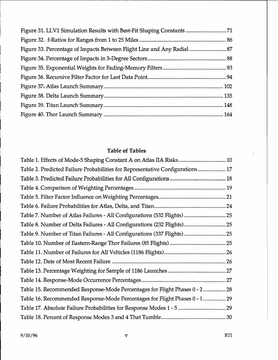
This page is a table of contents listing figures and tables for a technical report regarding launch vehicle failure probabilities and simulation results.

Figure 31. LLV1 Simulation Results with Best-Fit Shaping Constants ............................ 71
Figure 32. f-Ratios for Ranges from 1 to 25 Miles ............................................................ 86
Figure 33. Percentage of Impacts Between Flight Line and Any Radial ............................ 87
Figure 34. Percentage of Impacts in 5-Degree Sectors...................................................... 88
Figure 35. Exponential Weights for Fading-Memory Filters .............................................. 93
Figure 36. Recursive Filter Factor for Last Data Point...................................................... 94
Figure 37. Atlas Launch Summary.................................................................................... 102
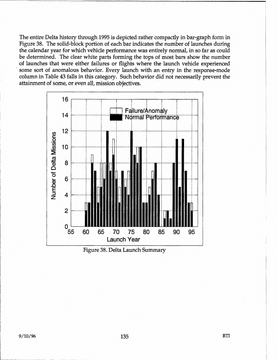
Figure 38. Delta Launch Summary.................................................................................... 135
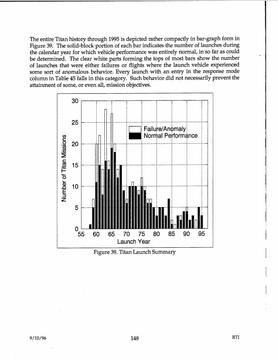
Figure 39. Titan Launch Summary.................................................................................... 148
Figure 40. Thor Launch Summary .................................................................................... 164

Table of Tables
Table 1. Effects of Mode-5 Shaping Constant A on Atlas IIA Risks.................................. 10
Table 2. Predicted Failure Probabilities for Representative Configurations ....................... 17
Table 3. Predicted Failure Probabilities for All Configurations .......................................... 18
Table 4. Comparison of Weighting Percentages ................................................................. 19
Table 5. Filter Factor Influence on Weighting Percentages................................................. 21
Table 6. Failure Probabilities for Atlas, Delta, and Titan..................................................... 24
Table 7. Number of Atlas Failures - All Configurations (532 Flights)................................. 25
Table 8. Number of Delta Failures - All Configurations (232 Flights)................................. 25
Table 9. Number of Titan Failures - All Configurations (337 Flights)................................. 25
Table 10. Number of Eastern-Range Thor Failures (85 Flights) ......................................... 25
Table 11. Number of Failures for All Vehicles (1186 Flights)............................................. 26
Table 12. Date of Most Recent Failure ............................................................................... 26
Table 13. Percentage Weighting for Sample of 1186 Launches .......................................... 27
Table 14. Response-Mode Occurrence Percentages............................................................ 27
Table 15. Recommended Response-Mode Percentages for Flight Phases 0 - 2 ................ 28
Table 16. Recommended Response-Mode Percentages for Flight Phases 0 - 1 ................ 29
Table 17. Absolute Failure Probabilities for Response Modes 1 - 5 ................................... 29
Table 18. Percent of Response Modes 3 and 4 That Tumble.............................................. 30

9/10/96                                                                 V                                                                 RTI

PAGE 9

other

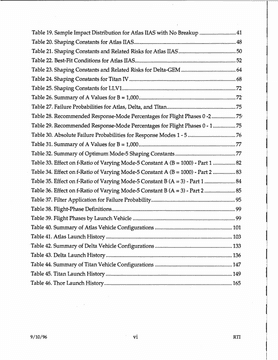
This page is a table of contents listing tables 19 through 46 and their corresponding page numbers in the report.

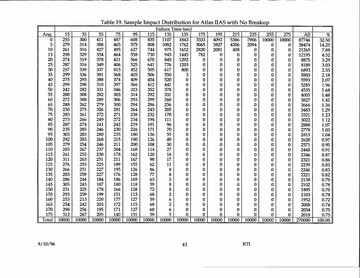
Table 19. Sample Impact Distribution for Atlas IIAS with No Breakup ............................ 41
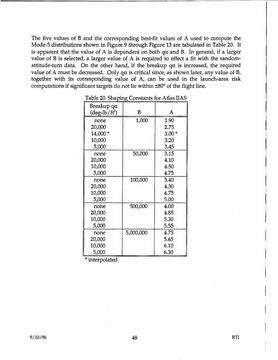
Table 20. Shaping Constants for Atlas IIAS....................................................................... 48
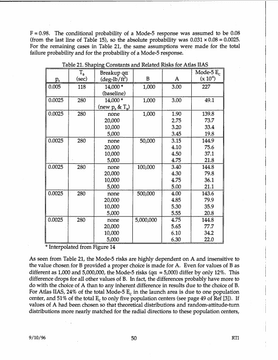
Table 21. Shaping Constants and Related Risks for Atlas IIAS......................................... 50
Table 22. Best-Fit Conditions for Atlas IIAS....................................................................... 52
Table 23. Shaping Constants and Related Risks for Delta-GEM ....................................... 64
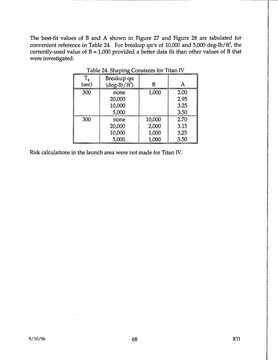
Table 24. Shaping Constants for Titan IV .......................................................................... 68
Table 25. Shaping Constants for LLV1............................................................................... 72
Table 26. Summary of A Values for B = 1,000................................................................... 72
Table 27. Failure Probabilities for Atlas, Delta, and Titan.................................................. 75
Table 28. Recommended Response-Mode Percentages for Flight Phases 0 -2 ................. 75
Table 29. Recommended Response-Mode Percentages for Flight Phases 0 - 1 ............... 75
Table 30. Absolute Failure Probabilities for Response Modes 1 - 5 ................................. 76
Table 31. Summary of A Values for B = 1,000................................................................... 77
Table 32. Summary of Optimum Mode-5 Shaping Constants ........................................... 77
Table 33. Effect on f-Ratio of Varying Mode-5 Constant A (B = 1000) - Part 1 ............... 82
Table 34. Effect on f-Ratio of Varying Mode-5 Constant A (B = 1000) - Part 2 ............... 83
Table 35. Effect on f-Ratio of Varying Mode-5 Constant B (A = 3) - Part 1 .................... 84
Table 36. Effect on f-Ratio of Varying Mode-5 Constant B (A = 3) - Part 2 .................... 85
Table 37. Filter Application for Failure Probability............................................................ 95
Table 38. Flight-Phase Definitions...................................................................................... 99
Table 39. Flight Phases by Launch Vehicle ....................................................................... 99
Table 40. Summary of Atlas Vehicle Configurations ......................................................... 101
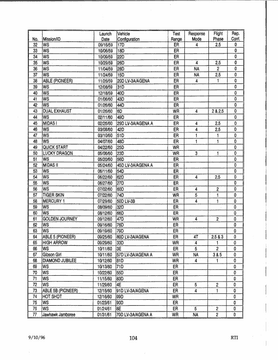
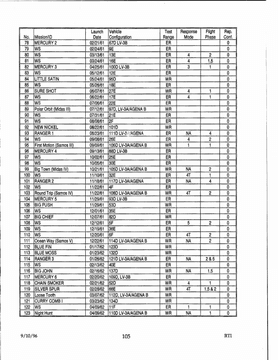
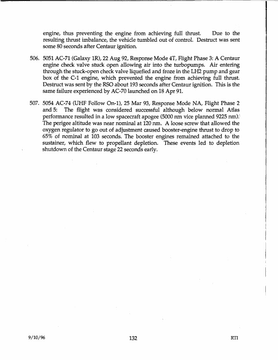
Table 41. Atlas Launch History .......................................................................................... 103
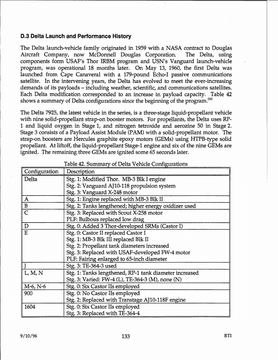
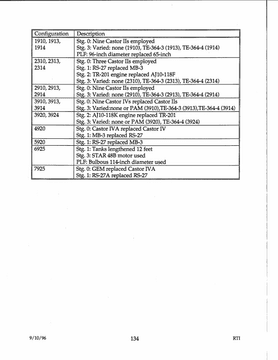
Table 42. Summary of Delta Vehicle Configurations ......................................................... 133
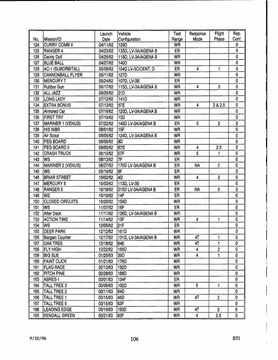
Table 43. Delta Launch History .......................................................................................... 136
Table 44. Summary of Titan Vehicle Configurations ......................................................... 147
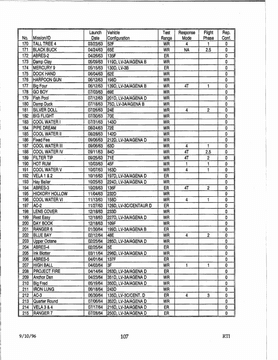
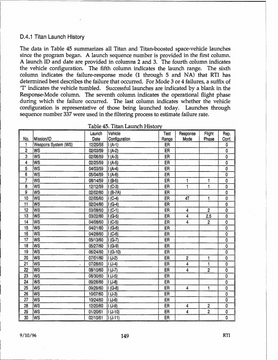
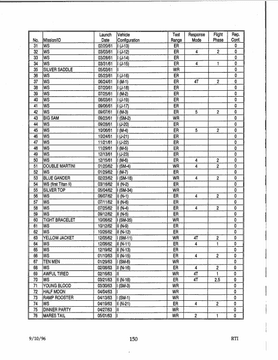
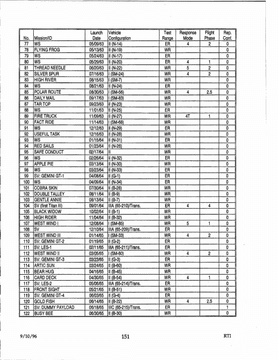
Table 45. Titan Launch History .......................................................................................... 149
Table 46. Thor Launch History ........................................................................................... 165

9/10/96                                            vi                                            RTI

PAGE 10

report

This page introduces the DAMP (facility DAMage and Personnel injury) risk-analysis program, which models failure responses of launch vehicles to estimate ground risks, specifically focusing on how unlikely failure modes can impact areas outside the immediate flight line.

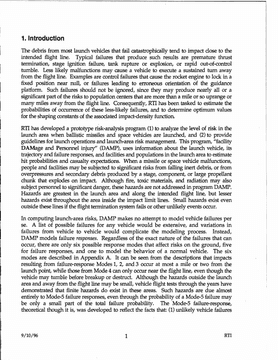
1. Introduction

The debris from most launch vehicles that fail catastrophically tend to impact close to the intended flight line. Typical failures that produce such results are premature thrust termination, stage ignition failure, tank rupture or explosion, or rapid out-of-control tumble. Less likely malfunctions may cause a vehicle to execute a sustained turn away from the flight line. Examples are control failures that cause the rocket engine to lock in a fixed position near null, or failures leading to erroneous orientation of the guidance platform. Such failures should not be ignored, since they may produce nearly all or a significant part of the risks to population centers that are more than a mile or so uprange or many miles away from the flight line. Consequently, RTI has been tasked to estimate the probabilities of occurrence of these less-likely failures, and to determine optimum values for the shaping constants of the associated impact-density function.

RTI has developed a prototype risk-analysis program (1) to analyze the level of risk in the launch area when ballistic missiles and space vehicles are launched, and (2) to provide guidelines for launch operations and launch-area risk management. This program, "facility DAMage and Personnel injury" (DAMP), uses information about the launch vehicle, its trajectory and failure responses, and facilities and populations in the launch area to estimate hit probabilities and casualty expectations. When a missile or space vehicle malfunctions, people and facilities may be subjected to significant risks from falling inert debris, or from overpressures and secondary debris produced by a stage, component, or large propellant chunk that explodes on impact. Although fire, toxic materials, and radiation may also subject personnel to significant danger, these hazards are not addressed in program DAMP. Hazards are greatest in the launch area and along the intended flight line, but lesser hazards exist throughout the area inside the impact limit lines. Small hazards exist even outside these lines if the flight termination system fails or other unlikely events occur.

In computing launch-area risks, DAMP makes no attempt to model vehicle failures per se. A list of possible failures for any vehicle would be extensive, and variations in failures from vehicle to vehicle would complicate the modeling process. Instead, DAMP models failure responses. Regardless of the exact nature of the failures that can occur, there are only six possible response modes that affect risks on the ground, five for failure responses, and one to model the behavior of a normal vehicle. The six modes are described in Appendix A. It can be seen from the descriptions that impacts resulting from failure-response Modes 1, 2, and 3 occur at most a mile or two from the launch point, while those from Mode 4 can only occur near the flight line, even though the vehicle may tumble before breakup or destruct. Although the hazards outside the launch area and away from the flight line may be small, vehicle flight tests through the years have demonstrated that finite hazards do exist in these areas. Such hazards are due almost entirely to Mode-5 failure responses, even through the probability of a Mode-5 failure may be only a small part of the total failure probability. The Mode-5 failure-response, theoretical though it is, was developed to reflect the facts that: (1) unlikely vehicle failures

9/10/96 1 RTI

PAGE 11

report

This page describes the development and methodology of the Mode-5 impact-density function used in the DAMP program to model vehicle failure impacts, including the rationale for vehicle-dependent shaping constants.

can cause impacts uprange or well away from the intended flight line, and (2) some vehicle failures cannot logically be classified as Response Modes 1, 2, 3, or 4.

In keeping with the above, the Mode-5 impact-density function was developed with the characteristics listed below. The function, which fills the void left by Modes 1 through 4, is sufficiently robust to include all possible impacts, yet seemingly comports with observed test results.

(1) Impacts can occur in any direction from the launch point and at any range within the vehicle's energy capabilities.

(2) At any given impact range from the launch point, the likelihood of impact decreases as the angular deviation from the flight line increases, becoming least likely in the uprange direction. For any fixed angular deviation from the flight line, the likelihood of impact decreases as the impact range increases.

(3) At fixed impact ranges near the launch point, the impact density function changes gradually as the impact direction swings 180° from downrange to uprange. As the impact range increases, the decrease in the density function becomes progressively more and more rapid with change in impact direction. In other words, the greater the impact range, the more rapidly the density function changes with angular deviation from the flight line.

As modeled in DAMP, the effects of destruct action on the Mode-5 density function are accounted for in the launch area by supplementing impacts inside the impact limit lines with those that would occur outside the impact limit lines if no destruct action were taken.

The Mode-5 failure-response methodology was fully developed in an earlier RTI report[1]. As pointed out there, the shape of the impact density function can be controlled somewhat through the selection of shaping constants that appear in the defining equation. Intuition suggests that the constants should be vehicle dependent, since (1) ruggedly built missiles would, after a malfunction, be more likely to impact well away from the flight line than would a fragile space vehicle that tends to break up before deviating significantly; and (2) certain vehicles, after a malfunction, tend to stabilize and continue thrusting at large angles of attack, while other vehicles that experience similar malfunctions tend to tumble. Hit probabilities computed by program DAMP for targets located more than two miles or so uprange from the pad or more than a few miles from the flight line, are due almost entirely to the Mode-5 impact-density function. Thus, the assumed probability of occurrence of a Mode-5 response as well as the selected Mode-5 constants are of considerable importance.

The tasking for this study is set forth as Task No. 10/95-77, Paragraph 2.0, of Contract FO4703-91-C-0112. The primary purpose of the tasking is: "Perform a study to determine the best values for Mode-5 failure probability and the Mode-5 density-function shaping constant A." Although not explicitly included in the statement of work, the study also develops absolute failure probabilities for Atlas, Delta, and Titan, and

9/10/96 2 RTI

PAGE 12

report

This page discusses the difficulty of establishing failure-response probabilities for launch vehicles and provides five historical examples of missile flight anomalies (Atlas and Titan series) to justify the need for a 'Mode-5' response protocol.

relative probabilities of occurrence for all failure-response modes for these vehicles, LLV1, and other new launch systems.

Although it may be reasonable to establish the relative probability of occurrence of a Mode-5 failure response by empirical means, the number of Mode-5 failures is too small to have any hope of establishing accurate values for the shaping constants from this sample alone. Inadequate descriptions of vehicle behavior in the available historical records and uncertainty in impact location following a malfunction add to the difficulty of classifying failure responses. In view of the limited data available for vehicles that have experienced Mode-5 failures, the values chosen for the Mode-5 constants must depend on simulations of vehicle behavior following failure.

2. Examples Showing Need for Mode 5

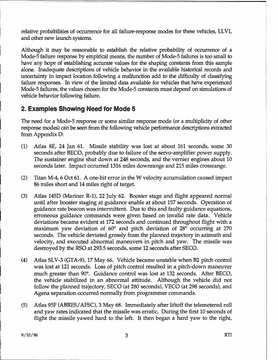
The need for a Mode-5 response or some similar response mode (or a multiplicity of other response modes) can be seen from the following vehicle performance descriptions extracted from Appendix D:

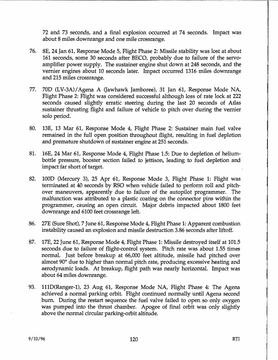
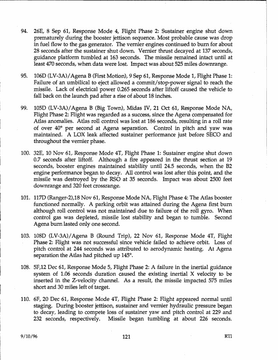
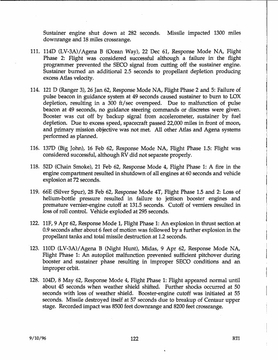
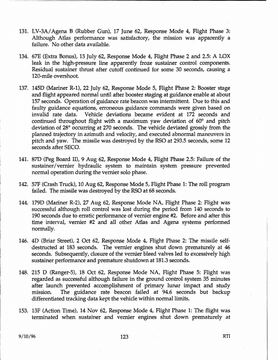
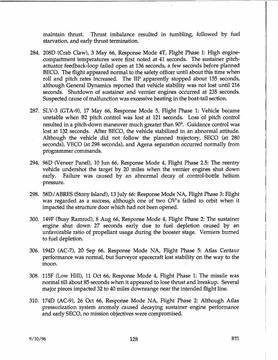
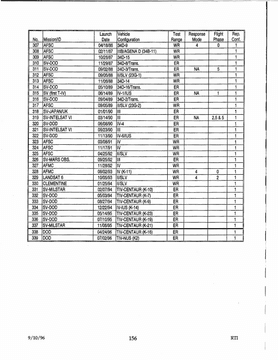
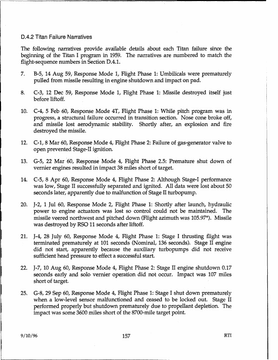
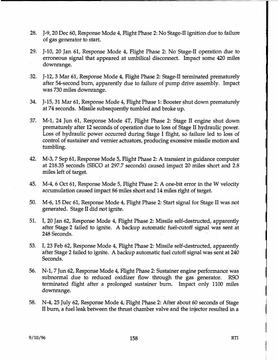
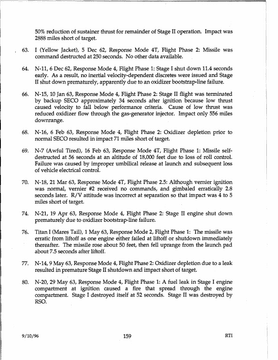
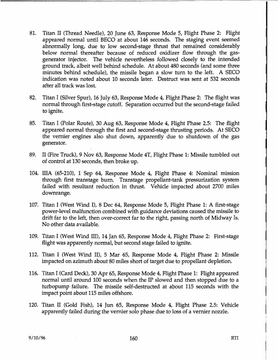
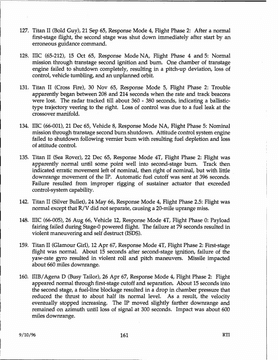
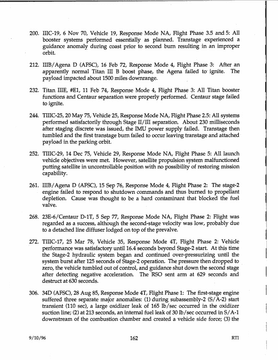
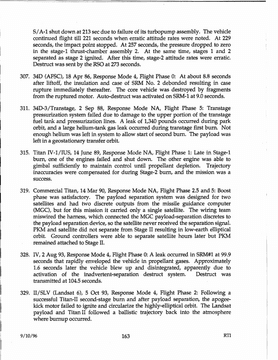
(1) Atlas 8E, 24 Jan 61. Missile stability was lost at about 161 seconds, some 30 seconds after BECO, probably due to failure of the servo-amplifier power supply. The sustainer engine shut down at 248 seconds, and the vernier engines about 10 seconds later. Impact occurred 1316 miles downrange and 215 miles crossrange.

(2) Titan M-4, 6 Oct 61. A one-bit error in the W velocity accumulation caused impact 86 miles short and 14 miles right of target.

(3) Atlas 145D (Mariner R-1), 22 July 62. Booster stage and flight appeared normal until after booster staging at guidance enable at about 157 seconds. Operation of guidance rate beacon was intermittent. Due to this and faulty guidance equations, erroneous guidance commands were given based on invalid rate data. Vehicle deviations became evident at 172 seconds and continued throughout flight with a maximum yaw deviation of 60° and pitch deviation of 28° occurring at 270 seconds. The vehicle deviated grossly from the planned trajectory in azimuth and velocity, and executed abnormal maneuvers in pitch and yaw. The missile was destroyed by the RSO at 293.5 seconds, some 12 seconds after SECO.

(4) Atlas SLV-3 (GTA-9), 17 May 66. Vehicle became unstable when B2 pitch control was lost at 121 seconds. Loss of pitch control resulted in a pitch-down maneuver much greater than 90°. Guidance control was lost at 132 seconds. After BECO, the vehicle stabilized in an abnormal attitude. Although the vehicle did not follow the planned trajectory, SECO (at 280 seconds), VECO (at 298 seconds), and Agena separation occurred normally from programmer commands.

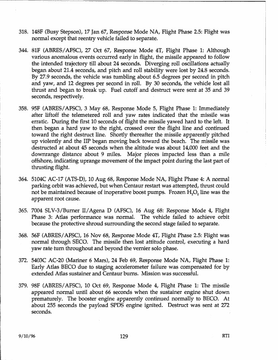
(5) Atlas 95F (ABRES/AFSC), 3 May 68. Immediately after liftoff the telemetered roll and yaw rates indicated that the missile was erratic. During the first 10 seconds of flight the missile yawed hard to the left. It then began a hard yaw to the right.

9/10/96 3 RTI

PAGE 13

report

This page contains technical summaries of flight anomalies and destruct events for four specific missile/launch vehicle missions: an unnamed mission, Delta Intelsat III, Delta Pioneer E, and Atlas 68E.

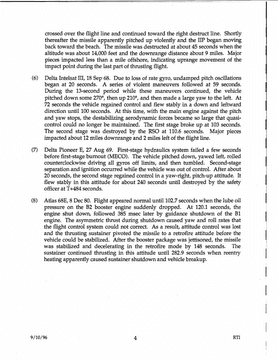
crossed over the flight line and continued toward the right destruct line. Shortly thereafter the missile apparently pitched up violently and the IIP began moving back toward the beach. The missile was destructed at about 45 seconds when the altitude was about 14,000 feet and the downrange distance about 9 miles. Major pieces impacted less than a mile offshore, indicating uprange movement of the impact point during the last part of thrusting flight.

(6) Delta Intelsat III, 18 Sep 68. Due to loss of rate gyro, undamped pitch oscillations began at 20 seconds. A series of violent maneuvers followed at 59 seconds. During the 13-second period while these maneuvers continued, the vehicle pitched down some 270°, then up 210°, and then made a large yaw to the left. At 72 seconds the vehicle regained control and flew stably in a down and leftward direction until 100 seconds. At this time, with the main engine against the pitch and yaw stops, the destabilizing aerodynamic forces became so large that quasi-control could no longer be maintained. The first stage broke up at 103 seconds. The second stage was destroyed by the RSO at 110.6 seconds. Major pieces impacted about 12 miles downrange and 2 miles left of the flight line.

(7) Delta Pioneer E, 27 Aug 69. First-stage hydraulics system failed a few seconds before first-stage burnout (MECO). The vehicle pitched down, yawed left, rolled counterclockwise driving all gyros off limits, and then tumbled. Second-stage separation and ignition occurred while the vehicle was out of control. After about 20 seconds, the second stage regained control in a yaw-right, pitch-up attitude. It flew stably in this attitude for about 240 seconds until destroyed by the safety officer at T+484 seconds.

(8) Atlas 68E, 8 Dec 80. Flight appeared normal until 102.7 seconds when the lube oil pressure on the B2 booster engine suddenly dropped. At 120.1 seconds, the engine shut down, followed 385 msec later by guidance shutdown of the B1 engine. The asymmetric thrust during shutdown caused yaw and roll rates that the flight control system could not correct. As a result, attitude control was lost and the thrusting sustainer pivoted the missile to a retrofire attitude before the vehicle could be stabilized. After the booster package was jettisoned, the missile was stabilized and decelerating in the retrofire mode by 148 seconds. The sustainer continued thrusting in this attitude until 282.9 seconds when reentry heating apparently caused sustainer shutdown and vehicle breakup.

9/10/96 4 RTI

PAGE 14

report

This page discusses the classification of vehicle failures in relation to response modes and safety protocols for destruct actions.

It is obvious from the response-mode definitions in Appendix A that none of the described vehicle failures can be considered as a Mode 1, 2, or 3 response, or a Mode-4 on-trajectory failure.* Except possibly for (2), it also seems apparent that none can be modeled as either a rapid tumble or a slow turn.

* Although prompt destruct action during any of the described flights might have resulted in a Mode-4 classification, the safety officer typically needs several seconds to evaluate data after a malfunction. Quick action is contrary to safety philosophy if impact limit lines are not threatened and the destruct system is not at risk, since additional flight time enhances the user's opportunity to pinpoint the nature of the problem.

9/10/96                                       5                                       RTI

PAGE 15

report

This page provides examples of Mode-5 rocket failure responses, specifically the Prospector (Joust) launch in June 1991 and the Red Tigress sounding rocket launch in August 1991.

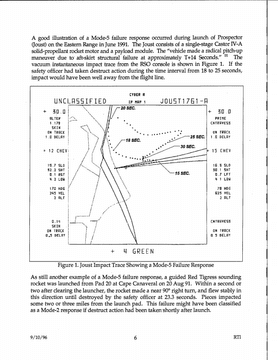
A good illustration of a Mode-5 failure response occurred during launch of Prospector (Joust) on the Eastern Range in June 1991. The Joust consists of a single-stage Castor IV-A solid-propellant rocket motor and a payload module. The "vehicle made a radical pitch-up maneuver due to aft-skirt structural failure at approximately T+14 Seconds." [2] The vacuum instantaneous impact trace from the RSO console is shown in Figure 1. If the safety officer had taken destruct action during the time interval from 18 to 25 seconds, impact would have been well away from the flight line.

[DIAGRAM: UNCLASSIFIED CYBER A IP MAP 1 JOUST1761-A. Shows impact trace with time markers at 15, 18, 20, 25, and 30 seconds.]

Figure 1. Joust Impact Trace Showing a Mode-5 Failure Response

As still another example of a Mode-5 failure response, a guided Red Tigress sounding rocket was launched from Pad 20 at Cape Canaveral on 20 Aug 91. Within a second or two after clearing the launcher, the rocket made a near 90° right turn, and flew stably in this direction until destroyed by the safety officer at 23.3 seconds. Pieces impacted some two or three miles from the launch pad. This failure might have been classified as a Mode-2 response if destruct action had been taken shortly after launch.

9/10/96 6 RTI

PAGE 16

report

This page provides a technical explanation of the Mode-5 failure response for debris impact analysis, including the mathematical formula used to calculate impact density and the definitions of the variables involved.

3. Understanding the Mode-5 Failure Response

Unlike failure response Modes 3 and 4, response Mode 5 (and also Mode 2) is not a direct function of time from launch. For Modes 3 and 4, the mean point of impact (MPI) for each debris class is fixed, once the failure time is established. At each instant there is only one possible location for the MPI for each debris class. On the other hand, the Mode-5 impact-density function for each debris class consists of a primary part and a secondary superimposed part. The primary impact-density function accounts for impact variability due to the erratic flight of the vehicle. It is used to determine the probability that the mean piece in a debris class resulting from vehicle breakup falls in a given area (say on a building or open field). The secondary density function accounts for debris dispersion due to vehicle breakup and to aerodynamic effects during free fall. It is used to determine the probability that fragments from the class actually hit a building or field. In other words, the primary impact-density function is used to compute the probability that the secondary function is centered in some specified area; the secondary function, which describes the distribution of class pieces about the mean point, is then used to compute the probability that one or more class pieces impacts on the specified population center or area.

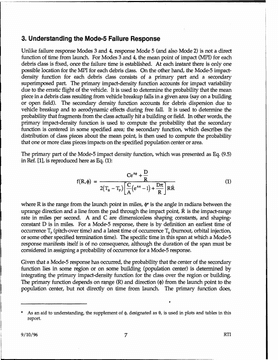
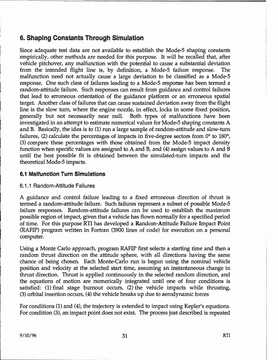
The primary part of the Mode-5 impact density function, which was presented as Eq. (9.5) in Ref. [1], is reproduced here as Eq. (1):

f(R,φ) = Ce^Aφ + D/R / 2(T_B - T_P)[C/A(e^Aπ - 1) + Dπ/R] R_dot (1)

where R is the range from the launch point in miles, φ* is the angle in radians between the uprange direction and a line from the pad through the impact point, R_dot is the impact-range rate in miles per second. A and C are dimensionless shaping constants, and shaping-constant D is in miles. For a Mode-5 response, there is by definition an earliest time of occurrence T_P (pitch-over time) and a latest time of occurrence T_B (burnout, orbital injection, or some other specified termination time). The specific time in this span at which a Mode-5 response manifests itself is of no consequence, although the duration of the span must be considered in assigning a probability of occurrence for a Mode-5 response.

Given that a Mode-5 response has occurred, the probability that the center of the secondary function lies in some region or on some building (population center) is determined by integrating the primary impact-density function for the class over the region or building. The primary function depends on range (R) and direction (φ) from the launch point to the population center, but not directly on time from launch. The primary function does,

* As an aid to understanding, the supplement of φ, designated as θ, is used in plots and tables in this report.

9/10/96 7 RTI

PAGE 17

report

This page provides technical details on Mode-5 impact-density functions, including mathematical modeling of debris dispersion and failure mechanisms for a Joust vehicle.

however, involve the quantity R which is expressed explicitly as a function of R and only implicitly as a function of time. Values of R from the nominal trajectory are differed to compute R.

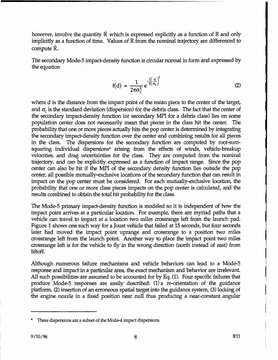
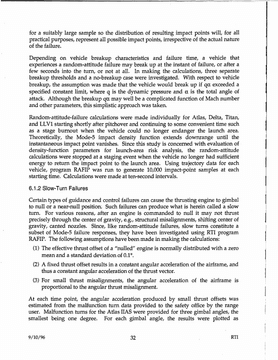
The secondary Mode-5 impact-density function is circular normal in form and expressed by the equation

f(d) = 1 / (2 * pi * sigma_c^2) * e^(-1/2 * (d / sigma_c)^2) (2)

where d is the distance from the impact point of the mean piece to the center of the target, and sigma_c is the standard deviation (dispersion) for the debris class. The fact that the center of the secondary impact-density function (or secondary MPI for a debris class) lies on some population center does not necessarily mean that pieces in the class hit the center. The probability that one or more pieces actually hits the pop center is determined by integrating the secondary impact-density function over the center and combining results for all pieces in the class. The dispersions for the secondary function are computed by root-sum-squaring individual dispersions* arising from the effects of winds, vehicle-breakup velocities, and drag uncertainties for the class. They are computed from the nominal trajectory, and can be explicitly expressed as a function of impact range. Since the pop center can also be hit if the MPI of the secondary density function lies outside the pop center, all possible mutually-exclusive locations of the secondary function that can result in impact on the pop center must be considered. For each mutually-exclusive location, the probability that one or more class pieces impacts on the pop center is calculated, and the results combined to obtain the total hit probability for the class.

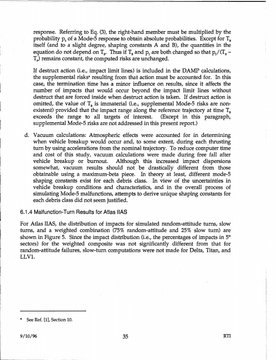
The Mode-5 primary impact-density function is modeled so it is independent of how the impact point arrives at a particular location. For example, there are myriad paths that a vehicle can travel to impact at a location two miles crossrange left from the launch pad. Figure 1 shows one such way for a Joust vehicle that failed at 15 seconds, but four seconds later had moved the impact point uprange and crossrange to a position two miles crossrange left from the launch point. Another way to place the impact point two miles crossrange left is for the vehicle to fly in the wrong direction (north instead of east) from liftoff.

Although numerous failure mechanisms and vehicle behaviors can lead to a Mode-5 response and impact in a particular area, the exact mechanism and behavior are irrelevant. All such possibilities are assumed to be accounted for by Eq. (1). Four specific failures that produce Mode-5 responses are easily described: (1) a re-orientation of the guidance platform, (2) insertion of an erroneous spatial target into the guidance system, (3) locking of the engine nozzle in a fixed position near null thus producing a near-constant angular

* These dispersions are a subset of the Mode-4 impact dispersions.

9/10/96 8 RTI

PAGE 18

report

This page discusses the mathematical modeling of Mode-5 failure responses, specifically the impact-density function, shaping constants A and B, and their application in DAMP risk analysis for the Atlas IIA launch vehicle.

acceleration of the vehicle body and a slow turn of the velocity vector, (4) erroneous accumulation of velocity bits by the guidance system. Many other Mode-5 responses are so convoluted that they defy description or categorization.

3.1 Effects of Mode-5 Shaping Constants

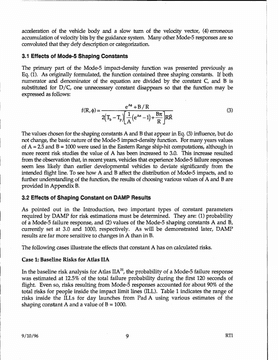
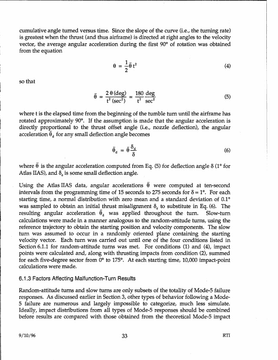
The primary part of the Mode-5 impact-density function was presented previously as Eq. (1). As originally formulated, the function contained three shaping constants. If both numerator and denominator of the equation are divided by the constant C, and B is substituted for D/C, one unnecessary constant disappears so that the function may be expressed as follows:

f(R,φ) = e^Aφ + B/R / 2(Tb - Tp)[1/A(e^Aπ - 1) + Bπ/R]RR (3)

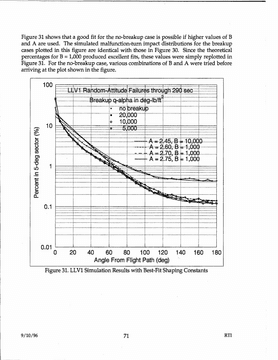
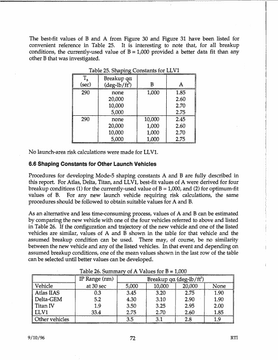
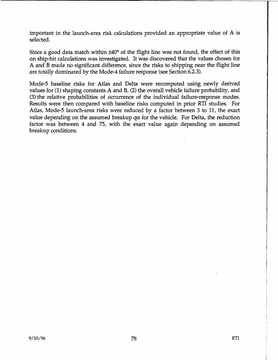
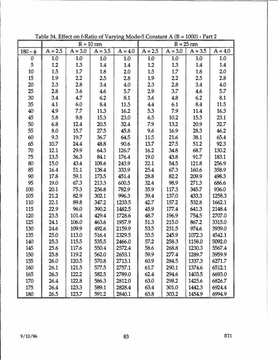
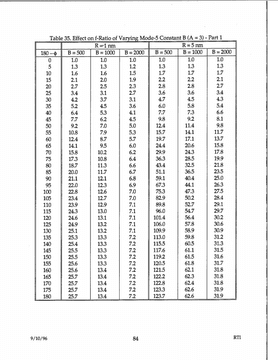
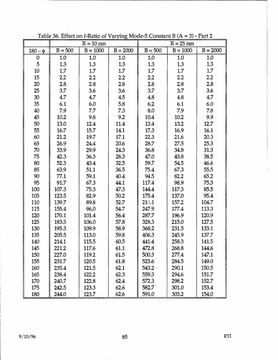
The values chosen for the shaping constants A and B that appear in Eq. (3) influence, but do not change, the basic nature of the Mode-5 impact-density function. For many years values of A = 2.5 and B = 1000 were used in the Eastern Range ship-hit computations, although in more recent risk studies the value of A has been increased to 3.0. This increase resulted from the observation that, in recent years, vehicles that experience Mode-5 failure responses seem less likely than earlier developmental vehicles to deviate significantly from the intended flight line. To see how A and B affect the distribution of Mode-5 impacts, and to further understanding of the function, the results of choosing various values of A and B are provided in Appendix B.

3.2 Effects of Shaping Constant on DAMP Results

As pointed out in the Introduction, two important types of constant parameters required by DAMP for risk estimations must be determined. They are: (1) probability of a Mode-5 failure response, and (2) values of the Mode-5 shaping constants A and B, currently set at 3.0 and 1000, respectively. As will be demonstrated later, DAMP results are far more sensitive to changes in A than in B.

The following cases illustrate the effects that constant A has on calculated risks.

Case 1: Baseline Risks for Atlas IIA

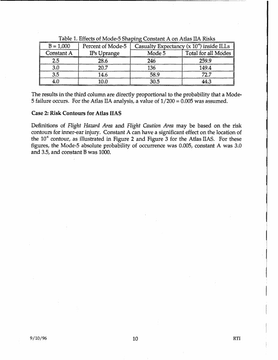
In the baseline risk analysis for Atlas IIA[3], the probability of a Mode-5 failure response was estimated at 12.5% of the total failure probability during the first 120 seconds of flight. Even so, risks resulting from Mode-5 responses accounted for about 90% of the total risks for people inside the impact limit lines (ILL). Table 1 indicates the range of risks inside the ILLs for day launches from Pad A using various estimates of the shaping constant A and a value of B = 1000.

9/10/96 9 RTI

PAGE 19

report

This page presents a table detailing the effects of Mode-5 shaping constant A on Atlas IIA risk assessments and discusses the definitions of flight hazard and caution areas based on risk contours.

Table 1. Effects of Mode-5 Shaping Constant A on Atlas IIA Risks
B = 1,000 | Percent of Mode-5 | Casualty Expectancy (x 10^-6) inside ILLs
Constant A | IPs Uprange | Mode 5 | Total for all Modes
2.5 | 28.6 | 246 | 259.9
3.0 | 20.7 | 136 | 149.4
3.5 | 14.6 | 58.9 | 72.7
4.0 | 10.0 | 30.5 | 44.3

The results in the third column are directly proportional to the probability that a Mode-5 failure occurs. For the Atlas IIA analysis, a value of 1/200 = 0.005 was assumed.

Case 2: Risk Contours for Atlas IIAS

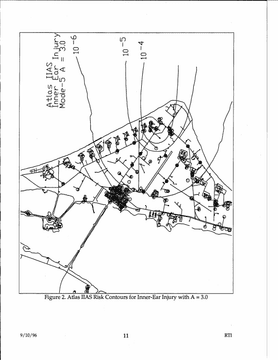
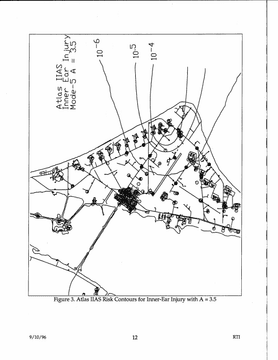
Definitions of Flight Hazard Area and Flight Caution Area may be based on the risk contours for inner-ear injury. Constant A can have a significant effect on the location of the 10^-6 contour, as illustrated in Figure 2 and Figure 3 for the Atlas IIAS. For these figures, the Mode-5 absolute probability of occurrence was 0.005, constant A was 3.0 and 3.5, and constant B was 1000.

9/10/96 10 RTI

PAGE 20

diagram

This page contains a technical diagram labeled 'Figure 2' showing Atlas IIAS risk contours for inner-ear injury.

Atlas IIAS
Inner Ear Injury
Mode-5 A = 3.0
10^-6
10^-5
10^-4

Figure 2. Atlas IIAS Risk Contours for Inner-Ear Injury with A = 3.0

9/10/96 11 RTI

PAGE 21

diagram

A technical diagram titled 'Atlas IIAS Risk Contours for Inner-Ear Injury with A = 3.5' showing geographical risk contours.

Atlas IIAS
Inner Ear Injury
Mode-5 A = 3.5

10^-6
10^-5
10^-4

Figure 3. Atlas IIAS Risk Contours for Inner-Ear Injury with A = 3.5

9/10/96 12 RTI

PAGE 22

report

This page outlines the methodology for assessing failure probabilities in launch vehicles, specifically discussing the 'parts-analysis' or engineering approach and its limitations as described in a 1992 Booz Allen & Hamilton report.

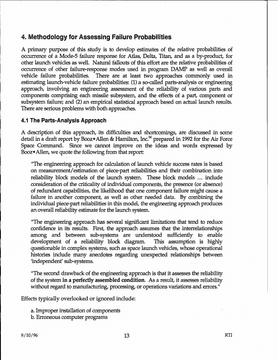
4. Methodology for Assessing Failure Probabilities

A primary purpose of this study is to develop estimates of the relative probabilities of occurrence of a Mode-5 failure response for Atlas, Delta, Titan, and as a by-product, for other launch vehicles as well. Natural fallouts of this effort are the relative probabilities of occurrence of other failure-response modes used in program DAMP as well as overall vehicle failure probabilities. There are at least two approaches commonly used in estimating launch-vehicle failure probabilities: (1) a so-called parts-analysis or engineering approach, involving an engineering assessment of the reliability of various parts and components comprising each missile subsystem, and the effects of a part, component or subsystem failure; and (2) an empirical statistical approach based on actual launch results. There are serious problems with both approaches.

4.1 The Parts-Analysis Approach

A description of this approach, its difficulties and shortcomings, are discussed in some detail in a draft report by Booz•Allen & Hamilton, Inc.[4] prepared in 1992 for the Air Force Space Command. Since we cannot improve on the ideas and words expressed by Booz•Allen, we quote the following from that report:

"The engineering approach for calculation of launch vehicle success rates is based on measurement/estimation of piece-part reliabilities and their combination into reliability block models of the launch system. These block models ... include consideration of the criticality of individual components, the presence (or absence) of redundant capabilities, the likelihood that one component failure might cause a failure in another component, as well as other needed data. By combining the individual piece-part reliabilities in this model, the engineering approach produces an overall reliability estimate for the launch system."

"The engineering approach has several significant limitations that tend to reduce confidence in its results. First, the approach assumes that the interrelationships among and between sub-systems are understood sufficiently to enable development of a reliability block diagram. This assumption is highly questionable in complex systems, such as space launch vehicles, whose operational histories include many anecdotes regarding unexpected relationships between 'independent' sub-systems."

"The second drawback of the engineering approach is that it assesses the reliability of the system in a perfectly assembled condition. As a result, it assesses reliability without regard to manufacturing, processing, or operations variations and errors."

Effects typically overlooked or ignored include:

a. Improper installation of components
b. Erroneous computer programs

9/10/96 13 RTI

PAGE 23

report

This page discusses the limitations of parts-analysis approaches in estimating the reliability of proposed vehicle designs, citing a report by the Office of Technology Assessment and Booz•Allen.

c. Insertion of improper computer programs
d. Support-personnel fatigue

A third limitation of the parts-analysis approach discussed in Ref. [4] deals with the subjectivity and invalid assumptions often used to estimate piece/component reliabilities. Here Booz•Allen quotes from a report[5] by the Office of Technology Assessment, and we do likewise:

"The design reliability of proposed vehicles is generally estimated using:

Data from laboratory tests of vehicle systems (e.g., engines and avionics) and components that have already been built;

Engineer's judgments about the reliability achievable in systems and components that have not been built;

Analyses of whether a failure in one system or component would cause other systems and components, or the vehicle to fail; and

Assumptions (often tacit) that:

the laboratory conditions under which systems were tested precisely duplicate the conditions under which the systems will operate,

the conditions under which the system will operate are those under which they were designed to operate,

the engineer's judgments about reliability are correct, and

the failure analyses considered all circumstances and details that influence reliability:

Such engineering estimates of design reliability are incomplete and subjective..." .

Effects influencing reliability that the analyst may fail to consider include:

a. Lightning strikes
b. Aging effects, particularly for solid propellants
c. Corrosion
d. Insufficient heat or cold insulation for critical components
e. Icing
f. Erroneous antennae patterns or instrumentation

Booz•Allen concludes as follows:

"Finally, due to its nature, the engineering approach can not account for undetected design flaws. (If these flaws were detected, and could be modeled,

PAGE 24

report

This page discusses the limitations of the 'parts-analysis' approach to vehicle reliability and introduces the 'empirical approach' as an alternative, while noting its own inherent difficulties in projecting future failure rates.

they would be corrected.) However, experience has shown that design flaws do cause failures in operational launch systems, and will likely do so in the future."

The major objection to the parts-analysis approach, hinted at above but not actually expressed, is that all such approaches involve either explicitly or implicitly a so-called K-factor. The K-factor is included in the reliability calculations in an attempt to compensate for the fact that the environment in which a part or system is tested is not the same as the flight environment. Since the K-factor is surely not the same for all components and systems, multiple values must be assumed and the entire process becomes highly subjective.

In view of the objections and limitations just presented, in this report the parts-analysis approach is not considered in assessing vehicle reliability or in estimating the relative probabilities of occurrence of the various failure-response modes.

4.2 The Empirical Approach

A seemingly more objective way to evaluate vehicle reliability (or conversely, vehicle failure probabilities) is by examining the actual performance of flight-tested vehicles. In support of this approach, the following is quoted from the Office of Technology Assessment[5] report previously referenced:

"The only completely objective method of estimating a vehicle's probability of failure is by statistical analysis of number of failures observed in identical vehicles under conditions representative of those under which future launches will be attempted."

Although we agree with the Office of Technology Assessment statement, the obvious difficulty with this approach is that no such sample of identical vehicles exists or is ever likely to exist.

In their report[4] previously referenced, Booz•Allen makes the same point in different words by stating that "the empirical approach has one significant drawback in that it can not project the effects of changes in the launch systems". The effects of such changes can only be assessed objectively by further flight testing.

The difficulty in projecting success rates (or failure rates) from past tests to future tests is clearly recognized. Nevertheless, RTI has relied exclusively on this method to estimate the relative probabilities of occurrence for the various failure-response modes. Even so, total objectivity cannot be claimed since, as will be seen later, the answers depend to a large extent on how the performance data are filtered, and how big a risk one wants to take that the true failure probability is underestimated.

9/10/96 15 RTI

PAGE 25

report

This page outlines the methodology for computing failure probabilities for Atlas, Delta, and Titan launch vehicles, including the use of filtered test results and weighting techniques.

5. Computation of Failure Probabilities

The test results for Atlas, Delta, and Titan in the tables of Appendix D have been used for three primary purposes:

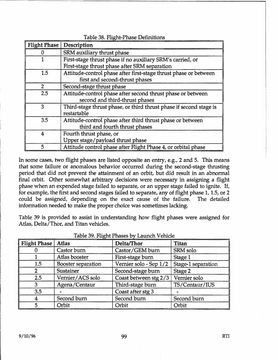
(1) To predict or estimate the overall probability that each vehicle will fail during the various phases of flight (see Table 39, Appendix D, for flight-phase definitions).

(2) To establish the relative and overall probabilities for Response Modes 1 through 5.

(3) To establish the relative frequency of tumble for Response Modes 3 and 4.

5.1 Overall Failure Probability

To predict failure probabilities for Atlas, Delta, and Titan, the test results in Appendix D for representative configurations (i.e., "1" in last column) have been filtered using three different weighting techniques described in Appendix C:

(1) Equal weighting

(2) Index-count weighting

(3) Exponential weighting

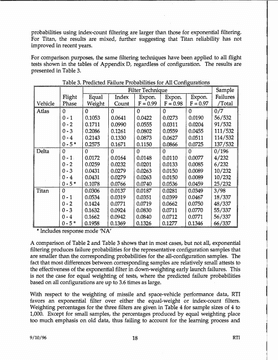
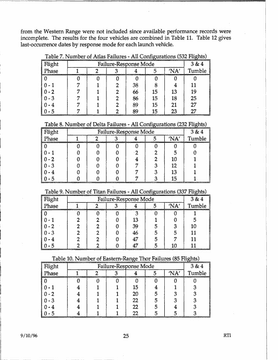
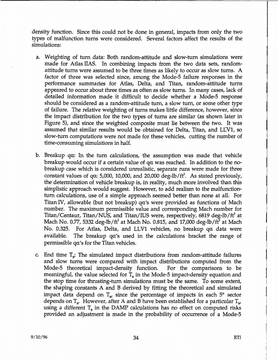
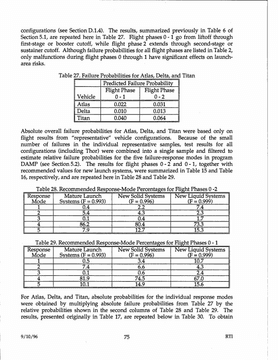
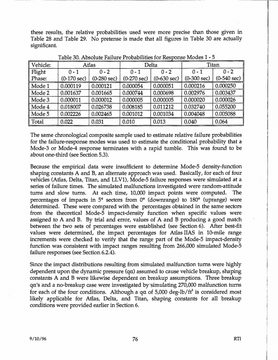
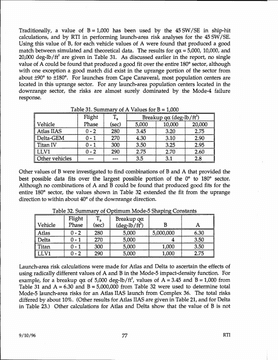
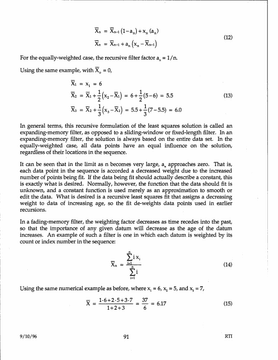
In computing filtered or weighted failure probabilities, a test is assigned a score of one to indicate the occurrence of a failure or some anomalous behavior, and a score of zero if no failure occurred. Admittedly, there may be disagreements about the classification of a few flights, since the launch agency may consider as successful or partially successful some flights that are shown as failures in Appendix D. To avoid such disagreements, it is better to think of some non-normal events, particularly those occurring late in flight, as anomalies rather than failures. The flight phases, as shown in column 2 of Table 2 and defined in Appendix D.1.3, are inclusive; e.g., flight phase "0 - 3" includes phases 0, 1, 1.5, 2, 2.5, and 3. An 'NA' in the response-mode column in the tables of Appendix D indicates that some failure or anomalous behavior has had an effect on the final orbit or impact point without producing additional risks to people on the ground or necessarily failing the mission. In the failure-probability calculations of Table 2 and Table 3, an 'NA' has been considered as a success for all flight phases except "0 - 5", irrespective of the phase in which the failure or anomalous behavior took place. Only in flight phase "0 - 5" is an 'NA' response considered a failure. The filtered results for representative configurations (defined in Appendix D.1.4) are given in Table 2 for six flight phases. For flights with multiple entries in the Response-Mode and Flight-Phase columns (e.g., see Appendix D.2.1, No. 257), the first listed value was used in the filtering process.

9/10/96 16 RTI

PAGE 26

report

This page presents a table of predicted failure probabilities for Atlas, Delta, and Titan vehicles using different filtering techniques, followed by an analysis of how these techniques and subjective decisions impact reliability estimates.

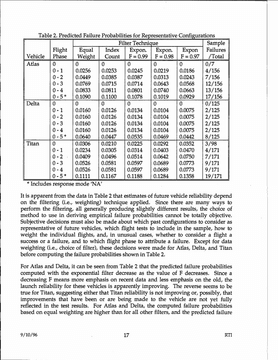
Table 2. Predicted Failure Probabilities for Representative Configurations

| Vehicle | Flight Phase | Equal Weight | Index Count | Expon. F = 0.99 | Expon. F = 0.98 | Expon. F = 0.97 | Sample Failures /Total |
| :--- | :--- | :--- | :--- | :--- | :--- | :--- | :--- |
| Atlas | 0 | 0 | 0 | 0 | 0 | 0 | 0/7 |
| | 0 - 1 | 0.0256 | 0.0253 | 0.0245 | 0.0219 | 0.0186 | 4/156 |
| | 0 - 2 | 0.0449 | 0.0385 | 0.0387 | 0.0313 | 0.0243 | 7/156 |
| | 0 - 3 | 0.0769 | 0.0715 | 0.0714 | 0.0643 | 0.0568 | 12/156 |
| | 0 - 4 | 0.0833 | 0.0811 | 0.0801 | 0.0740 | 0.0663 | 13/156 |
| | 0 - 5 * | 0.1090 | 0.1100 | 0.1078 | 0.1019 | 0.0929 | 17/156 |
| Delta | 0 | 0 | 0 | 0 | 0 | 0 | 0/125 |
| | 0 - 1 | 0.0160 | 0.0126 | 0.0134 | 0.0104 | 0.0075 | 2/125 |
| | 0 - 2 | 0.0160 | 0.0126 | 0.0134 | 0.0104 | 0.0075 | 2/125 |
| | 0 - 3 | 0.0160 | 0.0126 | 0.0134 | 0.0104 | 0.0075 | 2/125 |
| | 0 - 4 | 0.0160 | 0.0126 | 0.0134 | 0.0104 | 0.0075 | 2/125 |
| | 0 - 5 * | 0.0640 | 0.0447 | 0.0535 | 0.0469 | 0.0442 | 8/125 |
| Titan | 0 | 0.0306 | 0.0210 | 0.0225 | 0.0292 | 0.0352 | 3/98 |
| | 0 - 1 | 0.0234 | 0.0305 | 0.0314 | 0.0403 | 0.0470 | 4/171 |
| | 0 - 2 | 0.0409 | 0.0496 | 0.0514 | 0.0642 | 0.0750 | 7/171 |
| | 0 - 3 | 0.0526 | 0.0581 | 0.0597 | 0.0689 | 0.0773 | 9/171 |
| | 0 - 4 | 0.0526 | 0.0581 | 0.0597 | 0.0689 | 0.0773 | 9/171 |
| | 0 - 5 * | 0.1111 | 0.1167 | 0.1188 | 0.1284 | 0.1358 | 19/171 |

* Includes response mode ‘NA’

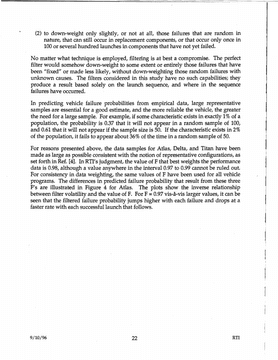
It is apparent from the data in Table 2 that estimates of future vehicle reliability depend on the filtering (i.e., weighting) technique applied. Since there are many ways to perform the filtering, all generally producing slightly different results, the choice of method to use in deriving empirical failure probabilities cannot be totally objective. Subjective decisions must also be made about which past configurations to consider as representative of future vehicles, which flight tests to include in the sample, how to weight the individual flights, and, in unusual cases, whether to consider a flight a success or a failure, and to which flight phase to attribute a failure. Except for data weighting (i.e., choice of filter), these decisions were made for Atlas, Delta, and Titan before computing the failure probabilities shown in Table 2.

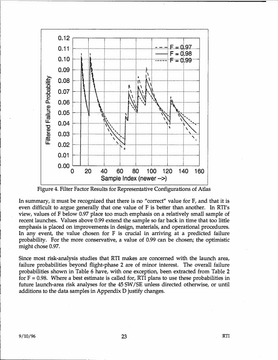
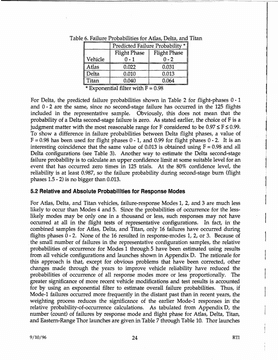
For Atlas and Delta, it can be seen from Table 2 that the predicted failure probabilities computed with the exponential filter decrease as the value of F decreases. Since a decreasing F means more emphasis on recent data and less emphasis on the old, the launch reliability for these vehicles is apparently improving. The reverse seems to be true for Titan, suggesting either that Titan reliability is not improving or, possibly, that improvements that have been or are being made to the vehicle are not yet fully reflected in the test results. For Atlas and Delta, the computed failure probabilities based on equal weighting are higher than for all other filters, and the predicted failure

9/10/96 17 RTI

PAGE 27

report

This page contains a technical analysis of failure probability filtering techniques (equal weight, index count, and exponential) applied to missile and space-vehicle flight test data, specifically comparing results for Atlas, Delta, and Titan vehicles.

probabilities using index-count filtering are larger than those for exponential filtering. For Titan, the results are mixed, further suggesting that Titan reliability has not improved in recent years.

For comparison purposes, the same filtering techniques have been applied to all flight tests shown in the tables of Appendix D, regardless of configuration. The results are presented in Table 3.

Table 3. Predicted Failure Probabilities for All Configurations

[Table data omitted for brevity]

* Includes response mode 'NA'

A comparison of Table 2 and Table 3 shows that in most cases, but not all, exponential filtering produces failure probabilities for the representative configuration samples that are smaller than the corresponding probabilities for the all-configuration samples. The fact that most differences between corresponding samples are relatively small attests to the effectiveness of the exponential filter in down-weighting early launch failures. This is not the case for equal weighting of tests, where the predicted failure probabilities based on all configurations are up to 3.6 times as large.

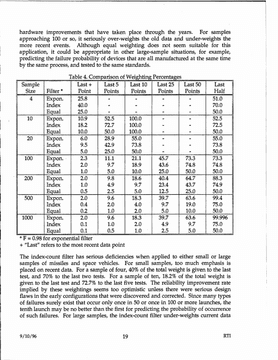
With respect to the weighting of missile and space-vehicle performance data, RTI favors an exponential filter over either the equal-weight or index-count filters. Weighting percentages for the three filters are given in Table 4 for sample sizes of 4 to 1,000. Except for small samples, the percentages produced by equal weighting place too much emphasis on old data, thus failing to account for the learning process and

9/10/96 18 RTI

PAGE 28

report

This page discusses the limitations of different weighting methods (exponential, index, and equal) for analyzing reliability data, specifically regarding missiles and space vehicles, and includes a comparison table.

hardware improvements that have taken place through the years. For samples approaching 100 or so, it seriously over-weights the old data and under-weights the more recent events. Although equal weighting does not seem suitable for this application, it could be appropriate in other large-sample situations, for example, predicting the failure probability of devices that are all manufactured at the same time by the same process, and tested to the same standards.

Table 4. Comparison of Weighting Percentages
Sample Size | Filter * | Last + Point | Last 5 Points | Last 10 Points | Last 25 Points | Last 50 Points | Last Half
4 | Expon. Index | 25.8 | - | - | - | - | 51.0
  | Index | 40.0 | - | - | - | - | 70.0
  | Equal | 25.0 | - | - | - | - | 50.0
10 | Expon. Index | 10.9 | 52.5 | 100.0 | - | - | 52.5
   | Index | 18.2 | 72.7 | 100.0 | - | - | 72.5
   | Equal | 10.0 | 50.0 | 100.0 | - | - | 50.0
20 | Expon. Index | 6.0 | 28.9 | 55.0 | - | - | 55.0
   | Index | 9.5 | 42.9 | 73.8 | - | - | 73.8
   | Equal | 5.0 | 25.0 | 50.0 | - | - | 50.0
100 | Expon. Index | 2.3 | 11.1 | 21.1 | 45.7 | 73.3 | 73.3
    | Index | 2.0 | 9.7 | 18.9 | 43.6 | 74.8 | 74.8
    | Equal | 1.0 | 5.0 | 10.0 | 25.0 | 50.0 | 50.0
200 | Expon. Index | 2.0 | 9.8 | 18.6 | 40.4 | 64.7 | 88.3
    | Index | 1.0 | 4.9 | 9.7 | 23.4 | 43.7 | 74.9
    | Equal | 0.5 | 2.5 | 5.0 | 12.5 | 25.0 | 50.0
500 | Expon. Index | 2.0 | 9.6 | 18.3 | 39.7 | 63.6 | 99.4
    | Index | 0.4 | 2.0 | 4.0 | 9.7 | 19.0 | 75.0
    | Equal | 0.2 | 1.0 | 2.0 | 5.0 | 10.0 | 50.0
1000 | Expon. Index | 2.0 | 9.6 | 18.3 | 39.7 | 63.6 | 99.996
     | Index | 0.1 | 1.0 | 2.0 | 4.9 | 9.7 | 75.0
     | Equal | 0.1 | 0.5 | 1.0 | 2.5 | 5.0 | 50.0
* F = 0.98 for exponential filter
+ "Last" refers to the most recent data point

The index-count filter has serious deficiencies when applied to either small or large samples of missiles and space vehicles. For small samples, too much emphasis is placed on recent data. For a sample of four, 40% of the total weight is given to the last test, and 70% to the last two tests. For a sample of ten, 18.2% of the total weight is given to the last test and 72.7% to the last five tests. The reliability improvement rate implied by these weightings seems too optimistic unless there were serious design flaws in the early configurations that were discovered and corrected. Since many types of failures surely exist that occur only once in 50 or once in 100 or more launches, the tenth launch may be no better than the first for predicting the probability of occurrence of such failures. For large samples, the index-count filter under-weights current data

9/10/96 19 RTI

PAGE 29

report

This page discusses the technical application of exponential filters for weighting missile and space-vehicle performance data, comparing them to index-count filters and explaining the selection of filter constants.

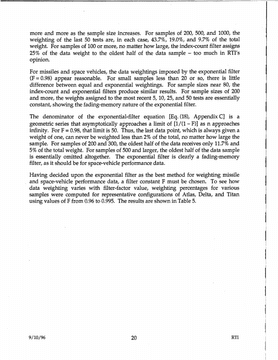
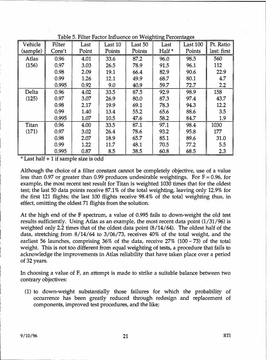
more and more as the sample size increases. For samples of 200, 500, and 1000, the weighting of the last 50 tests are, in each case, 43.7%, 19.0%, and 9.7% of the total weight. For samples of 100 or more, no matter how large, the index-count filter assigns 25% of the data weight to the oldest half of the data sample - too much in RTI's opinion.

For missiles and space vehicles, the data weightings imposed by the exponential filter (F = 0.98) appear reasonable. For small samples less than 20 or so, there is little difference between equal and exponential weightings. For sample sizes near 80, the index-count and exponential filters produce similar results. For sample sizes of 200 and more, the weights assigned to the most recent 5, 10, 25, and 50 tests are essentially constant, showing the fading-memory nature of the exponential filter.

The denominator of the exponential-filter equation [Eq. (18), Appendix C] is a geometric series that asymptotically approaches a limit of [1/(1 - F)] as n approaches infinity. For F = 0.98, that limit is 50. Thus, the last data point, which is always given a weight of one, can never be weighted less than 2% of the total, no matter how large the sample. For samples of 200 and 300, the oldest half of the data receives only 11.7% and 5% of the total weight. For samples of 500 and larger, the oldest half of the data sample is essentially omitted altogether. The exponential filter is clearly a fading-memory filter, as it should be for space-vehicle performance data.

Having decided upon the exponential filter as the best method for weighting missile and space-vehicle performance data, a filter constant F must be chosen. To see how data weighting varies with filter-factor value, weighting percentages for various samples were computed for representative configurations of Atlas, Delta, and Titan using values of F from 0.96 to 0.995. The results are shown in Table 5.

9/10/96 20 RTI

PAGE 30

report

This page presents Table 5, which details the influence of filter factors on weighting percentages for Atlas, Delta, and Titan vehicle test data, followed by an analysis of how these factors affect the weighting of recent versus older test results.

Table 5. Filter Factor Influence on Weighting Percentages
| Vehicle (sample) | Filter Cons't | Last Point | Last 10 Points | Last 50 Points | Last Half * | Last 100 Points | Pt. Ratio last: first |
| Atlas (156) | 0.96 | 4.01 | 33.6 | 87.2 | 96.0 | 98.5 | 560 |
| | 0.97 | 3.03 | 26.5 | 78.9 | 91.5 | 96.1 | 112 |
| | 0.98 | 2.09 | 19.1 | 66.4 | 82.9 | 90.6 | 22.9 |
| | 0.99 | 1.26 | 12.1 | 49.9 | 68.7 | 80.1 | 4.7 |
| | 0.995 | 0.92 | 9.0 | 40.9 | 59.7 | 72.7 | 2.2 |
| Delta (125) | 0.96 | 4.02 | 33.5 | 87.5 | 92.9 | 98.9 | 158 |
| | 0.97 | 3.07 | 26.9 | 80.0 | 87.3 | 97.4 | 43.7 |
| | 0.98 | 2.17 | 19.9 | 69.1 | 78.3 | 94.3 | 12.2 |
| | 0.99 | 1.40 | 13.4 | 55.2 | 65.6 | 88.6 | 3.5 |
| | 0.995 | 1.07 | 10.5 | 47.6 | 58.2 | 84.7 | 1.9 |
| Titan (171) | 0.96 | 4.00 | 33.5 | 87.1 | 97.1 | 98.4 | 1030 |
| | 0.97 | 3.02 | 26.4 | 78.6 | 93.2 | 95.8 | 177 |
| | 0.98 | 2.07 | 18.9 | 65.7 | 85.1 | 89.6 | 31.0 |
| | 0.99 | 1.22 | 11.7 | 48.1 | 70.5 | 77.2 | 5.5 |
| | 0.995 | 0.87 | 8.5 | 38.5 | 60.8 | 68.5 | 2.3 |
* Last half + 1 if sample size is odd

Although the choice of a filter constant cannot be completely objective, use of a value less than 0.97 or greater than 0.99 produces undesirable weightings. For F = 0.96, for example, the most recent test result for Titan is weighted 1030 times that for the oldest test; the last 50 data points receive 87.1% of the total weighting, leaving only 12.9% for the first 121 flights; the last 100 flights receive 98.4% of the total weighting thus, in effect, omitting the oldest 71 flights from the solution.

At the high end of the F spectrum, a value of 0.995 fails to down-weight the old test results sufficiently. Using Atlas as an example, the most recent data point (1/31/96) is weighted only 2.2 times that of the oldest data point (8/14/64). The oldest half of the data, stretching from 8/14/64 to 3/06/73, receives 40% of the total weight, and the earliest 56 launches, comprising 36% of the data, receive 27% (100 – 73) of the total weight. This is not too different from equal weighting of tests, a procedure that fails to acknowledge the improvements in Atlas reliability that have taken place over a period of 32 years.

In choosing a value of F, an attempt is made to strike a suitable balance between two contrary objectives:

(1) to down-weight substantially those failures for which the probability of occurrence has been greatly reduced through redesign and replacement of components, improved test procedures, and the like;

PAGE 31

report

This page discusses the methodology for filtering and weighting vehicle failure probability data, specifically addressing the use of representative samples and the selection of the variable F for Atlas, Delta, and Titan launch vehicles.

(2) to down-weight only slightly, or not at all, those failures that are random in nature, that can still occur in replacement components, or that occur only once in 100 or several hundred launches in components that have not yet failed.

No matter what technique is employed, filtering is at best a compromise. The perfect filter would somehow down-weight to some extent or entirely those failures that have been "fixed" or made less likely, without down-weighting those random failures with unknown causes. The filters considered in this study have no such capabilities; they produce a result based solely on the launch sequence, and where in the sequence failures have occurred.

In predicting vehicle failure probabilities from empirical data, large representative samples are essential for a good estimate, and the more reliable the vehicle, the greater the need for a large sample. For example, if some characteristic exists in exactly 1% of a population, the probability is 0.37 that it will not appear in a random sample of 100, and 0.61 that it will not appear if the sample size is 50. If the characteristic exists in 2% of the population, it fails to appear about 36% of the time in a random sample of 50.

For reasons presented above, the data samples for Atlas, Delta, and Titan have been made as large as possible consistent with the notion of representative configurations, as set forth in Ref. [4]. In RTI's judgment, the value of F that best weights the performance data is 0.98, although a value anywhere in the interval 0.97 to 0.99 cannot be ruled out. For consistency in data weighting, the same values of F have been used for all vehicle programs. The differences in predicted failure probability that result from these three F's are illustrated in Figure 4 for Atlas. The plots show the inverse relationship between filter volatility and the value of F. For F = 0.97 vis-à-vis larger values, it can be seen that the filtered failure probability jumps higher with each failure and drops at a faster rate with each successful launch that follows.

9/10/96 22 RTI

PAGE 32

report

This page contains a graph titled 'Figure 4. Filter Factor Results for Representative Configurations of Atlas' and accompanying text discussing the selection of the 'F' value for risk-analysis studies conducted by RTI.

Figure 4. Filter Factor Results for Representative Configurations of Atlas

In summary, it must be recognized that there is no "correct" value for F, and that it is even difficult to argue generally that one value of F is better than another. In RTI's view, values of F below 0.97 place too much emphasis on a relatively small sample of recent launches. Values above 0.99 extend the sample so far back in time that too little emphasis is placed on improvements in design, materials, and operational procedures. In any event, the value chosen for F is crucial in arriving at a predicted failure probability. For the more conservative, a value of 0.99 can be chosen; the optimistic might chose 0.97.

Since most risk-analysis studies that RTI makes are concerned with the launch area, failure probabilities beyond flight-phase 2 are of minor interest. The overall failure probabilities shown in Table 6 have, with one exception, been extracted from Table 2 for F = 0.98. Where a best estimate is called for, RTI plans to use these probabilities in future launch-area risk analyses for the 45 SW/SE unless directed otherwise, or until additions to the data samples in Appendix D justify changes.

9/10/96 23 RTI

PAGE 33

report

This page discusses failure probabilities for Atlas, Delta, and Titan launch vehicles, specifically focusing on flight phases and response modes, and references data from Appendix D.

Table 6. Failure Probabilities for Atlas, Delta, and Titan

| Vehicle | Predicted Failure Probability * |
| :--- | :--- | :--- |
| | Flight Phase 0 - 1 | Flight Phase 0 - 2 |
| Atlas | 0.022 | 0.031 |
| Delta | 0.010 | 0.013 |
| Titan | 0.040 | 0.064 |

* Exponential filter with F = 0.98

For Delta, the predicted failure probabilities shown in Table 2 for flight-phases 0 - 1 and 0 - 2 are the same, since no second-stage failure has occurred in the 125 flights included in the representative sample. Obviously, this does not mean that the probability of a Delta second-stage failure is zero. As stated earlier, the choice of F is a judgment matter with the most reasonable range for F considered to be 0.97 ≤ F ≤ 0.99. To show a difference in failure probabilities between Delta flight phases, a value of F = 0.98 has been used for flight phases 0 - 1, and 0.99 for flight phases 0 - 2. It is an interesting coincidence that the same value of 0.013 is obtained using F = 0.98 and all Delta configurations (see Table 3). Another way to estimate the Delta second-stage failure probability is to calculate an upper confidence limit at some suitable level for an event that has occurred zero times in 125 trials. At the 80% confidence level, the reliability is at least 0.987, so the failure probability during second-stage burn (flight phases 1.5 - 2) is no bigger than 0.013.

5.2 Relative and Absolute Probabilities for Response Modes

For Atlas, Delta, and Titan vehicles, failure-response Modes 1, 2, and 3 are much less likely to occur than Modes 4 and 5. Since the probabilities of occurrence for the less-likely modes may be only one in a thousand or less, such responses may not have occurred at all in the flight tests of representative configurations. In fact, in the combined samples for Atlas, Delta, and Titan, only 16 failures have occurred during flights phases 0 - 2. None of the 16 resulted in response-modes 1, 2, or 3. Because of the small number of failures in the representative configuration samples, the relative probabilities of occurrence for Modes 1 through 5 have been estimated using results from all vehicle configurations and launches shown in Appendix D. The rationale for this approach is that, except for obvious problems that have been corrected, other changes made through the years to improve vehicle reliability have reduced the probabilities of occurrence of all response modes more or less proportionally. The greater significance of more recent vehicle modifications and test results is accounted for by using an exponential filter to estimate overall failure probabilities. Thus, if Mode-1 failures occurred more frequently in the distant past than in recent years, the weighting process reduces the significance of the earlier Mode-1 responses in the relative probability-of-occurrence calculations. As tabulated from Appendix D, the number (count) of failures by response mode and flight phase for Atlas, Delta, Titan, and Eastern-Range Thor launches are given in Table 7 through Table 10. Thor launches

9/10/96 24 RTI

PAGE 34

report

This page contains statistical tables detailing failure-response modes for Atlas, Delta, Titan, and Eastern-Range Thor launch vehicles.

from the Western Range were not included since available performance records were incomplete. The results for the four vehicles are combined in Table 11. Table 12 gives last-occurrence dates by response mode for each launch vehicle.

Table 7. Number of Atlas Failures - All Configurations (532 Flights)
Flight Failure-Response Mode 3 & 4
Phase 1 2 3 4 5 'NA' Tumble
0 0 0 0 0 0 0 0
0 - 1 7 1 2 38 8 4 11
0 - 2 7 1 2 66 15 13 19
0 - 3 7 1 2 86 15 18 25
0 - 4 7 1 2 89 15 21 27
0 - 5 7 1 2 89 15 23 27

Table 8. Number of Delta Failures - All Configurations (232 Flights)
Flight Failure-Response Mode 3 & 4
Phase 1 2 3 4 5 'NA' Tumble
0 0 0 0 0 0 0 0
0 - 1 0 0 0 2 2 5 0
0 - 2 0 0 0 4 2 10 1
0 - 3 0 0 0 7 3 12 1
0 - 4 0 0 0 7 3 13 1
0 - 5 0 0 0 7 3 15 1

Table 9. Number of Titan Failures - All Configurations (337 Flights)
Flight Failure-Response Mode 3 & 4
Phase 1 2 3 4 5 'NA' Tumble
0 0 0 0 3 0 0 1
0 - 1 2 2 0 13 1 0 5
0 - 2 2 2 0 39 5 3 10
0 - 3 2 2 0 46 5 5 11
0 - 4 2 2 0 47 5 7 11
0 - 5 2 2 0 47 5 10 11

Table 10. Number of Eastern-Range Thor Failures (85 Flights)
Flight Failure-Response Mode 3 & 4
Phase 1 2 3 4 5 'NA' Tumble
0 0 0 0 0 0 0 0
0 - 1 4 1 1 15 4 1 3
0 - 2 4 1 1 20 5 3 3
0 - 3 4 1 1 22 5 3 3
0 - 4 4 1 1 22 5 4 3
0 - 5 4 1 1 22 5 5 3

9/10/96 25 RTI

PAGE 35

report

This page presents statistical tables regarding failure-response modes for various launch vehicles and discusses the methodology for estimating relative probabilities of these failures using an exponential filter.

Table 11. Number of Failures for All Vehicles (1186 Flights)
Flight Failure-Response Mode 3 & 4
Phase 1 2 3 4 5 'NA' Tumble
0 0 0 0 3 0 0 1
0 - 1 13 4 3 68 15 11 19
0 - 2 13 4 3 129 27 29 33
0 - 3 13 4 3 161 28 38 40
0 - 4 13 4 3 165 28 45 42
0 - 5 13 4 3 165 28 53 42

Table 12. Date of Most Recent Failure
Response Vehicle
Mode Atlas Delta Titan Thor *
1 03/02/65 none 12/12/59 04/19/58
2 12/18/81 none 05/01/63 12/30/58
3 04/25/61 none none 07/21/59
4 08/22/92 05/03/86 10/05/93 03/24//64
5 12/08/80 08/27/69 11/30/65 01/24/62
* Last Thor launch was 02/23/65

For the reasons advanced previously, an exponential filter has been used to estimate relative probabilities of occurrence for Modes 1 through 5 and the fraction of Mode-3 and Mode-4 failures that tumble while the vehicle is thrusting. The percentage weightings for various data samples are shown in Table 13 for values of F from 0.980 to 0.999. Because of the large size of the composite sample (1186), the filter-control constant of 0.98 used previously to estimate absolute failure probabilities for individual vehicles does not seem suitable for estimating relative probabilities for the individual response modes. Use of 0.98 would effectively place 98.2% of the total weight on the most recent 200 tests thus, in effect, eliminating the earliest 986 tests from the solution. These are the very tests needed to provide an adequate sample of failures from which to estimate relative frequencies of occurrence of the individual response modes.

PAGE 36

report

This page presents statistical analysis of launch data using different filter factors to weight recent versus older data, including tables showing percentage weighting and response-mode occurrence percentages.

Table 13. Percentage Weighting for Sample of 1186 Launches
Filter Constant | Last Point | Last 100 Points | Last 200 Points | Last 300 Points | Last 500 Points | Point Ratio Last:First
0.999 | 0.14 | 13.7 | 26.1 | 37.3 | 56.7 | 3.3
0.996 | 0.40 | 33.3 | 55.6 | 70.6 | 87.3 | 1.2 x 10^2
0.995 | 0.50 | 39.5 | 63.5 | 78.0 | 92.1 | 3.8 x 10^2
0.994 | 0.60 | 45.3 | 70.0 | 83.6 | 95.1 | 1.3 x 10^3
0.993 | 0.70 | 50.5 | 75.5 | 87.9 | 97.0 | 4.2 x 10^3
0.992 | 0.80 | 55.2 | 79.9 | 91.0 | 98.2 | 1.4 x 10^4
0.991 | 0.90 | 59.5 | 83.6 | 93.4 | 98.9 | 4.5 x 10^4
0.990 | 1.00 | 63.4 | 86.6 | 95.1 | 99.3 | 1.5 x 10^5
0.980 | 2.00 | 86.7 | 98.2 | 99.8 | 99.996 | 3.9 x 10^11

The value of F = 0.999 is considered inappropriate because, as seen in Table 13, the weighting factor applied to the most recent datum is only 3.3 times that applied to the oldest test result from 39 years ago. The most recent 200 and 300 points in the sample comprising 16.8% and 25.2% of the data receive only 26.1% and 37.3% of the total weight. This is not too different from equal weighting of data, which is appropriate only if the relative frequency of occurrence of each response mode has not changed significantly through the years. On the other hand, use of F = 0.99 effectively throws out the oldest 600 to 700 launches that are sorely needed for an adequate sample size.

The results of the filtering process are given in Table 14 for failures during flight phases 0 - 2.

Table 14. Response-Mode Occurrence Percentages
Filter Factor | Response Mode 1 | Response Mode 2 | Response Mode 3 | Response Mode 4 | Response Mode 5
0.999 | 7.39 | 2.27 | 1.70 | 73.30 | 15.34
0.996 | 2.24 | 4.35 | 0.37 | 80.37 | 12.67
0.995 | 1.32 | 4.92 | 0.19 | 82.59 | 10.98
0.994 | 0.73 | 5.26 | 0.09 | 84.57 | 9.35
0.993 | 0.39 | 5.37 | 0.04 | 86.25 | 7.95
0.992 | 0.20 | 5.31 | 0.02 | 87.68 | 6.78
0.991 | 0.11 | 5.13 | 0.01 | 88.92 | 5.84
0.990 | 0.05 | 4.87 | 0.00 | 90.02 | 5.06
0.980 | 0.00 | 1.86 | 0.00 | 96.81 | 1.33

The results in Table 14 show that the percentages of occurrence for response-modes 2 and 4 are relatively insensitive to filter-factor values, while the percentages for Modes 1, 3, and 5 decrease as filter memory (filter factor) decreases. This suggests that occurrences of Modes 1, 3, and 5 have been decreasing over the years, while Modes 2 and 4 occurrences have not changed much. Although it cannot be argued convincingly

9/10/96 27 RTI

PAGE 37

report

This page discusses the methodology for calculating failure-response mode percentages for various launch vehicles (Atlas, Delta, Titan, Thor) using different filter constants (F values) and provides a table of recommended percentages for flight phases 0-2.

that 0.993 is superior to 0.992 or 0.994, or even values outside this interval, a value of 0.993 was chosen.

This section has thus far described a rationale for selecting a filtering process and filter constant to estimate percentages of occurrence of failure-response modes for Atlas, Delta, and Titan launch vehicles. These are mature launch systems with improved reliability as a result of years of experience and corrections of problems. Although the designs of new launch vehicles may be based to some extent on mature systems, new systems are expected to fail at a higher rate. For vehicles with liquid-propellant stages burning at liftoff, the percentages of occurrence of the various response modes are more likely to be similar to the earlier versions of Atlas, Delta, and Titan than to current vehicles. For lack of any other data, for such new liquid-propellant systems the relative percentages for the five failure-response modes have been calculated using the total combined sample of Atlas, Delta, Titan, and Thor with a filter constant of 0.999 (almost equal weighting).

For new solid-propellant vehicles, use of F = 0.999 results in a Mode-1 percentage that seems much too high. All of the 13 Mode-1 failures in the composite sample (Table 11) involved liquid-propellant vehicles, whereas none of the Atlas, Delta, or Titan configurations with solid-propellant boosters have experienced a Mode-1 response. On the other hand, use of F = 0.993 that is applied for mature launch systems seems to reduce the probability of a Mode-5 response too much, since a Red Tigress vehicle and a Joust vehicle launched at the Cape in 1991 both experienced Mode-5 failure responses (see Section 2). As a compromise between new and mature liquid-propellant vehicles, a value of F = 0.996 has been assumed for new solid-propellant vehicles. The percentages shown in Table 15 for flight phases 0 - 2 have been obtained from Table 14. Similar information for flight phases 0 - 1 are given in Table 16. In future risk studies for the 45 SW/SE, RTI plans to use these relative percentages for mature and new systems.

Table 15. Recommended Response-Mode Percentages for Flight Phases 0 - 2
Response Mature Launch New Solid Systems New Liquid Systems
Mode Systems (F = 0.993) (F = 0.996) (F = 0.999)
1 0.4 2.2 7.4
2 5.4 4.3 2.3
3 0.1 0.4 1.7
4 86.2 80.4 73.3
5 7.9 12.7 15.3

9/10/96 28 RTI

PAGE 38

report

This page presents statistical tables (Table 16 and Table 17) regarding recommended response-mode percentages and absolute failure probabilities for various launch vehicles (Atlas, Delta, Titan) across different flight phases.

Table 16. Recommended Response-Mode Percentages for Flight Phases 0 - 1

| Response Mode | Mature Launch Systems (F = 0.993) | New Solid Systems (F = 0.996) | New Liquid Systems (F = 0.999) |
| :--- | :--- | :--- | :--- |
| 1 | 0.5 | 3.4 | 10.7 |
| 2 | 7.4 | 6.6 | 4.3 |
| 3 | 0.1 | 0.6 | 2.4 |
| 4 | 81.9 | 74.5 | 67.0 |
| 5 | 10.1 | 14.9 | 15.6 |

Absolute probabilities of occurrence for response Modes 1 through 5 can be obtained by multiplying the absolute failure probabilities for flight phases 0 - 1 and 0 - 2 (Table 6) by the relative failure probabilities in Table 15 and Table 16. The results are shown in Table 17. Probabilities are listed to six decimal places to show differences, not because all figures are actually significant. To obtain these results, more precise values for relative probabilities of occurrence were used than shown in Table 15 and Table 16.

Table 17. Absolute Failure Probabilities for Response Modes 1 - 5

| Vehicle: | Atlas | Delta | Titan |
| :--- | :--- | :--- | :--- | :--- | :--- | :--- |
| Flight Phase: | 0 - 1 (0-170 sec) | 0 - 2 (0-280 sec) | 0 - 1 (0-270 sec) | 0 - 2 (0-630 sec) | 0 - 1 (0-300 sec) | 0 - 2 (0-540 sec) |
| Mode 1 | 0.000119 | 0.000121 | 0.000054 | 0.000051 | 0.000216 | 0.000250 |
| Mode 2 | 0.001637 | 0.001665 | 0.000744 | 0.000698 | 0.002976 | 0.003437 |
| Mode 3 | 0.000011 | 0.000012 | 0.000005 | 0.000005 | 0.000020 | 0.000026 |
| Mode 4 | 0.018007 | 0.026738 | 0.008185 | 0.011212 | 0.032740 | 0.055200 |
| Mode 5 | 0.002226 | 0.002465 | 0.001012 | 0.001034 | 0.004048 | 0.005088 |
| Total | 0.022 | 0.031 | 0.010 | 0.013 | 0.040 | 0.064 |

For each vehicle, the absolute probabilities for Modes 1, 2, and 3 differ slightly for flight phases 0 - 1 and 0 - 2. This difference is due to the unequal data weighting produced by the exponential filter. If equal data weighting had been applied, the absolute probabilities for these modes would have been identical as expected, since Modes 1, 2, and 3 cannot occur beyond flight phase 1.

Differences in absolute probabilities for Modes 4 and 5 for flight phases 0 - 1 and 0 - 2 can also be seen in the table. A part of this difference may result from unequal data weighting, but primarily it is due to the obvious fact that fewer Mode 4 and 5 failures have occurred during flight phase 0 - 1 than during the longer span of flight phase 0 - 2.

9/10/96 29 RTI

PAGE 39

report

This page discusses the statistical probability of thrusting tumbles for Mode-3 and Mode-4 flight responses, presenting data in Table 18 and concluding that RTI will assume a one-third failure rate for future studies.

5.3 Relative Probability of Tumble for Response-Modes 3 and 4

Exponential filters with values of F from 0.98 to 0.999 have been used to estimate the percentage of Mode-3 and Mode-4 responses that terminate with a thrusting tumble. Results are given in Table 18 for flight phases 0 - 2 and 0 - 5. For launch-area risk calculations, only flight phases 0 - 2 are of interest. The data sample was a chronological composite of all Atlas, Delta, Titan, and Thor tests and configurations shown in Appendix D. To several decimal places at least, the values in the table are determined entirely from Mode-4 responses, since the last vehicle to experience a Mode-3 response (4/25/61) is weighted out of the solution. The results in Table 18 are based on a total sample size of 1,186 flight tests.

Table 18. Percent of Response Modes 3 and 4 That Tumble
Filter Factor | Flight Phases 0 - 2 | Flight Phases 0 - 5
0.999 | 25.0 | 25.0
0.996 | 26.3 | 27.0
0.993 | 27.3 | 28.6
0.990 | 28.3 | 30.1
0.980 | 31.3 | 34.8

Through flight phase 2, there were 33 tumbles out of a total of 132 Mode-3 and Mode-4 responses. Through flight phase 5, there were 42 tumbles out of 168 Mode-3 and Mode-4 responses.

As seen from Table 13, the smaller the filter factor, the greater the weight placed on recent test data. In view of this, it is apparent from Table 18 that the percentage of Mode-4 responses that end with a thrusting tumble has been increasing gradually. The same conclusion is reached for flight phases 0 - 2 and 0 - 5. In recognition of this gradual increase, in future studies RTI will assume that approximately one-third of Mode-3 and Mode-4 failure responses end with a thrusting tumble.

9/10/96 30 RTI

PAGE 40

report

This page describes the methodology for simulating Mode-5 failure responses, specifically focusing on random-attitude and slow-turn failures using the RAFIP program.

6. Shaping Constants Through Simulation

Since adequate test data are not available to establish the Mode-5 shaping constants empirically, other methods are needed for this purpose. It will be recalled that, after vehicle pitchover, any malfunction with the potential to cause a substantial deviation from the intended flight line is, by definition, a Mode-5 failure response. The malfunction need not actually cause a large deviation to be classified as a Mode-5 response. One such class of failures leading to a Mode-5 response has been termed a random-attitude failure. Such responses can result from guidance and control failures that lead to erroneous orientation of the guidance platform or an erroneous spatial target. Another class of failures that can cause sustained deviation away from the flight line is the slow turn, where the engine nozzle, in effect, locks in some fixed position, generally but not necessarily near null. Both types of malfunctions have been investigated in an attempt to estimate numerical values for Mode-5 shaping constants A and B. Basically, the idea is to (1) run a large sample of random-attitude and slow-turn failures, (2) calculate the percentages of impacts in five-degree sectors from 0° to 180°, (3) compare these percentages with those obtained from the Mode-5 impact density function when specific values are assigned to A and B, and (4) assign values to A and B until the best possible fit is obtained between the simulated-turn impacts and the theoretical Mode-5 impacts.

6.1 Malfunction Turn Simulations

6.1.1 Random-Attitude Failures

A guidance and control failure leading to a fixed erroneous direction of thrust is termed a random-attitude failure. Such failures represent a subset of possible Mode-5 failure responses. Random-attitude failures can be used to establish the maximum possible region of impact, given that a vehicle has flown normally for a specified period of time. For this purpose RTI has developed a Random-Attitude Failure Impact Point (RAFIP) program written in Fortran (3900 lines of code) for execution on a personal computer.

Using a Monte Carlo approach, program RAFIP first selects a starting time and then a random thrust direction on the attitude sphere, with all directions having the same chance of being chosen. Each Monte-Carlo run is begun using the nominal vehicle position and velocity at the selected start time, assuming an instantaneous change in thrust direction. Thrust is applied continuously in the selected random direction, and the equations of motion are numerically integrated until one of four conditions is satisfied: (1) final stage burnout occurs, (2) the vehicle impacts while thrusting, (3) orbital insertion occurs, (4) the vehicle breaks up due to aerodynamic forces

For conditions (1) and (4), the trajectory is extended to impact using Kepler's equations. For condition (3), an impact point does not exist. The process just described is repeated

9/10/96 31 RTI

PAGE 41

report

This page details the methodology for calculating impact points for random-attitude and slow-turn vehicle failures, specifically referencing the use of the RAFIP program for risk analysis.

for a suitably large sample so the distribution of resulting impact points will, for all practical purposes, represent all possible impact points, irrespective of the actual nature of the failure.

Depending on vehicle breakup characteristics and failure time, a vehicle that experiences a random-attitude failure may break up at the instant of failure, or after a few seconds into the turn, or not at all. In making the calculations, three separate breakup thresholds and a no-breakup case were investigated. With respect to vehicle breakup, the assumption was made that the vehicle would break up if qα exceeded a specified constant limit, where q is the dynamic pressure and α is the total angle of attack. Although the breakup qα may well be a complicated function of Mach number and other parameters, this simplistic approach was taken.

Random-attitude-failure calculations were made individually for Atlas, Delta, Titan, and LLV1 starting shortly after pitchover and continuing to some convenient time such as a stage burnout when the vehicle could no longer endanger the launch area. Theoretically, the Mode-5 impact density function extends downrange until the instantaneous impact point vanishes. Since this study is concerned with evaluation of density-function parameters for launch-area risk analysis, the random-attitude calculations were stopped at a staging event when the vehicle no longer had sufficient energy to return the impact point to the launch area. Using trajectory data for each vehicle, program RAFIP was run to generate 10,000 impact-point samples at each starting time. Calculations were made at ten-second intervals.

6.1.2 Slow-Turn Failures

Certain types of guidance and control failures can cause the thrusting engine to gimbal to null or a near-null position. Such failures can produce what is herein called a slow turn. For various reasons, after an engine is commanded to null it may not thrust precisely through the center of gravity, e.g., structural misalignments, shifting center of gravity, canted nozzles. Since, like random-attitude failures, slow turns constitute a subset of Mode-5 failure responses, they have been investigated using RTI program RAFIP. The following assumptions have been made in making the calculations:

(1) The effective thrust offset of a “nulled” engine is normally distributed with a zero mean and a standard deviation of 0.1°.

(2) A fixed thrust offset results in a constant angular acceleration of the airframe, and thus a constant angular acceleration of the thrust vector.

(3) For small thrust misalignments, the angular acceleration of the airframe is proportional to the angular thrust misalignment.

At each time point, the angular acceleration produced by small thrust offsets was estimated from the malfunction turn data provided to the safety office by the range user. Malfunction turns for the Atlas IIAS were provided for three gimbal angles, the smallest being one degree. For each gimbal angle, the results were plotted as

9/10/96 32 RTI

PAGE 42

report

This page details the mathematical methodology for calculating angular acceleration during tumble turns and slow turns for the Atlas IIAS, as part of a larger analysis of Mode-5 failure responses.

cumulative angle turned versus time. Since the slope of the curve (i.e., the turning rate) is greatest when the thrust (and thus airframe) is directed at right angles to the velocity vector, the average angular acceleration during the first 90° of rotation was obtained from the equation

θ = 1/2 θ̈ t² (4)

so that

θ̈ = 2 θ (deg) / t² (sec²) = 180 deg / t² sec² (5)

where t is the elapsed time from the beginning of the tumble turn until the airframe has rotated approximately 90°. If the assumption is made that the angular acceleration is directly proportional to the thrust offset angle (i.e., nozzle deflection), the angular acceleration θ̈d for any small deflection angle becomes

θ̈d = θ̈ δd / δ (6)

where θ̈ is the angular acceleration computed from Eq. (5) for deflection angle δ (1° for Atlas IIAS), and δd is some small deflection angle.

Using the Atlas IIAS data, angular accelerations θ̈ were computed at ten-second intervals from the programming time of 15 seconds to 275 seconds for δ = 1°. For each starting time, a normal distribution with zero mean and a standard deviation of 0.1° was sampled to obtain an initial thrust misalignment δd to substitute in Eq. (6). The resulting angular acceleration θ̈d was applied throughout the turn. Slow-turn calculations were made in a manner analogous to the random-attitude turns, using the reference trajectory to obtain the starting position and velocity components. The slow turn was assumed to occur in a randomly oriented plane containing the starting velocity vector. Each turn was carried out until one of the four conditions listed in Section 6.1.1 for random-attitude turns was met. For conditions (1) and (4), impact points were calculated and, along with thrusting impacts from condition (2), summed for each five-degree sector from 0° to 175°. At each starting time, 10,000 impact-point calculations were made.

6.1.3 Factors Affecting Malfunction-Turn Results

Random-attitude turns and slow turns are only subsets of the totality of Mode-5 failure responses. As discussed earlier in Section 3, other types of behavior following a Mode-5 failure are numerous and largely impossible to categorize, much less simulate. Ideally, impact distributions from all types of Mode-5 responses should be combined before results are compared with those obtained from the theoretical Mode-5 impact

PAGE 43

report

This page details the methodology for simulating malfunction turns in aerospace vehicles, specifically discussing weighting of turn data, vehicle breakup criteria (qα), and the impact of end time (TB) on simulation results.

density function. Since this could not be done in general, impacts from only the two types of malfunction turns were considered. Several factors affect the results of the simulations:

a. Weighting of turn data: Both random-attitude and slow-turn simulations were made for Atlas IIAS. In combining impacts from the two data sets, random-attitude turns were assumed to be three times as likely to occur as slow turns. A factor of three was selected since, among the Mode-5 failure responses in the performance summaries for Atlas, Delta, and Titan, random-attitude turns appeared to occur about three times as often as slow turns. In many cases, lack of detailed information made it difficult to decide whether a Mode-5 response should be considered as a random-attitude turn, a slow turn, or some other type of failure. The relative weighting of turns makes little difference, however, since the impact distribution for the two types of turns are similar (as shown later in Figure 5), and since the weighted composite must lie between the two. It was assumed that similar results would be obtained for Delta, Titan, and LLV1, so slow-turn computations were not made for these vehicles, cutting the number of time-consuming simulations in half.

b. Breakup qα: In the turn calculations, the assumption was made that vehicle breakup would occur if a certain value of qα was reached. In addition to the no-breakup case which is considered unrealistic, separate runs were made for three constant values of qα: 5,000, 10,000, and 20,000 deg-lb/ft². As stated previously, the determination of vehicle breakup is, in reality, much more involved than this simplistic approach would suggest. However, to add realism to the malfunction-turn calculations, use of a simple approach seemed better than none at all. For Titan IV, allowable (but not breakup) qα's were provided as functions of Mach number. The maximum permissible value and corresponding Mach number for Titan/Centaur, Titan/NUS, and Titan/IUS were, respectively, 6819 deg-lb/ft² at Mach No. 0.77, 5332 deg-lb/ft² at Mach No. 0.815, and 17,000 deg-lb/ft² at Mach No. 0.325. For Atlas, Delta, and LLV1 vehicles, no breakup qα data were available. The breakup qα's used in the calculations bracket the range of permissible qα's for the Titan vehicles.

c. End time TB: The simulated impact distributions from random-attitude failures and slow turns were compared with impact distributions computed from the Mode-5 theoretical impact-density function. For the comparisons to be meaningful, the value selected for TB in the Mode-5 impact-density equation and the stop time for thrusting-turn simulations must be the same. To some extent, the shaping constants A and B derived by fitting the theoretical and simulated impact data depend on TB, since the percentage of impacts in each 5° sector depends on TB. However, after A and B have been established for a particular TB, using a different TB in the DAMP calculations has no effect on computed risks provided an adjustment is made in the probability of occurrence of a Mode-5

PAGE 44

report

This page discusses technical calculations regarding Mode-5 responses, destruct actions, vacuum calculations for vehicle breakup, and malfunction-turn results for the Atlas IIAS launch vehicle.

response. Referring to Eq. (3), the right-hand member must be multiplied by the probability p₅ of a Mode-5 response to obtain absolute probabilities. Except for T_B itself (and to a slight degree, shaping constants A and B), the quantities in the equation do not depend on T_B. Thus if T_B and p₅ are both changed so that p₅/(T_B - T_p) remains constant, the computed risks are unchanged.

If destruct action (i.e., impact limit lines) is included in the DAMP calculations, the supplemental risks* resulting from that action must be accounted for. In this case, the termination time has a minor influence on results, since it affects the number of impacts that would occur beyond the impact limit lines without destruct that are forced inside when destruct action is taken. If destruct action is omitted, the value of T_B is immaterial (i.e., supplemental Mode-5 risks are non-existent) provided that the impact range along the reference trajectory at time T_B exceeds the range to all targets of interest. (Except in this paragraph, supplemental Mode-5 risks are not addressed in this present report.)

d. Vacuum calculations: Atmospheric effects were accounted for in determining when vehicle breakup would occur and, to some extent, during each thrusting turn by using accelerations from the nominal trajectory. To reduce computer time and cost of this study, vacuum calculations were made during free fall after vehicle breakup or burnout. Although this increased impact dispersions somewhat, vacuum results should not be drastically different from those obtainable using a maximum-beta piece. In theory at least, different mode-5 shaping constants exist for each debris class. In view of the uncertainties in vehicle breakup conditions and characteristics, and in the overall process of simulating Mode-5 malfunctions, attempts to derive unique shaping constants for each debris class did not seem justified.

6.1.4 Malfunction-Turn Results for Atlas IIAS

For Atlas IIAS, the distribution of impacts for simulated random-attitude turns, slow turns, and a weighted combination (75% random-attitude and 25% slow turn) are shown in Figure 5. Since the impact distribution (i.e., the percentages of impacts in 5° sectors) for the weighted composite was not significantly different from that for random-attitude failures, slow-turn computations were not made for Delta, Titan, and LLV1.

* See Ref. [1], Section 10.

9/10/96 35 RTI

PAGE 45

diagram

This page contains a technical graph titled 'Figure 5. Combined Random-Attitude and Slow-Turn Results' illustrating Atlas IIAS failure data.

Atlas IIAS Failures through 280 sec
Breakup q-alpha = 20,000 deg-lb/ft^2
  o Random-attitude turns
  [ ] Slow turns
  v Combined turns (0.75 random + 0.25 slow)

Figure 5. Combined Random-Attitude and Slow-Turn Results

9/10/96 36 RTI

PAGE 46

report

This page discusses the simulation of Atlas IIAS vehicle breakups based on dynamic pressure constants (q-alpha) and presents a graph showing breakup percentages over time.

6.2 Shaping Constants for Atlas IIAS

6.2.1 Optimum Mode-5 Shaping Constants

Since the dynamic pressures that can cause the Atlas IIAS to break up were not available, random-attitude failures were simulated for a no-breakup case and for three breakup qα’s: 20,000 deg-lb/ft², 10,000 deg-lb/ft², and 5,000 deg-lb/ft². For each case, 270,000 trajectories were run, giving a total of 1,080,000. It turned out that the value chosen for the breakup qα was critical in determining shaping constant A, since the lower the qα, the less the thrusting time before breakup, and the higher the percentages of impacts in sectors near the flight line.

For Atlas IIAS, the effects of qα on breakup are shown in Figure 6 where, for the selected qα’s, the percentages of random-attitude turns that result in breakup before 280 seconds are plotted against failure time.

[DIAGRAM: A line graph titled "Figure 6. Atlas IIAS Breakup Percentages for Random-Attitude Turns" showing Breakup Percent (%) vs Failure Time (sec) for three q-alpha values: 5,000, 10,000, and 20,000 deg-lb/ft².]

For failures between 10 and 30 seconds, most breakups do not occur at failure, but later in flight after the vehicle has built up significant velocity. For failures between 40 and 105 seconds, more than 80% breakup occurs, even for qα’s as high as 20,000 deg-lb/ft².

9/10/96 37 RTI

PAGE 47

report

This page describes the methodology for analyzing impact distributions and failure patterns of the Atlas IIAS vehicle, specifically referencing Figures 7 and 8 and Table 19.

In this region, breakup occurs at or shortly after vehicle failure. Beyond 170 seconds, the dynamic pressure between failure and 280 seconds stays sufficiently low so that the vehicle remains intact.

The dramatic differences in impact distributions that can result at certain times during flight if the vehicle is subject to aerodynamic breakup can be seen by comparing the impact footprints in Figure 7 and Figure 8. Both patterns show 10,000 impact points from random-attitude failures of the Atlas IIAS at 130 seconds. Figure 7 is for no breakup, and Figure 8 is for a breakup qα of 5,000 deg-lb/ft².

The data in Table 19 comprise an example of a 270,000-point sample of random-attitude failures run at 10-second intervals from 15 to 275 seconds. (For brevity, only every-other failure time is shown in the table.) Ten thousand impacts are computed at each failure time. Five-degree sectors are identified in the left-hand column. For each time, the number of impacts in each 5° sector is shown in the column for that time. The total number of impacts for all failure times and the percentages of impacts in each sector are given in the last two columns of the table.

9/10/96 38 RTI

PAGE 48

diagram

This page contains a diagram labeled Figure 7, showing Atlas IIAS impact points under specific failure conditions.

Atlas IIAS Impacts
Random-Attitude Failures at 130 sec.
Thrust to 280 sec.
No Breakup

Figure 7. Atlas IIAS Impacts with No Breakup

9/10/96 39 RTI

PAGE 49

diagram

This page contains a map diagram labeled 'Figure 8' showing Atlas IIAS impact points with specific failure and breakup parameters.

Atlas IIAS Impacts
Random-Attitude Failures at 130 sec.
Thrust to 280 sec.
Breakup q-alpha = 5,000 deg-lb/ft2

Figure 8. Atlas IIAS Impacts with Breakup

9/10/96 40 RTI

PAGE 50

report

This page contains a technical table titled 'Table 19. Sample Impact Distribution for Atlas IIAS with No Breakup' detailing numerical data related to impact failure times.

Table 19. Sample Impact Distribution for Atlas IIAS with No Breakup

[Table data omitted for brevity, containing numerical impact distribution data]

9/10/96 41 RTI

PAGE 51

report

This page presents Figure 9, a graph showing Atlas IIAS simulation results for impact percentages in 5-degree sectors, along with an analysis of the curve fitting for variable A.

In Figure 9, the percentages of impacts in 5° sectors from 0° to 180° have been plotted for Atlas IIAS random-attitude turns out to 280 seconds. (It should be remembered that random-attitude turns are representative of combined random-attitude and slow turns.) For B = 1000, theoretical Mode-5 impact percentages are also plotted in the figure for best-fit values of A obtained by trial and error.

[GRAPH: Atlas IIAS Random-Attitude Failures through 280 sec]

Figure 9. Atlas IIAS Simulation Results with B = 1,000

By observing curve shapes, it can perhaps be seen that no single value of A causes a theoretical impact distribution and a distribution of impacts from random-attitude turns to match closely over the entire range of 5° sectors. Attempts to improve the match on one end of the curve by selecting a different A merely degrades the match on

9/10/96 42 RTI

PAGE 52

report

This page discusses technical data matching for Mode-5 and Mode-4 failure responses in the context of Atlas IIAS launch risk analysis, specifically addressing discrepancies in impact distributions near the flight line.

the other end. It is possible, however, to obtain fairly close agreement over sectors* from ±80° to ±180°, as seen in Figure 9. Since for Atlas IIAS there are few, if any, significant population centers in the launch area outside these sectors (i.e., within ±80° of the flight line), failure of the curves to match closely near the flight line is of little consequence. If a better data match is considered desirable for computing risks to population centers within ±80° of the flight line (e.g., ships), either a different A can be selected for use with B = 1,000 or other values of A and B can be derived. If only a single value of B is used, no matter what the value, a good match between theoretical and simulated data is not possible over the entire 180° sector for various breakup qa’s.

Before becoming too concerned about lack of a data match between 0° and 80°, it should be remembered that many types of Mode-5 responses cannot be simulated, so that the malfunction-turn impact distributions plotted in Figure 9 are only a subset of all possible Mode-5 impacts. Based on twelve Mode-5 failure responses for which impact data are available, it is believed that inclusion of the “non-simulatable” Mode-5 responses would considerably improve the match in the sector from ±10° to ±80°. Another mitigating factor is that risks near the flight line are totally dominated by Mode-4 failure responses.

To see how data matching is affected by selecting widely differing values of B, the theoretical Mode-5 impact distributions were computed for B = 50,000, 100,000, 500,000, and 5,000,000. Best-fit values for A were again determined by trial and error. Results are shown in Figure 10 through Figure 13 along with the same impact distributions for random-attitude turns plotted in Figure 9.

* For other values of B and qa, close agreement is possible from ±60° to ±180°.

9/10/96 43 RTI

PAGE 53

diagram

This page contains a technical chart titled 'Atlas IIAS Random-Attitude Failures through 280 sec' showing simulation results for various breakup q-alpha values.

Atlas IIAS Random-Attitude Failures through 280 sec
Breakup q-alpha in deg-lb/ft^2
▼ no breakup
• 20,000
◦ 10,000
□ 5,000
B = 50,000
— A = 3.15
--- A = 4.10
--- A = 4.50
— A = 4.75
Percent in 5-deg sector (%)
Angle From Flight Path (deg)
Figure 10. Atlas IIAS Simulation Results with B = 50,000
9/10/96 44 RTI

PAGE 54

diagram

This page contains a technical graph titled 'Figure 11. Atlas IIAS Simulation Results with B = 100,000' showing random-attitude failure percentages based on angle from flight path.

Atlas IIAS Random-Attitude Failures through 280 sec
Breakup q-alpha in deg-lb/ft^2
- no breakup
- 20,000
- 10,000
- 5,000
B = 100,000
A = 3.40
A = 4.30
A = 4.75
A = 5.00
Percent in 5-deg sector (%)
Angle From Flight Path (deg)
Figure 11. Atlas IIAS Simulation Results with B = 100,000
9/10/96 45 RTI

PAGE 55

diagram

This page contains a technical graph titled 'Atlas IIAS Random-Attitude Failures through 280 sec' showing simulation results for various breakup parameters.

Atlas IIAS Random-Attitude Failures through 280 sec
Breakup q-alpha in deg-lb/ft^2
▼ no breakup
• 20,000
○ 10,000
□ 5,000
B = 500,000
A = 4.00
A = 4.80
A = 5.30
A = 5.55

Figure 12. Atlas IIAS Simulation Results with B = 500,000

9/10/96 46 RTI

PAGE 56

diagram

This page contains a technical graph titled 'Atlas IIAS Random-Attitude Failures through 280 sec' showing simulation results for different breakup q-alpha values.

Atlas IIAS Random-Attitude Failures through 280 sec
Breakup q-alpha in deg-lb/ft^2
▼ no breakup
• 20,000
○ 10,000
□ 5,000
B = 5,000,000
— A = 4.75
--- A = 5.65
--- A = 6.10
--- A = 6.30
Percent in 5-deg sector (%)
Angle From Flight Path (deg)
Figure 13. Atlas IIAS Simulation Results with B = 5,000,000
9/10/96 47 RTI

PAGE 57

report

This page provides technical data regarding shaping constants for the Atlas IIAS launch vehicle, specifically detailing the relationship between variables A, B, and breakup qα for risk computations.

The five values of B and the corresponding best-fit values of A used to compute the Mode-5 distributions shown in Figure 9 through Figure 13 are tabulated in Table 20. It is apparent that the value of A is dependent on both qα and B. In general, if a larger value of B is selected, a larger value of A is required to effect a fit with the random-attitude-turn data. On the other hand, if the breakup qα is increased, the required value of A must be decreased. Only qα is critical since, as shown later, any value of B, together with its corresponding value of A, can be used in the launch-area risk computations if significant targets do not lie within ±80° of the flight line.

Table 20. Shaping Constants for Atlas IIAS
Breakup qα (deg-lb/ft²) | B | A
none | 1,000 | 1.90
20,000 | | 2.75
14,000 * | | 3.00 *
10,000 | | 3.20
5,000 | | 3.45
none | 50,000 | 3.15
20,000 | | 4.10
10,000 | | 4.50
5,000 | | 4.75
none | 100,000 | 3.40
20,000 | | 4.30
10,000 | | 4.75
5,000 | | 5.00
none | 500,000 | 4.00
20,000 | | 4.85
10,000 | | 5.30
5,000 | | 5.55
none | 5,000,000 | 4.75
20,000 | | 5.65
10,000 | | 6.10
5,000 | | 6.30
* interpolated

9/10/96 48 RTI

PAGE 58

report

This page contains technical analysis regarding Mode-5 launch-area risks for the Atlas IIAS rocket, including a graph plotting constant A against breakup q-alpha and a discussion of failure probability calculations.

Because of the uncertainties in breakup conditions, the values of A for each B in Table 20 have been plotted against qα in Figure 14. By reading from the plots, a value of A for the five values of B can be obtained for any breakup qα deemed appropriate between 5,000 and 20,000 deg-lb/ft².

[GRAPH: Mode-5 Constant A vs Breakup q-alpha (deg-lb/ft²)]

Figure 14. Effects of Breakup q-alpha on A for Atlas IIAS

6.2.2 Launch-Area Mode-5 Risks

The twenty sets of A and B shown in Table 20 were used to compute Mode-5 launch-area risks for population centers inside the impact limit lines for an Atlas IIAS daytime launch of a Telstar-4 payload from Pad 36A. Results of these and two other cases are given in Table 21. The Mode-5 Ec in the first line (old baseline case) of Table 21 is presented for comparison only. It was obtained from data in the first line of Table 45 of an earlier RTI study[3]. In Ref. [3], the total Atlas IIAS failure probability for the first two minutes of flight was set at 0.04, with the probability of a Mode-5 failure response assumed to be 0.005. The second line in Table 21 shows the result of a recomputation of the Mode-5 baseline risks, again with B = 1000 and A = 3, using newly derived values for the total failure probability and for a Mode-5 failure response. For flight phases 0 – 2, a total failure probability of 0.031 was assumed, as extracted from Table 6 for

9/10/96 49 RTI

PAGE 59

report

This page presents Table 21, which details shaping constants and related risks for the Atlas IIAS launch vehicle, followed by an analysis of how these risks depend on variables A and B.

F = 0.98. The conditional probability of a Mode-5 response was assumed to be 0.08 (from the last line of Table 15), so the absolute probability was 0.031 x 0.08 = 0.0025. For the remaining cases in Table 21, the same assumptions were made for the total failure probability and for the probability of a Mode-5 response.

Table 21. Shaping Constants and Related Risks for Atlas IIAS
| p5 | TB (sec) | Breakup qa (deg-lb/ft2) | B | A | Mode-5 Ec (x 10-6) |
|---|---|---|---|---|---|
| 0.005 | 118 | 14,000 * (baseline) | 1,000 | 3.00 | 227 |
| 0.0025 | 280 | 14,000 * (new p5 & TB) | 1,000 | 3.00 | 49.1 |
| 0.0025 | 280 | none | 1,000 | 1.90 | 139.8 |
| | | 20,000 | | 2.75 | 73.7 |
| | | 10,000 | | 3.20 | 33.4 |
| | | 5,000 | | 3.45 | 19.8 |
| 0.0025 | 280 | none | 50,000 | 3.15 | 144.9 |
| | | 20,000 | | 4.10 | 75.6 |
| | | 10,000 | | 4.50 | 37.1 |
| | | 5,000 | | 4.75 | 21.8 |
| 0.0025 | 280 | none | 100,000 | 3.40 | 144.8 |
| | | 20,000 | | 4.30 | 79.8 |
| | | 10,000 | | 4.75 | 36.1 |
| | | 5,000 | | 5.00 | 21.1 |
| 0.0025 | 280 | none | 500,000 | 4.00 | 143.6 |
| | | 20,000 | | 4.85 | 79.9 |
| | | 10,000 | | 5.30 | 35.9 |
| | | 5,000 | | 5.55 | 20.8 |
| 0.0025 | 280 | none | 5,000,000 | 4.75 | 144.8 |
| | | 20,000 | | 5.65 | 77.7 |
| | | 10,000 | | 6.10 | 34.2 |
| | | 5,000 | | 6.30 | 22.0 |
* Interpolated from Figure 14

As seen from Table 21, the Mode-5 risks are highly dependent on A and insensitive to the value chosen for B provided a proper choice is made for A. Even for values of B as different as 1,000 and 5,000,000, the Mode-5 risks (qa = 5,000) differ by only 12%. This difference drops for all other values of B. In fact, the differences probably have more to do with the choice of A than to any inherent difference in results due to the choice of B. For Atlas IIAS, 24% of the total Mode-5 Ec in the launch area is due to one population center, and 51% of the total Ec to only five population centers (see page 49 of Ref [3]). If values of A had been chosen so that theoretical distributions and random-attitude-turn distributions more nearly matched for the radial directions to these population centers,

9/10/96 50 RTI

PAGE 60

report

This page discusses the effects of Mode-5 constants on ship-hit contours, specifically analyzing the relationship between variables A and B in the Mode-5 density function.

the differences in calculated Mode-5 risks for the different values of B would surely have been less.

Further understanding of why small differences in Ec exist can be gained by plotting values of the Mode-5 density function computed from Eq. (3) This has been done in Figure 15 for a range of three miles using values of A and B from Table 21 for qα = 5,000 deg-lb/ft². Since Eq. (3) does not include a factor to account for the probability of a Mode-5 failure, the values plotted in the figure are conditional impact probabilities per square mile. For the sector from 120° to 180°, which is where most population centers are located, the density-function value for B = 5,000,000 is largest and for B = 1,000 is smallest. Results consistent with this are shown in Table 21, where the largest and smallest Ec's are for B = 5,000,000 and B = 1,000, respectively.

[GRAPHIC: Plot of Mode-5 Density-Function Value vs Theta (deg) with legend for various A and B values]

Figure 15. Mode-5 Density-Function Values at Three Miles

6.2.3 Effects of Mode-5 Constants on Ship-Hit Contours

In the preceding section, certain values were assigned to B and, by trial and error, best-fit values of A were found. For every breakup qα and every B, it was possible to find a value of A that produced good agreement between theoretical and simulated impact data over 5° sectors from ±100° to ±180° (see Figure 10 through Figure 13). In some

9/10/96 51 RTI

PAGE 61

report

This page discusses technical risk assessment calculations for Atlas IIAS launch vehicles, specifically focusing on best-fit conditions for population center risk modeling and the dominance of Mode-4 failure responses.

cases the agreement gradually deteriorated for angles below ±100° while, in other cases, agreement was remarkably good to ±40°. Below this, agreement was generally poor except in a region between ±3° and ±6° where the theoretical and simulated curves crossed.

As pointed out previously, for Atlas pad locations at the Cape essentially all significant population centers (except ships) are located in the sectors from ±100° to ±180°. Thus any B with the corresponding best-fit value of A can be used to compute launch-area risks, irrespective of the assumed breakup qα. In unusual cases at the Cape or at other launch locations, population centers may be located outside sectors of good agreement for some B's. If such situations arise, a value of B should be used in the risk calculations that produces the best fit over the largest sector possible, generally ±40° to ±180°. The values of B producing this result are listed in Table 22 as functions of breakup conditions.

Table 22. Best-Fit Conditions for Atlas IIAS
Breakup Conditions | B | A
none | 50,000 | 3.15
20,000 | 100,000 | 4.30
10,000 | 100,000 | 4.75
5,000 | 5,000,000 | 6.30

Although the selected values of A produce poor agreement in the sectors from 0° to ±40°, this does not mean that good agreement in this region is impossible. Instead, it means that the value of A required to produce good agreement in the ±40° sectors will produce poor agreement elsewhere. In special situations where the only population centers of interest are within ±40° of the flight line, other values of A can be derived for use in the risk calculations.

From a practical standpoint, the effort required to find a value of A that produces a better fit within ±40° or so of the flight line is unnecessary. Within this sector, the Mode-4 failure response, which is almost 11 times more likely to occur than a Mode-5 response, totally dominates the computed risks. As verification, the DAMP program was run for the Atlas IIAS vehicle, and ship-hit contours plotted for three vastly different pairs of A's and B's. The results are shown in Figure 16 through Figure 21, where the total failure probability during the first two minutes of flight was assumed to be 0.04, and the probabilities of Mode-4 and Mode-5 responses were 0.033 and 0.005, respectively: For each A and B, ship-hit contours were computed for Mode 5 alone, and then for all response modes. As expected, some downrange extension occurred in the Mode-5 contours as the value of A was increased, since the higher the value of A, the more concentrated impacts are near the flight line. When all response modes were included in the calculations, contour differences were almost imperceptible, showing the total dominance of Mode 4. If the calculations were remade with a Mode-4

9/10/96 52 RTI

PAGE 62

diagram

This page contains a technical graph labeled Figure 16, illustrating Atlas IIAS Mode-5 Ship-Hit Contours, along with a brief mathematical explanation regarding response likelihood.

response 10.9* instead of 6.6 (0.033 ÷ 0.005 = 6.6) times as likely as a Mode-5 response, the differences in contours would be even less.

[DIAGRAM: A graph titled "Atlas IIAS" and "Mode 5 P1" showing "Crossrange Distance (nm)" on the y-axis and "Downrange Distance (nm)" on the x-axis. The graph contains two dashed-line contours labeled 10^-5 and 10^-6. Text within the graph reads "B = 1,000" and "A = 3.00".]

Figure 16. Atlas IIAS Mode-5 Ship-Hit Contours with A = 3.00

* From Table 15, 86.2 ÷ 7.9 = 10.9.

9/10/96 53 RTI

PAGE 63

diagram

This page contains a technical diagram labeled Figure 17, showing Atlas IIAS All-Mode Ship-Hit Contours with specific parameters.

Atlas IIAS All Mode P_I

Figure 17. Atlas IIAS All-Mode Ship-Hit Contours with A = 3.00

9/10/96 54 RTI

PAGE 64

diagram

This page contains a technical diagram labeled Figure 18, showing Atlas IIAS Mode-5 ship-hit contours with specific parameters.

Atlas IIAS Mode 5 P_I 10^-5 10^-6 Crossrange Distance (nm) Downrange Distance (nm) B = 1,000 A = 3.45 Figure 18. Atlas IIAS Mode-5 Ship-Hit Contours with A = 3.45 9/10/96 55 RTI

PAGE 65

diagram

This page contains a technical graph labeled Figure 19, illustrating Atlas IIAS All-Mode Ship-Hit Contours with specific probability parameters.

Atlas IIAS All Mode P_I

[Graph showing Crossrange Distance (nm) vs Downrange Distance (nm) with contours for 10^-4, 10^-5, and 10^-6]

Figure 19. Atlas IIAS All-Mode Ship-Hit Contours with A = 3.45

9/10/96 56 RTI

PAGE 66

diagram

This page contains a technical diagram labeled Figure 20, showing Atlas IIAS Mode-5 ship-hit contours with specific parameters for B and A.

Atlas IIAS
Mode 5 P_I
10^-5
10^-6
B = 5,000,000
A = 6.30
Figure 20. Atlas IIAS Mode-5 Ship-Hit Contours with A = 6.30
9/10/96 57 RTI

PAGE 67

report

This page contains a technical figure illustrating Atlas IIAS ship-hit contours and a section describing the methodology for calculating range distributions of theoretical and simulated impacts.

Atlas IIAS All Mode Pi

[Graph showing Crossrange Distance (nm) vs Downrange Distance (nm) with contours for 10^-4, 10^-5, and 10^-6. B = 5,000,000, A = 6.30]

Figure 21. Atlas IIAS All-Mode Ship-Hit Contours with A = 6.30

6.2.4 Range Distributions of Theoretical and Simulated Impacts

Earlier discussions had to do with how well the angular part of the Mode-5 impact density function could be made to agree with angular data derived from simulated random-attitude turns. A similar procedure was used to test agreement between the range part of the Mode-5 impact density function and the simulated data. For this purpose, beginning at 15 seconds random-attitude turns were made at 2-second intervals out to 279 seconds, assuming no breakup and breakup qa's of 5,000 and 20,000 deg-lb/ft^2. At each time, 2,000 trajectories and impact points were computed, giving a total sample of 266,000 for each breakup condition. For each impact point, the range from the pad was computed, and the total number of impacts calculated in 10-mile range intervals out to 350 miles. Impacts beyond this range were placed in a single range category. The percentage of impacts in each range interval was then computed and plotted as shown in Figure 22.

9/10/96 58 RTI

PAGE 68

report

This page contains a graph (Figure 22) and accompanying text describing impact-range distributions for Atlas IIAS, comparing theoretical Mode-5 impacts with random-attitude failures at various breakup q-alpha values.

Atlas IIAS
Theoretical
Breakup q-alpha = 5,000 deg-lb/ft^2
Breakup q-alpha = 20,000 deg-lb/ft^2
No Breakup

Figure 22. Impact-Range Distributions

Theoretical impact percentages for the same 10-mile range intervals were obtained by integrating the Mode-5 impact-density function [Eq. (3)] between the angle limits of zero and π, and between the range limits of R1 and R2, and doubling the results. The percentages are plotted in Figure 22. As pointed out in more detail at the end of Appendix B, the percentage of impacts in any range interval is independent of the values of A and B.

Figure 22 shows that the range impact distributions for theoretical Mode-5 impacts and random-attitude failures for breakup qa’s between 5,000 and 20,000 deg-lb/ft^2 are in excellent agreement out to 50 miles. Theoretical percentages and random-attitude percentages for qa = 5,000 deg-lb/ft^2 (considered to be the most realistic value) are in good agreement out to 190 miles. Beyond that the differences appear fairly large, magnified as they are by the logarithmic scale, although the maximum absolute difference is only 0.4%. The steep rise in all curves at 350 miles is artificially created by lumping all impacts beyond 350 miles into one range interval instead of 10-mile intervals.

9/10/96 59 RTI

PAGE 69

report

This page outlines the methodology for determining shaping constants for the Delta-GEM system, involving simulated impact data and theoretical density functions.

6.3 Shaping Constants for Delta-GEM

Although less extensive, the computations made and graphs plotted to establish Mode-5 shaping constants for Delta parallel those described in Section 6.2 for Atlas IIAS. The approach may be summarized as follows:

(1) Calculate impact points from 10,000 simulated random-attitude turns made at 10-second intervals from programming time at 6 seconds until staging at 270 seconds (260,000 simulations total). The impact points from these turns, which produce impact results similar to slow turns, are assumed to be representative of the totality of Mode-5 impacts.

(2) Determine the percentages of impacts in 5° sectors from 0° to 180°.

(3) For assumed values of A and B, compute the percentages of impacts in the same 5° sectors from the theoretical Mode-5 impact-density function.

(4) By trial and error, find values of A and B that provide a best fit between the simulated and theoretical impact data.

9/10/96 60 RTI

PAGE 70

report

This page contains technical analysis and a graph regarding the breakup percentages of Delta-GEM vehicles during simulated random-attitude turns.

6.3.1 Optimum Mode-5 Shaping Constants

The percentage of Delta vehicles that break up during simulated random-attitude turns are plotted against failure time in Figure 23. The same breakup qα's used in the Atlas IIAS calculations were used here. It can be seen from the figure that over 50% of the vehicles break up, either immediately or eventually, if a turn begins between about 10 and 115 seconds.

[GRAPH: Delta-GEM Breakup Percentages]

Figure 23. Delta-GEM Breakup Percentages

9/10/96 61 RTI

PAGE 71

report

This page contains technical analysis and a graph (Figure 24) regarding Delta-GEM simulation results for malfunction-turn impacts, specifically discussing the variables A and B in relation to breakup q-alpha values.

Figure 24 shows the percentages of malfunction-turn impacts in 5° sectors for no breakup and for breakup qa's of 20,000, 10,000, and 5,000 deg-lb/ft². For B = 1,000, theoretical Mode-5 impacts are also plotted using best-fit values of A. This value of B was chosen since it is currently used by RTI in making launch-area risk studies for the 45th Space Wing. In the sectors from ±80° to ±180°, where most of the population centers are located, fairly good data fits were possible for all breakup qa's except 5,000 deg-lb/ft². No value of A could be found to produce a good fit with B = 1,000. The bottom plot in Figure 25 shows that an excellent fit between malfunction-turn and theoretical data is possible for qa = 5,000 deg-lb/ft² if a different choice of B is made.

[GRAPH: Delta-GEM Random-Attitude Failures through 270 sec]

Figure 24. Delta-GEM Simulation Results with B = 1,000

9/10/96 62 RTI

PAGE 72

report

This page contains a technical analysis and graph (Figure 25) regarding Delta-GEM simulation results, specifically focusing on random-attitude failures and best-fit shaping constants.

The simulated impact percentages plotted in Figure 25 are identical with those shown in Figure 24. The theoretical percentages in Figure 25 were obtained by trying various combinations of B and A until the best possible fit was obtained in the sectors from ±60° to ±180°. From these plots it seems apparent that a reasonable fit between malfunction-turn and theoretical Mode-5 impact data can be found for any qα between 5,000 and 20,000 deg-lb/ft².

[GRAPH: Delta-GEM Random-Attitude Failures through 270 sec. Breakup q-alpha in deg-lb/ft². Legend: no breakup, 20,000, 10,000, 5,000. A=2.60, B=10,000; A=3.15, B=2,000; A=3.35, B=2,000; A=3.50, B=4. X-axis: Angle From Flight Path (deg). Y-axis: Percent in 5-deg sector (%).]

Figure 25. Delta-GEM Simulation Results with Best-Fit Shaping Constants

9/10/96 63 RTI

PAGE 73

report

This page discusses the calculation of Mode-5 launch-area risks for the Delta-GEM/GPS-10 vehicle, presenting data in Table 23 and analyzing the sensitivity of these risks to variables A and B.

6.3.2 Launch-Area Mode-5 Risks

Using values of A and B from Figure 24 and Figure 25, program DAMP was run to compute Mode-5 launch-area risks for population centers inside the impact limit lines for a Delta-GEM/GPS-10 daytime launch from Pad 17A. Results from these and two other cases are shown in Table 23. The Mode-5 Ec in the first line (old baseline case) is presented for comparison. It was obtained from the first line of Table 55 of an earlier RTI study[3]. In that study, the total Delta failure probability during the first 130 seconds of flight was set at 0.02, with the probability of a Mode-5 response assumed to be 0.0025. The second line in Table 23 shows the result of a recomputation of the Mode-5 risks, again with B = 1,000 and A = 3, using failure probabilities derived earlier in this report. From Table 6 and Table 15, the failure probability during flight phases 0 - 2 is 0.013, and the relative frequency of occurrence of a Mode-5 response is 0.08. The absolute probability of a Mode-5 response thus becomes 0.013 x 0.08 = 0.001.

Table 23. Shaping Constants and Related Risks for Delta-GEM

[Table data omitted for brevity]

* Interpolated from data contained in Figure 24

As in the case of Atlas, Table 23 again shows that the risks in the launch area are highly dependent on qa and thus on A, but relatively insensitive to changes in B if a proper value is selected for A. For example, if qa = 10,000, the computed risks for B = 1,000 (A = 3.10) and B = 2,000 (A = 3.35) differ by less than 3%. For the no-breakup cases where B = 1,000 and then 10,000, the computed risks in the launch area differ by less than 2%.

Launch-area risks are highly dependent on the vehicle's capability to withstand aerodynamic forces. Except early in flight, low-strength vehicles generally break up quickly after a malfunction turn begins. The later such turns occur, the more likely pieces are to impact downrange of the launch point, thus lessening risks to uprange populations. The effects of vehicle strength on risk are clearly seen in Table 23 where,

9/10/96 64 RTI

PAGE 74

report

This page discusses the shaping constants for the Titan IV launch vehicle, specifically detailing the simulation parameters used to determine vehicle breakup percentages during random-attitude turns.

for example, the risks are over 20 times as great if the vehicle's breakup qα is 20,000 rather than 5,000 deg-lb/ft².

6.4 Shaping Constants for Titan IV

Mode-5 shaping constants for Titan IV were developed as described in Section 6.3 for Delta, except that a total of 290,000 simulations were run between the programming time of 18 seconds and staging at 300 seconds. The percentage of vehicles that break up during simulated random-attitude turns are plotted against failure time in Figure 26. The same qα's used with Atlas and Delta were used here, and similar breakup results were obtained.

[IMAGE: Graph titled "Titan IV" showing "Breakup Percent (%)" vs "Failure Time (sec)" for q-alpha values of 5,000, 10,000, and 20,000 deg-lb/ft²]

Figure 26. Titan IV Breakup Percentages

9/10/96 65 RTI

PAGE 75

report

This page presents Figure 27, which displays Titan IV random-attitude failure impact percentages based on different breakup q-alpha values and best-fit A values for a fixed B value of 1,000.

Figure 27 shows the percentages of malfunction-turn impacts in 5° sectors for no breakup and for breakup qa's of 20,000, 10,000, and 5,000 deg-lb/ft². For B = 1,000, theoretical Mode-5 impact distributions are also plotted in the figure using best-fit values of A. This value of B was chosen since it is currently used by RTI in making launch-area risk studies for 45 SW/SE. Within the sectors from ±60° to ±180°, where most population centers are located, data fits are reasonably good. As seen in the next figure, the divergence for the no-breakup case can be greatly reduced by selecting other values for B and A.

[IMAGE: Titan IV Random-Attitude Failures through 300 sec. Breakup q-alpha in deg-lb/ft²: no breakup, 20,000, 10,000, 5,000. B = 1,000, A = 2.00, A = 2.95, A = 3.25, A = 3.50. X-axis: Angle From Flight Path (deg). Y-axis: Percent in 5-deg sector (%).]

Figure 27. Titan Simulation Results with B = 1,000

9/10/96 66 RTI

PAGE 76

report

This page contains a technical analysis of Titan IV random-attitude failure simulations, including a graph showing impact distributions and best-fit shaping constants.

The simulated impact distributions plotted in Figure 28 are identical to those shown in Figure 27. The theoretical Mode-5 percentages were obtained by testing various combinations of B and A until a good fit between the simulated malfunction-turn results and theoretical impact-distribution data was obtained in the sectors from ±60° to ±180°. Although somewhat better fits may be possible for the lower breakup qa's, the effort to find them did not seem worthwhile, since the A's and B's shown in the figure produced fits that were more than adequate in the sectors where the population centers are located.

[GRAPHIC: Titan IV Random-Attitude Failures through 300 sec]

Figure 28. Titan Simulation Results with Best-Fit Shaping Constants

9/10/96 67 RTI

PAGE 77

report

This page provides a table of shaping constants (B and A) for the Titan IV launch vehicle and notes that risk calculations for the launch area were not performed.

The best-fit values of B and A shown in Figure 27 and Figure 28 are tabulated for convenient reference in Table 24. For breakup qa's of 10,000 and 5,000 deg-lb/ft², the currently-used value of B = 1,000 provided a better data fit than other values of B that were investigated.

Table 24. Shaping Constants for Titan IV

| T_B (sec) | Breakup qa (deg-lb/ft²) | B | A |
|---|---|---|---|
| 300 | none | 1,000 | 2.00 |
| | 20,000 | | 2.95 |
| | 10,000 | | 3.25 |
| | 5,000 | | 3.50 |
| 300 | none | 10,000 | 2.70 |
| | 20,000 | 2,000 | 3.15 |
| | 10,000 | 1,000 | 3.25 |
| | 5,000 | 1,000 | 3.50 |

Risk calculations in the launch area were not made for Titan IV.

9/10/96 68 RTI

PAGE 78

report

This page discusses the development of shaping constants for the LLV1 vehicle, including simulation parameters and a graph showing breakup percentages over time.

6.5 Shaping Constants for LLV1

Shaping constants for LLV1 were developed as described in Section 6.3 for Delta, except that a total of 290,000 simulations were made between the programming time of 1 second and staging at 290 seconds. The percentages of vehicles that break up during simulated random-attitude turns are plotted in Figure 29. As expected, the results are similar to those shown previously for Atlas, Delta, and Titan although, due to its higher acceleration, the rapid drop-off from near 100% breakup occurs at an earlier time for the LLV1 than for the other vehicles.

[GRAPH: LLV1 Breakup Percentages]

Figure 29. LLV1 Breakup Percentages

9/10/96 69 RTI

PAGE 79

report

This page contains Figure 30, which displays LLV1 simulation results for malfunction-turn impacts, along with an explanatory paragraph regarding the data and the use of the B=1,000 parameter by RTI for 45 SW/SE risk studies.

Figure 30 shows the percentage of malfunction-turn impacts in 5° sectors for no breakup, and for breakup qa's of 20,000, 10,000, and 5,000 deg-lb/ft². The three breakup qa's produced impact distributions that were surprisingly similar, possibly due to the vehicle's higher acceleration. Theoretical Mode-5 impact distributions are also plotted in the figure for B = 1,000 and best-fit values of A. This value of B was chosen since it is currently used by RTI in making launch-area risk studies for 45 SW/SE. For all except the no-breakup case, values of A were found that produced good fits between the malfunction-turn and Mode-5 impact distributions in the sectors from ±60° to ±180°.

[GRAPHIC: LLV1 Random-Attitude Failures through 290 sec]

Figure 30. LLV1 Simulation Results with B = 1,000

9/10/96 70 RTI

PAGE 80

report

This page contains Figure 31, which displays LLV1 simulation results for random-attitude failures, comparing no-breakup and breakup cases with various shaping constants.

Figure 31 shows that a good fit for the no-breakup case is possible if higher values of B and A are used. The simulated malfunction-turn impact distributions for the breakup cases plotted in this figure are identical with those in Figure 30. Since the theoretical percentages for B = 1,000 produced excellent fits, these values were simply replotted in Figure 31. For the no-breakup case, various combinations of B and A were tried before arriving at the plot shown in the figure.

[GRAPH: LLV1 Random-Attitude Failures through 290 sec]

Figure 31. LLV1 Simulation Results with Best-Fit Shaping Constants

9/10/96 71 RTI

PAGE 81

report

This page discusses the derivation of shaping constants A and B for various launch vehicles, including Atlas, Delta, Titan, and LLV1, and provides tables for reference.

The best-fit values of B and A from Figure 30 and Figure 31 have been listed for convenient reference in Table 25. It is interesting to note that, for all breakup conditions, the currently-used value of B = 1,000 provided a better data fit than any other B that was investigated.

Table 25. Shaping Constants for LLV1
[Table data omitted for brevity]

No launch-area risk calculations were made for LLV1.

6.6 Shaping Constants for Other Launch Vehicles

Procedures for developing Mode-5 shaping constants A and B are fully described in this report. For Atlas, Delta, Titan, and LLV1, best-fit values of A were derived for four breakup conditions (1) for the currently-used value of B = 1,000, and (2) for optimum-fit values of B. For any new launch vehicle requiring risk calculations, the same procedures should be followed to obtain suitable values for A and B.

As an alternative and less time-consuming process, values of A and B can be estimated by comparing the new vehicle with one of the four vehicles referred to above and listed in Table 26. If the configuration and trajectory of the new vehicle and one of the listed vehicles are similar, values of A and B shown in the table for that vehicle and the assumed breakup condition can be used. There may, of course, be no similarity between the new vehicle and any of the listed vehicles. In that event and depending on assumed breakup conditions, one of the mean values shown in the last row of the table can be selected until better values can be developed.

Table 26. Summary of A Values for B = 1,000
[Table data omitted for brevity]

9/10/96 72 RTI

PAGE 82

report

This page outlines potential future investigations for the Mode-5 modeling process, listing specific technical tasks related to shaping constants, impact simulations, and failure probability updates for various missile systems.

7. Potential Future Investigations

Because of contract limitations on funds and the deadline for publishing the report, certain interesting facets of the Mode-5 modeling process could not be fully investigated. Several such issues are listed below in considered order of importance:

(1) Effects on shaping constants A and B of using more precise breakup (qα) conditions during malfunction-turn simulations.

(2) Effects on shaping constants A and B (and thus overall risks) if different values of TB are used in computing theoretical and simulated impacts (e.g., TB corresponding to burnout of zero, first, and second stages).

(3) Effects on shaping constants A and B if drag is accounted for in computing free-fall impact points after a malfunction turn. (Shaping constants could be determined for maximum, minimum, and intermediate ballistic coefficients, then interpolated for other values. This more accurate approach would ultimately require extensive modifications to DAMP.)

(4) Effects on shaping constants A and B if sectors smaller than 5° are used to compare theoretical and simulated impact data (e.g., 1° or 2°).

(5) Effects on relative failure probabilities for solid-propellant vehicles if unclassified solid-propellant vehicles or declassified test results are used in the historical data samples (e.g., Pershing, Polaris, Poseidon, Trident).

Other tasks that should be performed at some point in the future include:

(a) Update absolute failure probabilities for Atlas, Delta, Titan, and perhaps other vehicles.

(b) Develop suitable shaping constants A and B for new vehicles. (In this regard, see Section 6.6)

9/10/96 73 RTI

PAGE 83

report

This page provides a summary of the DAMP risk-computation program, detailing the methodology for modeling vehicle failure responses, calculating impact probabilities, and estimating failure probabilities for various launch vehicles like Atlas, Delta, and Titan.

8. Summary

In RTI's risk-computation program DAMP, vehicle failures per se are not considered. Instead each catastrophic failure is assumed to produce one of five failure responses, and it is these response modes that are modeled in DAMP. Although most catastrophic failures result in impacts near the flight line, less likely malfunctions may cause debris to fall either uprange or well away from the flight line. In DAMP, vehicle failures with this potential are, for the most part, classified as Mode-5 failure responses. The resulting impacts are modeled by a rather formidable-looking density function that includes two shaping constants (A and B) that strongly influence the nature of the impact-density function. To obtain absolute probabilities (or risks), the function must be multiplied by a probability-of-occurrence factor (p5). The primary purpose of this study was to determine the best values for A, B, and p5 for various vehicle programs. Other objectives not explicitly included in the statement of work were to develop absolute failure probabilities for Atlas, Delta, and Titan and to derive relative probabilities of occurrence for the five failure-response modes in DAMP.

Although some risk analyses may ignore unlikely failure-response modes, Section 2 demonstrates the need for a Mode-5 response - or some similar response - through brief descriptions of actual vehicle flights. Section 3 and Appendix B provide the reader with a fuller understanding of the nature and intricacies of the Mode-5 impact-density function. Together, they show how density-function shaping is affected by values of A and B, and in particular how the Atlas IIAS launch-area risk contours change if the value of A is changed.

Section 4 is a philosophical discussion of methods of assessing vehicle failure probability (or reliability). Two approaches are discussed, one strictly empirical, the other a parts-analysis method that involves the assignment of failure probabilities to individual parts, components, and systems. Although difficulties exist with both approaches, the empirical method was chosen to estimate both absolute and relative failure probabilities.

As the first step in estimating failure probabilities empirically, performance histories were gathered, summarized, and tabulated (Appendix D) by launch date for Atlas, Delta, and Titan vehicle launches from the Eastern and Western Ranges, and for Thor launches from the Eastern Range. Obtaining this information, and assigning response modes and associated flight phases for each failure consumed a large portion of the effort expended on this task.

A filtering (i.e., data weighting) technique was selected (see Section 5.1 and Appendix C) and applied to the launch failure data to estimate overall failure probabilities by flight phase (see Section D.1.3) for Atlas, Delta, and Titan vehicles. The recommended failure probabilities are based on test results involving only those vehicle configurations that are considered to be representative of current launch

9/10/96 74 RTI

PAGE 84

report

This page provides technical data regarding failure probabilities and response-mode percentages for Atlas, Delta, and Titan launch vehicles, referencing various tables and program DAMP.

configurations (see Section D.1.4). The results, summarized previously in Table 6 of Section 5.1, are repeated here in Table 27. Flight phases 0 - 1 go from liftoff through first-stage or booster cutoff, while flight phase 2 extends through second-stage or sustainer cutoff. Although failure probabilities for all flight phases are listed in Table 2, only malfunctions during flight phases 0 through 1 have significant effects on launch-area risks.

Table 27. Failure Probabilities for Atlas, Delta, and Titan
| Vehicle | Predicted Failure Probability |
| --- | --- |
| | Flight Phase 0 - 1 | Flight Phase 0 - 2 |
| Atlas | 0.022 | 0.031 |
| Delta | 0.010 | 0.013 |
| Titan | 0.040 | 0.064 |

Absolute overall failure probabilities for Atlas, Delta, and Titan were based only on flight results from “representative” vehicle configurations. Because of the small number of failures in the individual representative samples, test results for all configurations (including Thor) were combined into a single sample and filtered to estimate relative failure probabilities for the five failure-response modes in program DAMP (see Section 5.2). The results for flight phases 0 - 2 and 0 - 1, together with recommended values for new launch systems, were summarized in Table 15 and Table 16, respectively, and are repeated here in Table 28 and Table 29.

Table 28. Recommended Response-Mode Percentages for Flight Phases 0 - 2
| Response Mode | Mature Launch Systems (F = 0.993) | New Solid Systems (F = 0.996) | New Liquid Systems (F = 0.999) |
| --- | --- | --- | --- |
| 1 | 0.4 | 2.2 | 7.4 |
| 2 | 5.4 | 4.3 | 2.3 |
| 3 | 0.1 | 0.4 | 1.7 |
| 4 | 86.2 | 80.4 | 73.3 |
| 5 | 7.9 | 12.7 | 15.3 |

Table 29. Recommended Response-Mode Percentages for Flight Phases 0 - 1
| Response Mode | Mature Launch Systems (F = 0.993) | New Solid Systems (F = 0.996) | New Liquid Systems (F = 0.999) |
| --- | --- | --- | --- |
| 1 | 0.5 | 3.4 | 10.7 |
| 2 | 7.4 | 6.6 | 4.3 |
| 3 | 0.1 | 0.6 | 2.4 |
| 4 | 81.9 | 74.5 | 67.0 |
| 5 | 10.1 | 14.9 | 15.6 |

For Atlas, Delta, and Titan, absolute probabilities for the individual response modes were obtained by multiplying absolute failure probabilities from Table 27 by the relative probabilities shown in the second columns of Table 28 and Table 29. The results, presented originally in Table 17, are repeated below in Table 30. To obtain

9/10/96 75 RTI

PAGE 85

report

This page provides technical data on absolute failure probabilities for various vehicle response modes (Atlas, Delta, Titan) and describes the methodology used to simulate Mode-5 failure responses and impact distributions.

these results, the relative probabilities used were more precise than those given in Table 28 and Table 29. No pretense is made that all figures in Table 30 are actually significant.

Table 30. Absolute Failure Probabilities for Response Modes 1 - 5
Vehicle: Atlas Delta Titan
Flight 0 - 1 0 - 2 0 - 1 0 - 2 0 - 1 0 - 2
Phase: (0-170 sec) (0-280 sec) (0-270 sec) (0-630 sec) (0-300 sec) (0-540 sec)
Mode 1 0.000119 0.000121 0.000054 0.000051 0.000216 0.000250
Mode 2 0.001637 0.001665 0.000744 0.000698 0.002976 0.003437
Mode 3 0.000011 0.000012 0.000005 0.000005 0.000020 0.000026
Mode 4 0.018007 0.026738 0.008185 0.011212 0.032740 0.055200
Mode 5 0.002226 0.002465 0.001012 0.001034 0.004048 0.005088
Total 0.022 0.031 0.010 0.013 0.040 0.064

The same chronological composite sample used to estimate relative failure probabilities for the failure-response modes was used to estimate the conditional probability that a Mode-3 or Mode-4 response terminates with a rapid tumble. This was found to be about one-third (see Section 5.3).

Because the empirical data were insufficient to determine Mode-5 density-function shaping constants A and B, an alternate approach was used. Basically, for each of four vehicles (Atlas, Delta, Titan, and LLV1), Mode-5 failure responses were simulated at a series of failure times. The simulated malfunctions investigated were random-attitude turns and slow turns. At each time, 10,000 impact points were computed. The percentages of impacts in 5° sectors from 0° (downrange) to 180° (uprange) were determined. These were compared with the percentages obtained in the same sectors from the theoretical Mode-5 impact-density function when specific values were assigned to A and B. By trial and error, values of A and B producing a good match between the two sets of percentages were established (see Section 6). After best-fit values were determined, the impact percentages for Atlas IIAS in 10-mile range increments were checked to verify that the range part of the Mode-5 impact-density function was consistent with impact ranges resulting from 266,000 simulated Mode-5 failure responses (see Section 6.2.4).

Since the impact distributions resulting from simulated malfunction turns were highly dependent upon the dynamic pressure (qα) assumed to cause vehicle breakup, shaping constants A and B were likewise dependent on breakup assumptions. Three breakup qα's and a no-breakup case were investigated by simulating 270,000 malfunction turns for each of the four conditions. Although a qα of 5,000 deg-lb/ft² is considered most likely applicable for Atlas, Delta, and Titan, shaping constants for all breakup conditions were provided earlier in Section 6.

9/10/96 76 RTI

PAGE 86

report

This page discusses the use of shaping constants A and B in launch-area risk calculations for various launch vehicles, including Atlas, Delta, Titan, and LLV1, and provides summary tables for these constants.

Traditionally, a value of B = 1,000 has been used by the 45 SW/SE in ship-hit calculations, and by RTI in performing launch-area risk analyses for the 45 SW/SE. Using this value of B, for each vehicle values of A were found that produced a good match between simulated and theoretical data. The results for qα = 5,000, 10,000, and 20,000 deg-lb/ft² are given in Table 31. As discussed earlier in the report, no single value of A could be found that produced a good fit over the entire 180° sector, although with one exception a good match did exist in the uprange portion of the sector from about ±90° to ±180°. For launches from Cape Canaveral, most population centers are located in this uprange sector. For any launch-area population centers located in the downrange sector, the risks are almost surely dominated by the Mode-4 failure response.

Table 31. Summary of A Values for B = 1,000

Vehicle | Flight Phase | TB (sec) | Breakup qα (deg-lb/ft²) | 5,000 | 10,000 | 20,000
Atlas IIAS | 0 - 2 | 280 | 3.45 | 3.20 | 2.75
Delta-GEM | 0 - 1 | 270 | 4.30 | 3.10 | 2.90
Titan IV | 0 - 1 | 300 | 3.50 | 3.25 | 2.95
LLV1 | 0 - 2 | 290 | 2.75 | 2.70 | 2.60
Other vehicles | --- | --- | 3.5 | 3.1 | 2.8

Other values of B were investigated to find combinations of B and A that provided the best possible data fits over the largest possible portion of the 0° to 180° sector. Although no combinations of A and B could be found that produced good fits for the entire 180° sector, the values shown in Table 32 extended the fit from the uprange direction to within about 40° of the downrange direction.

Table 32. Summary of Optimum Mode-5 Shaping Constants

Vehicle | Flight Phase | TB (sec) | Breakup qα (deg-lb/ft²) | B | A
Atlas | 0 - 2 | 280 | 5,000 | 5,000,000 | 6.30
Delta | 0 - 1 | 270 | 5,000 | 4 | 3.50
Titan | 0 - 1 | 300 | 5,000 | 1,000 | 3.50
LLV1 | 0 - 2 | 290 | 5,000 | 1,000 | 2.75

Launch-area risk calculations were made for Atlas and Delta to ascertain the effects of using radically different values of A and B in the Mode-5 impact-density function. For example, for a breakup qα of 5,000 deg-lb/ft², values of A = 3.45 and B = 1,000 from Table 31 and A = 6.30 and B = 5,000,000 from Table 32 were used to determine total Mode-5 launch-area risks for an Atlas IIAS launch from Complex 36. The total risks differed by about 10%. (Other results for Atlas IIAS are given in Table 21, and for Delta in Table 23.) Other calculations for Atlas and Delta show that the value of B is not

9/10/96 77 RTI

PAGE 87

report

This page discusses the recomputation of Mode-5 baseline risks for Atlas and Delta launch vehicles, noting that risks to shipping are dominated by Mode-4 failure responses.

important in the launch-area risk calculations provided an appropriate value of A is selected.

Since a good data match within ±40° of the flight line was not found, the effect of this on ship-hit calculations was investigated. It was discovered that the values chosen for A and B made no significant difference, since the risks to shipping near the flight line are totally dominated by the Mode-4 failure response (see Section 6.2.3).

Mode-5 baseline risks for Atlas and Delta were recomputed using newly derived values for (1) shaping constants A and B, (2) the overall vehicle failure probability, and (3) the relative probabilities of occurrence of the individual failure-response modes. Results were then compared with baseline risks computed in prior RTI studies. For Atlas, Mode-5 launch-area risks were reduced by a factor between 3 to 11, the exact value depending on the assumed breakup qα for the vehicle. For Delta, the reduction factor was between 4 and 75, with the exact value again depending on assumed breakup conditions.

9/10/96                                       78                                       RTI

PAGE 88

report

This page outlines the six failure response modes used in Program DAMP to model vehicle behavior during launch failures.

Appendix A. Failure Response Modes in Program DAMP

In program DAMP, no attempt is made to model vehicle behavior for failure of specific systems and components. A list of such failures and possible behaviors for any vehicle would be extensive, and variations from vehicle to vehicle would complicate the modeling process, or make it almost impossible. Instead, failure responses are modeled in DAMP without regard to the specific failure that causes the response. There are only six possible response modes in DAMP, five for failures, and one to model the behavior of a normal vehicle. The six vehicle-response modes are described in layman's language as follows; technical descriptions are provided in Ref. [1].

Mode 1: Vehicle topples over or falls back on the launch point after a rise of, at most, a few feet. Propellants deflagrate or explode with some assumed TNT equivalency.

Mode 2: Vehicle loses control at or shortly after liftoff, with all flight directions equally likely. Destruct is transmitted as soon as erratic flight is confirmed, usually no later than six to twelve seconds after launch. For each vehicle, a latest destruct time is established that is used in computing the maximum impact distance for pieces, given that a Mode-2 response has occurred.

Mode 3: Vehicle fails to pitch-program normally, producing near-vertical flight while thrusting at normal levels. Vehicle may tumble rapidly out of control at any point during vertical flight resulting in spontaneous breakup, or may be destroyed when destruct criteria are violated. The mode is terminated by destruct action if the vehicle reaches the so-called "straight-up" time without programming. This time varies with launch vehicle and with mission, but usually occurs (at Cape Canaveral Air Station) between 30 and 70 seconds after launch.

Mode 4: Vehicle flies within normal limits until some malfunction terminates thrust, causes spontaneous breakup, or results in destruct by flight-control personnel. Breakup may or may not be preceded by a rapid tumble while the vehicle is still thrusting but, in any event, vehicle debris and components impact near the intended flight line.

Mode 5: Vehicle may impact in any direction from the launch point within its range capability. At any range, impacts are most likely to occur along the flight line, becoming less likely as the angular deviation from the flight line increases. As the impact range increases, weighting is progressively increased to favor the downrange direction. In any fixed direction, the impact probability decreases as the impact range increases. Flight may terminate spontaneously due to complete loss of vehicle stability or because of destruct action. Outside the launch area, any malfunction with the potential to cause a substantial deviation from the intended flight direction is classified as a Mode-5 failure response. By definition, Mode-5

9/10/96 79 RTI

PAGE 89

report

This page describes technical definitions for failure-response modes (specifically Mode 6 and Mode NA) used in the DAMP risk computation model for aerospace vehicle launches.

responses begin at vehicle pitch-over or programming for vertically-launched missiles, and at liftoff for those not launched vertically.

Mode 6: Unlike impacts from response Modes 1 through 5, Mode-6 impacts result from normal flights and normal impacts of separated stages and components. Jettisoned components are assumed to be non-explosive. For each impacting stage or component, a mean point of impact and bivariate-normal impact dispersions in downrange and crossrange components are assumed. The impact dispersions include the effects of variations in vehicle performance, drag uncertainties, and winds.

Of the five failure-response modes, only Mode 5 is modeled to allow for the possibility of failure of the flight termination system, since vehicles experiencing other failure responses tend to impact within the impact limit lines. In DAMP, risk computations for Modes 2 through 4 are based on the assumption that the flight termination system is successfully employed when required. Failure responses originally classified as Mode 2, 3, or 4 may be reclassified as Mode 5 if the flight termination system fails or subsequent vehicle performance does not conform with the original response-mode definition. Risks associated with vehicle failure responses accompanied by a failure of the flight termination system are assumed to be adequately modeled in DAMP by Mode 5.

The five failure-response modes modeled in DAMP are sufficient to account for all anomalous impacts in the estimation of risks. However, some vehicle failures and anomalous behaviors have an effect on mission success without increasing risks to people and property on the ground. These behaviors have been assigned Mode NA (not applicable) in the response-mode column of the launch-history tables in Appendix D.

9/10/96 80 RTI

PAGE 90

report

This page, Appendix B of a technical report, explains the mathematical impact of shaping constants A and B on Mode-5 impact-density functions, specifically regarding debris dispersion patterns.

Appendix B. Shaping-Constant Effects on Mode-5 Impact Distributions

The values chosen for shaping constants A and B that appear in the Mode-5 impact-density function [Eq. (3)] have a significant effect on the angular distribution of impacts about the launch point. This Appendix shows the effects of A and B on (1) the ratio of impacts along the downrange line to any other radial through the launch point, and (2) the percentages of impacts in various sectors relative to the downrange line.

Following the procedures outlined in Section 9.7 of Reference [1], it is interesting to observe the effects of varying the constants A and B. This is done in terms of a so-called f-ratio, which is expressed in Ref. [1] as Eq. (9.19), and is repeated here:

f - ratio = (e^Aπ + B/R) / (e^Aφ + B/R) (7)

The ratio shows how much more likely impact is to occur along the flight line (where φ = π) than along some other radial line that makes an angle θ (θ = π - φ) with the flight line. Table 33 and Table 34 present f-ratios for values of A = 2.5, 3.0, 3.5, and 4.0, and B = 1000 for impact ranges from one to 25 miles. Table 35 and Table 36 show the effects of halving and doubling the constant B for a fixed value of A = 3.0.

Before citing numerical examples, it should be emphasized that the data in Table 33 through Table 36 are derived from the primary Mode-5 impact-density function and, as such, they indicate likelihood ratios for the location of the secondary Mode-5 density functions. A secondary function, it will be remembered, describes the dispersion of a debris class about the impact point of the mean piece in the class. Thus, referring to Table 34 with A = 3.0, it can be seen that the secondary impact-density function for a debris class is 4.7 times more likely to be centered 10 miles downrange along the flight line (θ = 0°) than 10 miles from the launch point along a radial line that makes a 30° angle with the flight line. As another example, the secondary function (i.e., the impact point for the mean piece in a debris class) is 82.2 times more likely to be located 25 miles downrange along the flight line than 25 miles crossrange (θ = 90°), and assuming no destruct action, that it is 303.2/82.2 = 3.7 times more likely to be located 25 miles crossrange than 25 miles uprange (θ = 180°).

9/10/96 81 RTI

PAGE 91

report

This page contains a technical data table (Table 33) detailing the effect on f-Ratio of varying Mode-5 Constant A, with B held at 1000.

Table 33. Effect on f-Ratio of Varying Mode-5 Constant A (B = 1000) - Part 1

[Table data omitted for brevity, containing numerical values for R=1 nm and R=5 nm across varying A values and 180-phi angles]

9/10/96 82 RTI

PAGE 92

report

This page contains a technical data table (Table 34) showing the effect on f-Ratio of varying Mode-5 Constant A with B fixed at 1000.

Table 34. Effect on f-Ratio of Varying Mode-5 Constant A (B = 1000) - Part 2

| 180 - φ | A = 2.5 | A = 3.0 | A = 3.5 | A = 4.0 | A = 2.5 | A = 3.0 | A = 3.5 | A = 4.0 |
|---|---|---|---|---|---|---|---|---|
| 0 | 1.0 | 1.0 | 1.0 | 1.0 | 1.0 | 1.0 | 1.0 | 1.0 |
| 5 | 1.2 | 1.3 | 1.4 | 1.4 | 1.2 | 1.3 | 1.4 | 1.4 |
| 10 | 1.5 | 1.7 | 1.8 | 2.0 | 1.5 | 1.7 | 1.8 | 2.0 |
| 15 | 1.9 | 2.2 | 2.5 | 2.8 | 1.9 | 2.2 | 2.5 | 2.8 |
| 20 | 2.3 | 2.8 | 3.4 | 4.0 | 2.3 | 2.8 | 3.4 | 4.0 |
| 25 | 2.8 | 3.6 | 4.6 | 5.7 | 2.9 | 3.7 | 4.6 | 5.7 |
| 30 | 3.4 | 4.7 | 6.2 | 8.1 | 3.6 | 4.8 | 6.2 | 8.1 |
| 35 | 4.1 | 6.0 | 8.4 | 11.5 | 4.4 | 6.1 | 8.4 | 11.5 |
| 40 | 4.9 | 7.7 | 11.3 | 16.2 | 5.3 | 7.9 | 11.4 | 16.3 |
| 45 | 5.8 | 9.8 | 15.3 | 23.0 | 6.5 | 10.2 | 15.5 | 23.1 |
| 50 | 6.8 | 12.4 | 20.5 | 32.4 | 7.9 | 13.2 | 20.9 | 32.7 |
| 55 | 8.0 | 15.7 | 27.5 | 45.8 | 9.6 | 16.9 | 28.3 | 46.2 |
| 60 | 9.3 | 19.7 | 36.7 | 64.5 | 11.5 | 21.6 | 38.1 | 65.4 |
| 65 | 10.7 | 24.4 | 48.8 | 90.6 | 13.7 | 27.5 | 51.2 | 92.3 |
| 70 | 12.1 | 29.9 | 64.3 | 126.7 | 16.2 | 34.8 | 68.7 | 130.2 |
| 75 | 13.5 | 36.3 | 84.1 | 176.4 | 19.0 | 43.8 | 91.7 | 183.1 |
| 80 | 15.0 | 43.4 | 108.6 | 243.9 | 22.1 | 54.5 | 121.8 | 256.9 |
| 85 | 16.4 | 51.1 | 138.4 | 333.9 | 25.4 | 67.3 | 160.6 | 358.9 |
| 90 | 17.8 | 59.1 | 173.5 | 451.4 | 28.8 | 82.2 | 209.9 | 498.3 |
| 95 | 19.0 | 67.3 | 213.3 | 600.5 | 32.4 | 98.9 | 271.3 | 686.6 |
| 100 | 20.1 | 75.3 | 256.8 | 782.9 | 35.9 | 117.3 | 345.7 | 936.0 |
| 105 | 21.2 | 82.9 | 302.1 | 996.3 | 39.4 | 137.0 | 433.3 | 1258.3 |
| 110 | 22.1 | 89.8 | 347.2 | 1233.5 | 42.7 | 157.2 | 532.8 | 1662.1 |
| 115 | 22.9 | 96.0 | 390.2 | 1482.5 | 45.9 | 177.4 | 641.3 | 2148.4 |
| 120 | 23.5 | 101.4 | 429.4 | 1728.6 | 48.7 | 196.9 | 754.5 | 2707.0 |
| 125 | 24.1 | 106.0 | 463.6 | 1957.9 | 51.3 | 215.0 | 867.2 | 3315.0 |
| 130 | 24.6 | 109.9 | 492.6 | 2159.9 | 53.5 | 231.5 | 974.6 | 3939.0 |
| 135 | 25.0 | 113.0 | 516.4 | 2329.5 | 55.5 | 245.9 | 1072.3 | 4542.1 |
| 140 | 25.3 | 115.5 | 535.5 | 2466.0 | 57.2 | 258.3 | 1158.0 | 5092.0 |
| 145 | 25.6 | 117.6 | 550.4 | 2572.4 | 58.6 | 268.8 | 1230.3 | 5567.4 |
| 150 | 25.8 | 119.2 | 562.0 | 2653.1 | 59.9 | 277.4 | 1289.7 | 5959.9 |
| 155 | 26.0 | 120.5 | 570.8 | 2713.1 | 60.9 | 284.5 | 1337.3 | 6271.7 |
| 160 | 26.1 | 121.5 | 577.5 | 2757.1 | 61.7 | 290.1 | 1374.6 | 6512.1 |
| 165 | 26.3 | 122.2 | 582.5 | 2789.0 | 62.4 | 294.6 | 1403.5 | 6693.0 |
| 170 | 26.4 | 122.8 | 586.3 | 2812.0 | 63.0 | 298.2 | 1425.6 | 6826.7 |
| 175 | 26.4 | 123.3 | 589.1 | 2828.4 | 63.4 | 301.0 | 1442.3 | 6924.4 |
| 180 | 26.5 | 123.7 | 591.2 | 2840.1 | 63.8 | 303.2 | 1454.9 | 6994.9 |

9/10/96 83 RTI

PAGE 93

report

This page contains a technical data table (Table 35) showing the effect on f-Ratio of varying Mode-5 Constant B with A=3.

Table 35. Effect on f-Ratio of Varying Mode-5 Constant B (A = 3) - Part 1

| 180 - φ | B = 500 | B = 1000 | B = 2000 | B = 500 | B = 1000 | B = 2000 |
|---|---|---|---|---|---|---|
| 0 | 1.0 | 1.0 | 1.0 | 1.0 | 1.0 | 1.0 |
| 5 | 1.3 | 1.3 | 1.2 | 1.3 | 1.3 | 1.3 |
| 10 | 1.6 | 1.6 | 1.5 | 1.7 | 1.7 | 1.7 |
| 15 | 2.1 | 2.0 | 1.9 | 2.2 | 2.2 | 2.1 |
| 20 | 2.7 | 2.5 | 2.3 | 2.8 | 2.8 | 2.7 |
| 25 | 3.4 | 3.1 | 2.7 | 3.6 | 3.6 | 3.4 |
| 30 | 4.2 | 3.7 | 3.1 | 4.7 | 4.5 | 4.3 |
| 35 | 5.2 | 4.5 | 3.6 | 6.0 | 5.8 | 5.4 |
| 40 | 6.4 | 5.3 | 4.1 | 7.7 | 7.3 | 6.6 |
| 45 | 7.7 | 6.2 | 4.5 | 9.8 | 9.2 | 8.1 |
| 50 | 9.2 | 7.0 | 5.0 | 12.4 | 11.4 | 9.8 |
| 55 | 10.8 | 7.9 | 5.3 | 15.7 | 14.1 | 11.7 |
| 60 | 12.4 | 8.7 | 5.7 | 19.7 | 17.1 | 13.7 |
| 65 | 14.1 | 9.5 | 6.0 | 24.4 | 20.6 | 15.8 |
| 70 | 15.8 | 10.2 | 6.2 | 29.9 | 24.3 | 17.8 |
| 75 | 17.3 | 10.8 | 6.4 | 36.3 | 28.5 | 19.9 |
| 80 | 18.7 | 11.3 | 6.6 | 43.4 | 32.5 | 21.8 |
| 85 | 20.0 | 11.7 | 6.7 | 51.1 | 36.5 | 23.5 |
| 90 | 21.1 | 12.1 | 6.8 | 59.1 | 40.4 | 25.0 |
| 95 | 22.0 | 12.3 | 6.9 | 67.3 | 44.1 | 26.3 |
| 100 | 22.8 | 12.6 | 7.0 | 75.3 | 47.3 | 27.5 |
| 105 | 23.4 | 12.7 | 7.0 | 82.9 | 50.2 | 28.4 |
| 110 | 23.9 | 12.9 | 7.1 | 89.8 | 52.7 | 29.1 |
| 115 | 24.3 | 13.0 | 7.1 | 96.0 | 54.7 | 29.7 |
| 120 | 24.6 | 13.1 | 7.1 | 101.4 | 56.4 | 30.2 |
| 125 | 24.9 | 13.2 | 7.1 | 106.0 | 57.8 | 30.6 |
| 130 | 25.1 | 13.2 | 7.1 | 109.9 | 58.9 | 30.9 |
| 135 | 25.3 | 13.3 | 7.2 | 113.0 | 59.8 | 31.2 |
| 140 | 25.4 | 13.3 | 7.2 | 115.5 | 60.5 | 31.3 |
| 145 | 25.5 | 13.3 | 7.2 | 117.6 | 61.1 | 31.5 |
| 150 | 25.5 | 13.3 | 7.2 | 119.2 | 61.5 | 31.6 |
| 155 | 25.6 | 13.3 | 7.2 | 120.5 | 61.8 | 31.7 |
| 160 | 25.6 | 13.4 | 7.2 | 121.5 | 62.1 | 31.8 |
| 165 | 25.7 | 13.4 | 7.2 | 122.2 | 62.3 | 31.8 |
| 170 | 25.7 | 13.4 | 7.2 | 122.8 | 62.4 | 31.8 |
| 175 | 25.7 | 13.4 | 7.2 | 123.3 | 62.6 | 31.9 |
| 180 | 25.7 | 13.4 | 7.2 | 123.7 | 62.6 | 31.9 |

9/10/96 84 RTI

PAGE 94

report

This page contains a technical data table (Table 36) showing the effect on f-ratio of varying Mode-5 constant B for specific R values.

Table 36. Effect on f-Ratio of Varying Mode-5 Constant B (A = 3) - Part 2

| 180 - φ | B = 500 | B = 1000 | B = 2000 | B = 500 | B = 1000 | B = 2000 |
|---|---|---|---|---|---|---|
| 0 | 1.0 | 1.0 | 1.0 | 1.0 | 1.0 | 1.0 |
| 5 | 1.3 | 1.3 | 1.3 | 1.3 | 1.3 | 1.3 |
| 10 | 1.7 | 1.7 | 1.7 | 1.7 | 1.7 | 1.7 |
| 15 | 2.2 | 2.2 | 2.2 | 2.2 | 2.2 | 2.2 |
| 20 | 2.8 | 2.8 | 2.8 | 2.8 | 2.8 | 2.8 |
| 25 | 3.7 | 3.6 | 3.6 | 3.7 | 3.7 | 3.6 |
| 30 | 4.7 | 4.7 | 4.5 | 4.8 | 4.8 | 4.7 |
| 35 | 6.1 | 6.0 | 5.8 | 6.2 | 6.1 | 6.0 |
| 40 | 7.9 | 7.7 | 7.3 | 8.0 | 7.9 | 7.8 |
| 45 | 10.2 | 9.8 | 9.2 | 10.4 | 10.2 | 9.9 |
| 50 | 13.0 | 12.4 | 11.4 | 13.4 | 13.2 | 12.7 |
| 55 | 16.7 | 15.7 | 14.1 | 17.3 | 16.9 | 16.1 |
| 60 | 21.2 | 19.7 | 17.1 | 22.3 | 21.6 | 20.3 |
| 65 | 26.9 | 24.4 | 20.6 | 28.7 | 27.5 | 25.3 |
| 70 | 33.9 | 29.9 | 24.3 | 36.8 | 34.8 | 31.3 |
| 75 | 42.3 | 36.3 | 28.3 | 47.0 | 43.8 | 38.5 |
| 80 | 52.3 | 43.4 | 32.5 | 59.7 | 54.5 | 46.6 |
| 85 | 63.9 | 51.1 | 36.5 | 75.4 | 67.3 | 55.5 |
| 90 | 77.1 | 59.1 | 40.4 | 94.5 | 82.2 | 65.2 |
| 95 | 91.7 | 67.3 | 44.1 | 117.4 | 98.9 | 75.3 |
| 100 | 107.3 | 75.3 | 47.3 | 144.4 | 117.3 | 85.5 |
| 105 | 123.5 | 82.9 | 50.2 | 175.4 | 137.0 | 95.4 |
| 110 | 139.7 | 89.8 | 52.7 | 210.1 | 157.2 | 104.7 |
| 115 | 155.4 | 96.0 | 54.7 | 247.9 | 177.4 | 113.3 |
| 120 | 170.1 | 101.4 | 56.4 | 287.7 | 196.9 | 120.9 |
| 125 | 183.5 | 106.0 | 57.8 | 328.3 | 215.0 | 127.5 |
| 130 | 195.3 | 109.9 | 58.9 | 368.2 | 231.5 | 133.1 |
| 135 | 205.5 | 113.0 | 59.8 | 406.3 | 245.9 | 137.7 |
| 140 | 214.1 | 115.5 | 60.5 | 441.4 | 258.3 | 141.5 |
| 145 | 221.2 | 117.6 | 61.1 | 472.8 | 268.8 | 144.6 |
| 150 | 227.0 | 119.2 | 61.5 | 500.3 | 277.4 | 147.1 |
| 155 | 231.7 | 120.5 | 61.8 | 523.6 | 284.5 | 149.0 |
| 160 | 235.4 | 121.5 | 62.1 | 543.2 | 290.1 | 150.5 |
| 165 | 238.4 | 122.2 | 62.3 | 559.3 | 294.6 | 151.7 |
| 170 | 240.7 | 122.8 | 62.4 | 572.3 | 298.2 | 152.7 |
| 175 | 242.5 | 123.3 | 62.6 | 582.7 | 301.0 | 153.4 |
| 180 | 244.0 | 123.7 | 62.6 | 591.0 | 303.2 | 154.0 |

9/10/96 85 RTI

PAGE 95

report

This page contains a technical analysis of f-ratios for vehicle impact probabilities, including a graph (Figure 32) and explanatory text.

The f-ratios in Table 33 and Table 34 (also in Table 35 and Table 36) have been plotted in Figure 32 for A = 3.0 and B = 1000. Reading from the 10-mile plot for θ = 90°, it can be seen that a vehicle experiencing a Mode-5 response is about 60 times more likely to impact along the flight line than along the 90-degree radial. Essentially the same value (actually 59.1) appears in Table 34.

[GRAPH: f-Ratios for Ranges from 1 to 25 Miles]

Figure 32. f-Ratios for Ranges from 1 to 25 Miles

9/10/96 86 RTI

PAGE 96

report

This page contains a technical analysis of the Mode-5 impact density function for Atlas IIAS, including a graph (Figure 33) showing how the variable A affects impact percentages relative to the flight line.

There are other ways to show how the value chosen for A affects the Mode-5 impact density function. For five values of A, the plots in Figure 33 show the percentages* of Atlas IIAS impacts that lie between the flight line and any radial line through the launch point that makes an angle θ with respect to the flight line. If A = 3.0, it can be seen that approximately 46% of all Mode-5 impacts lie between 0° and 20°. If A is 4.0, the percentage of impacts between 0° and 20° increases to about 64%.

[DIAGRAM: A line graph titled 'Figure 33. Percentage of Impacts Between Flight Line and Any Radial' showing curves for A values 1.0, 2.0, 3.0, 4.0, and 5.0 plotted against Theta (deg) and Percent.]

* The Mode-5 impact density function must be integrated numerically to arrive at the values plotted in Figure 33. Since the quantity R that appears in the density function is trajectory dependent, somewhat different curves would be obtained for other trajectories and vehicles.

9/10/96 87 RTI

PAGE 97

report

This page discusses the impact-density function for Mode-5 impacts, specifically analyzing how the variable A affects the distribution of impacts in 5-degree sectors, and compares it to the LARA program's GFDF model.

Another way to show how the value of A affects Mode-5 impacts is illustrated in Figure 34. For the same values of A used previously in Figure 33, the graphs in Figure 34 show the percentages of impacts in any 5° sector between radials that make angles of θ° and (θ + 5)° with respect to the flight line. It is interesting to note that if A is set equal to 1.0 with B = 1,000, impacts in all 5° sectors are approximately the same, thus resulting in an impact-density function that is essentially uniform in direction.

[GRAPH: Data for Atlas IIAS, B = 1000, showing Percent in 5-deg Sector (%) vs Angle from Flight Path, Theta (deg)]

Figure 34. Percentage of Impacts in 5-Degree Sectors

For A = 1, the Mode-5 impact-density function is essentially the same as a density function formerly used in the Launch Risk Analysis (LARA) Program at the Western Range to model gross azimuth failures. This response mode was called the Gross Flight Deviation Failure (GFDF) mode. In LARA the range and azimuth portions of the GFDF density function were assumed to be independent. Impact azimuths were uniformly distributed, while the range density function can be represented as

f(R) = P / (T_B * R) (8)

9/10/96 88 RTI

PAGE 98

report

This page discusses mathematical modeling for impact probability in the DAMP system, specifically regarding GFDF and Mode-5 failure responses.

where p is the probability of occurrence of the GFDF mode, TB is the stage burn time, and R is the rate of change of the impact range. The function cannot be applied early in flight before programming when R is essentially zero. The range portion of the Mode-5 impact-density function used in DAMP reduces to essentially the same form. If Eq. (3) is integrated between the limits of zero and π, the conditional Mode-5 density function reduces to

f(R) = 1 / (TB - Tp)R (9)

where Tp is the programming time, and TB and R are as previously defined. To obtain absolute values, f(R) must of course be multiplied by the probability of occurrence of a Mode-5 failure response.

Although the GFDF density function may be a suitable model for random-attitude failures occurring at or a few seconds after programming, the performance histories in Appendix D indicate that such failures are no more likely to occur at programming than at any other time. Thus, there appears to be no need for including a GFDF mode per se in the risk calculations, since all random-attitude failures are accounted for by the Mode-5 density function. However, if for some obscure reason inclusion of a GFDF response mode is desired, two approaches are possible: (1) run the GFDF mode separately in DAMP (by using Mode-5 with A = 1) while zeroing out all other response modes; (2) modify DAMP to handle two separate Mode-5 density functions, each with its own values of A and B. Obviously approach (2) is much more involved and time consuming to implement.

Although it may not be obvious, the probability of impact in any annular range interval obtained by integrating the Mode-5 density function between the interval boundaries is independent of the values assigned to A and B. If Eq. (3) is integrated between the angle limits of zero and π (and only for these limits), the A's and B's cancel leaving the probability of impact between R1 and R2 as a function of impact range alone. With a change of variable, the probability of impacting between R1 and R2 becomes a simple function of time (see pages 84 and 85 of Ref. [1] for details).

9/10/96 89 RTI

PAGE 99

report

This page, Appendix C of a report, discusses methodologies for estimating launch-vehicle failure probabilities, specifically comparing constant failure-rate functions with non-constant functions like the Duane model.

Appendix C. Filter Characteristics

Estimating launch-vehicle failure probabilities using empirical launch data is an uncertain process when the sample size is small and the data are obtained from an evolving system. One approach that may be used to estimate failure probabilities is to perform a least-squares fit to trial outcome values (0 = success, 1 = failure). For mature launch vehicles, failure probabilities have decreased markedly from their early experimental days. For new programs, empirical data may be scant or nonexistent.

One decision that must be made involves the type of function to fit to the data. The true nature of the failure-rate function may be unknown or extremely complex, or there may be insufficient data to estimate a complex function. The easiest calculation is made when a constant failure-rate function is assumed. However, available data appear to indicate that failure rates decrease as a program matures, at least up to a point. If it can be assumed that launch-vehicle failure probabilities decrease over time (i.e., as the number of launches increases), then some non-constant function (perhaps linear or exponential) can be chosen for the fit, or the data weighted as a function of time. In estimating Atlas reliability, General Dynamics[6] chose the latter option by adopting the Duane model. This model is based on the assumption that the mean number of launches between failures increases when causes of failure are corrected. Although this may be the case up to a point, eventually reliability seems to level off at a fairly constant value. Consequently, for mature programs RTI has chosen to fit the failure-rate function to a constant. Such a fit can be based on simple least squares using a fixed-length sliding-window filter to allow for changes in the estimated value over time, or on a least squares fit with unequal weighting.

If a constant function is fit to a set of data using least squares with equal weighting of data, the solution is given by the mean:

X = 1/n * sum(xi) (10)

Consider the following example:
x1 = 6
x2 = 5
x3 = 7

Then,
X = (6+5+7)/3 = 18/3 = 6 (11)

Recursively,

9/10/96 90 RTI

PAGE 100

report

This page provides mathematical formulas and explanations for recursive least squares filters, specifically discussing expanding-memory and fading-memory filters.

X_n = X_{n-1} (1-a_n) + x_n (a_n)
X_n = X_{n-1} + a_n (x_n - X_{n-1})
(12)

For the equally-weighted case, the recursive filter factor a_n = 1/n.

Using the same example, with X_o = 0,

X_1 = x_1 = 6
X_2 = X_1 + 1/2 (x_2 - X_1) = 6 + 1/2 (5-6) = 5.5
X_3 = X_2 + 1/3 (x_3 - X_2) = 5.5 + 1/3 (7-5.5) = 6.0
(13)

In general terms, this recursive formulation of the least squares solution is called an expanding-memory filter, as opposed to a sliding-window or fixed-length filter. In an expanding-memory filter, the solution is always based on the entire data set. In the equally-weighted case, all data points have an equal influence on the solution, regardless of their locations in the sequence.

It can be seen that in the limit as n becomes very large, a_n approaches zero. That is, each data point in the sequence is accorded a decreased weight due to the increased number of points being fit. If the data being fit should actually describe a constant, this is exactly what is desired. Normally, however, the function that the data should fit is unknown, and a constant function is used merely as an approximation to smooth or edit the data. What is desired is a recursive least squares fit that assigns a decreasing weight to data of increasing age, so the fit de-weights data points used in earlier recursions.

In a fading-memory filter, the weighting factor decreases as time recedes into the past, so that the importance of any given datum will decrease as the age of the datum increases. An example of such a filter is one in which each datum is weighted by its count or index number in the sequence:

X_n = (sum_{i=1}^n i x_i) / (sum_{i=1}^n i)
(14)

Using the same numerical example as before, where x_1 = 6, x_2 = 5, and x_3 = 7,

X = (1*6 + 2*5 + 3*7) / (1+2+3) = 37/6 = 6.17
(15)

9/10/96 91 RTI

PAGE 101

report

This page provides mathematical formulas and examples for recursive and exponentially-weighted filters used in data analysis.

For the recursive form of this filter, where each datum is weighted by its position in the chronological sequence, the recursive filter factor for the nth point is given by

an = n / sum(i=1 to n) i = 2n / n(n+1) = 2 / (n+1) (16)

Using Eq. (12),

n=1 | a1 = 1 | X1 = x1 = 6
-------------------------------------------
n=2 | a2 = 2/3 | X2 = 6 + 2/3(5-6) = 5.33 (17)
-------------------------------------------
n=3 | a3 = 1/2 | X3 = 5.33 + 1/2(7-5.33) = 6.17

The "memory" (i.e., importance) of older data in this filter fades at a rate dictated by the filter. The 50th value is 50 times more important than the first, and the 100th value is twice as important as the 50th and 100 times more important than the first.

The exponentially-weighted filter provides the analyst with more flexibility. This filter uses Fi as a weighting factor, where the filter-control constant F is a value chosen between zero and one, and i is the "age-count" of the ith data point. For this filter, i = 0 now designates the current or latest data point, i = 1 designates the immediately preceding or next-to-last data point, etc., so the data points are indexed in reverse chronological order starting with zero. The weighted least-squares solution is

Xn = sum(i=0 to n-1) Fi * xn-i / sum(i=0 to n-1) Fi (18)

Using F = 0.9 and the same example as before,

X3 = (F^0 * x3 + F^1 * x2 + F^2 * x1) / (F^0 + F^1 + F^2) (19)
= ((.9)^0(7) + (.9)^1(5) + (.9)^2(6)) / ((.9)^0 + (.9)^1 + (.9)^2)
= (7 + 4.5 + 4.86) / 2.71 = 16.36 / 2.71 = 6.04

The weighting of each data point for sample sizes up to 300 is shown in Figure 35 for values of F from 0.8 to 1.0. For F = 1, all points in the sample are weighted equally. For

9/10/96 92 RTI

PAGE 102

report

This page provides a technical explanation and graph regarding exponential weights for fading-memory filters, including the mathematical formula for the recursive filter factor.

F = 0.8, only the most recent 25 or so data points contribute to the final result, since all older data points are essentially weighted out of the solution.

[DIAGRAM: A graph titled 'Figure 35. Exponential Weights for Fading-Memory Filters' showing curves for various F values plotted against Data Index.]

Figure 35. Exponential Weights for Fading-Memory Filters

For the exponentially-weighted fading-memory filter, it can be shown that the recursive filter factor used in Eq. (12) is

a_n = (1 - F) / (1 - F^n) (20)

Since 0 ≤ F ≤ 1, a_n in Eq. (20) does not approach zero as n approaches infinity (as the other two filters do), but instead approaches the value (1 - F). If F = 0, then a_n = 1 for all n, the filter has no memory at all, and the filtered value always equals the last measurement. In the limit as F approaches one, L'Hospital's rule can be applied to

9/10/96 93 RTI

PAGE 103

report

This page provides a technical explanation of recursive exponential-filter equations and index-weighted filters, including a graph (Figure 36) illustrating filter factors for various sample sizes.

show that a_n approaches 1/n, the filter-factor value for the equally-weighted case, and the filter memory no longer fades. For values of F between zero and one, the rate at which the filter memory fades decreases as F increases. The analyst can control the rate at which the filter memory fades by selecting an appropriate value of F.

As the number of points n increases, the value of a_n used in the recursive exponential-filter equation decreases continuously as it asymptotically approaches 1 - F. For any given n, a larger a_n means more emphasis is placed on the current data point and less on previous points. That is, the larger the recursive filter factor a_n, the faster the filter memory fades. Filter factors for sample sizes up to 300 points are shown in Figure 36 for six different filters. Early in the data-index count (n less than 30), the filter based on index-number weighting has the fastest fading memory, since for 30 data points or fewer the filter has the largest filter factors. After 160 points or so, the index-weighted filter fades at a slower rate than the exponential filter with F = 0.99. Consequently, users of index-count-based fading filters frequently calculate a filter factor for some maximum value of n that is then applied to all subsequent data points as well. For example, if a maximum count of about 180 is used for n; this filter from that point on will behave similarly to the exponentially-fading filter with F = 0.99.

[GRAPH: Figure 36. Recursive Filter Factor for Last Data Point]

9/10/96 94 RTI

PAGE 104

report

This page explains the application of a fading-memory recursive filter to estimate failure probability in a series of ten test launches, providing a table of results for two different filter constants.

The fading-memory recursive filter, defined by Eqs. (12) and (20), can be applied to launch test results to estimate failure probability. For this application the values to be filtered are the test outcomes, with 0 representing a successful launch, and 1 representing a failure or anomalous behavior. Given a series of outcomes, the filtered result after each launch in the series represents the estimate of failure probability at that point. Filtered results for two filter-control constants are shown in Table 37 for a hypothetical series of ten launches for which all but the second and fourth flights were successful.

Table 37. Filter Application for Failure Probability

Index | Outcome | Filter factor, an | Fail. Prob. | Filter factor, an | Fail. Prob.
1 | 0 | 1.0000 | 0.0 | 1.0000 | 0.0
2 | 1 | 0.5051 | 0.5051 | 0.5263 | 0.5263
3 | 0 | 0.3401 | 0.3333 | 0.3690 | 0.3321
4 | 1 | 0.2576 | 0.5051 | 0.2908 | 0.5263
5 | 0 | 0.2082 | 0.3999 | 0.2442 | 0.3978
6 | 0 | 0.1752 | 0.3299 | 0.2132 | 0.3129
7 | 0 | 0.1517 | 0.2798 | 0.1917 | 0.2529
8 | 0 | 0.1340 | 0.2423 | 0.1756 | 0.2085
9 | 0 | 0.1203 | 0.2132 | 0.1632 | 0.1745
10 | 0 | 0.1093 | 0.1899 | 0.1535 | 0.1477

In this example, estimated failure probabilities are shown for two values of the filter constant that force the filter to fade at two different rates. After ten launches the estimated failure probability using F = 0.98 is 0.1899. For the faster fading-memory filter (F = 0.90), the result is 0.1477. Both estimates are less than that obtained by equal weighting, since the two failures occurred early in the sequence. Note that after four launches (2 successes and 2 failures) both filtered estimates exceed 0.5, since one of the two failures occurred during the fourth flight.

If the 1's and 0's used in the example to represent failures and successes were reversed, the same filter would provide estimates of probability of success.

9/10/96 95 RTI

PAGE 105

report

This page introduces Appendix D, which details the launch and performance histories of Atlas, Delta, Titan, and Thor missiles, including the methodology for data collection and the structure of the provided summaries.

Appendix D. Launch and Performance Histories

D.1 Basic Data

In support of the empirical approach to use post-test results to estimate future vehicle failure rates, the performance histories for Atlas, Delta, Titan, and Thor missiles/vehicles were studied. Results are summarized in Appendix D as follows:
Appendix D.2: Atlas Launch and Performance History
Appendix D.3: Delta Launch and Performance History
Appendix D.4: Titan Launch and Performance History
Appendix D.5: Thor Launch and Performance History

The histories include all Atlas, Delta, and Titan launches from the Eastern and Western Ranges prior to 1 September 1996. For Thor, only Eastern Range launches are included, since this summary was completed before it was decided not to use Thor results in predicting failure probabilities for Delta. The Atlas, Titan, and Thor summaries include both weapons systems tests and space flights, while the Delta summary includes only space flights.

For each vehicle, each section of the appendix is divided into two parts:

(1) A tabular summary listing all launches in chronological order by sequence number, a mission identifier, launch date, vehicle configuration, launch range, the failure-response mode to which any failure has been assigned, the flight phase in which the failure or anomalous behavior occurred, and a configuration flag (0 or 1) indicating whether the vehicle is sufficiently representative of current vehicles to be included in the data sample used to predict vehicle reliability.

(2) A brief narrative – necessarily brief in most cases due to lack of information – describing the general nature of the failure or the behavior of the vehicle after failure, or the effects of the failure on flight parameters.

D.1.1 Data Sources

The vehicle performance summaries and histories were collected primarily from the following sources:

(1) “Eastern Range Launches, 1950 - 1994, Chronological Summary”, 45th Space Wing History Office.[7]

(2) Extension to (1) updating the launch summary through 30 December 1995.[8]

(3) “Vandenberg AFB Launch Summary”, Headquarters 30th Space Wing, Office of History, Launch Chronology, 1958 - 1995.[9]

9/10/96 96 RTI

PAGE 106

report

This page contains a list of bibliographic references for launch data and a note regarding discrepancies in source data concerning launch dates and time zones.

(4) "Spacelift Effective Capacity: Part 1 - Launch Vehicle Projected Success Rate Analysis", Draft prepared by Booz•Allen & Hamilton, Inc. 19 February 1992, prepared for Air Force Space Command Launch Services Office.[4]

(5) Isakowitz, Steven J., (updated by Jeff Samella), International Reference Guide to Space Launch Systems, Second Edition, published and distributed by AIAA in 1995.[10]

(6) Smith, O. G., "Launch Systems for Manned Spacecraft", Draft, July 23, 1991.[11]

(7) "Comparison of Orbit Parameters - Table 1", prepared by McDonnell Douglas Space Systems Company, Delta launches through 4 Nov 95.[12]

(8) Missiles/Space Vehicle Files, 45th Space Wing, Wing Safety, Mission Flight Control and Analysis (SEO), 1957 through 1995.[13]

(9) Missile Launch Operations Logs, 30th Space Wing, copies provided via ACTA, Inc., (Mr. James Baeker), 1963 through 1995.[14]

(10) "Titan IV, America's Silent Hero", published by Lockheed Martin in Florida Today, 13 Nov 95.[15]

(11) "Atlas Program Flight History" (through April 1965), General Dynamics Report EM-1860, 26 April 1965.[16]

(12) Fenske, C. W., "Atlas Flight Program Summary", Lockheed Martin, April 1995.[17]

(13) Brater, Bob, "Launch History", Lockheed Martin FAX to RTI, March 13, 1996.[18]

(14) Several USAF Accident/Incident Reports for Atlas and Titan failures.[19]

(15) Quintero, Andrew H., "Launch Failures from the Eastern Range Since 1975", Aerospace memo, February 25, 1996, provided to RTI by Bill Zelinsky.[20]

(16) Set of "Titan Flight Anomaly/Failure Summary" since 1959, received from Lockheed Martin, April 4, 1996.[21]

(17) Chang, I-Shih, "Space Launch Vehicle Failures (1984 - 1995)", Aerospace Report No. TOR-96(8504)-2, January 1996.[22]

There were numerous discrepancies in the source data, particularly with regard to launch date and vehicle configuration. Some sources apparently list launch dates in local time, others use Greenwich time, and in some cases the same source may use both with no indication of which is which. Most of the launch dates shown in Appendix D agree with those in the Eastern Range and Western Range summaries published by the respective History offices. Since the dates on these summaries are not consistently local or Greenwich, neither are the dates listed in Appendix D. Although launch dates are

9/10/96 97 RTI
PAGE 107

report

This page details the methodology for assigning failure-response modes and flight phases in the tabular summaries of Appendix D for program DAMP, while also noting potential data discrepancies.

used to order the vehicle tests for filtering, whether the dates are inconsistently in local or Greenwich times is inconsequential. In most cases, the ordering is not affected by a one-day change in launch date. In rare cases where the order of two launches might be inadvertently reversed, the filtering calculations are unaffected if the interchanged flights are both failures or both successes. Even when this is not the case, the effect on the final results for samples greater than one-hundred is negligible.

Configuration discrepancies also existed in the source data as, for example, the listing of the same Atlas vehicle as a IIA in one source and as a IIAS in another. In rare cases, a launch may have been called a success in one document and a failure in another, with little or no data provided to make it clear whether the difference in classification was due to error or different success criteria. Although a considerable effort was made to eliminate errors and discrepancies in Appendix D, there can be no assurance that the effort was 100% successful.

D.1.2 Assignment of Failure-Response Modes

In the tabular historical summaries in Appendix D, the column labeled "Response Mode" refers to the failure-response modes in program DAMP. The numbers 1 through 5 in this column correlate with the failure-response modes described in Appendix A. The letter "T" following either a "3" or "4" indicates that the vehicle executed a thrusting tumble before breakup or destruct. An "NA" (i.e., not applicable) appearing in the column means that some anomalous behavior caused stages or components to impact outside their normal impact areas without necessarily failing the flight, or that the anomalous behavior resulted in an unplanned orbit that may or may not have interfered with mission objectives. If the response-mode column is blank, either the flight was a success, or there was no information in the data sources to indicate otherwise.

In some cases where the data sources contained only sketchy or incomplete information, assignment of the response mode involved some speculation. Mostly, this situation arose in trying to decide between response modes 4 and 5 or between modes 4 and 4T or, in rare cases, what mode to assign when the vehicle response did not exactly fit any of the response-mode definitions.

D.1.3 Assignment of Flight Phase

The number shown in the "Flight Phase" column in the tabular summaries of Appendix D indicates the phase of vehicle flight in which the failure or anomalous behavior occurred. Definitions of flight phase are given in Table 38. The assigned numbers are arbitrary, but were chosen in a way that suggests the vehicle stage that failed or the stage that was thrusting when the failure occurred.

9/10/96 98 RTI

PAGE 108

report

This page provides technical definitions for flight phases used in launch vehicle analysis and a table mapping these phases to specific events for Atlas, Delta/Thor, and Titan launch vehicles.

Table 38. Flight-Phase Definitions
Flight Phase | Description
0 | SRM auxiliary thrust phase
1 | First-stage thrust phase if no auxiliary SRM's carried, or First-stage thrust phase after SRM separation
1.5 | Attitude-control phase after first-stage thrust phase or between first and second-thrust phases
2 | Second-stage thrust phase
2.5 | Attitude-control phase after second thrust phase or between second and third-thrust phases
3 | Third-stage thrust phase, or third thrust phase if second stage is restartable
3.5 | Attitude-control phase after third thrust phase or between third and fourth thrust phases
4 | Fourth thrust phase, or Upper stage/payload thrust phase
5 | Attitude control phase after Flight Phase 4, or orbital phase

In some cases, two flight phases are listed opposite an entry, e.g., 2 and 5. This means that some failure or anomalous behavior occurred during the second-stage thrusting period that did not prevent the attainment of an orbit, but did result in an abnormal final orbit. Other somewhat arbitrary decisions were necessary in assigning a flight phase when an expended stage failed to separate, or an upper stage failed to ignite. If, for example, the first and second stages failed to separate, any of flight phase 1, 1.5, or 2 could be assigned, depending on the exact cause of the failure. The detailed information needed to make the proper choice was sometimes lacking.

Table 39 is provided to assist in understanding how flight phases were assigned for Atlas, Delta/Thor, and Titan vehicles.

Table 39. Flight Phases by Launch Vehicle
Flight Phase | Atlas | Delta/Thor | Titan
0 | Castor burn | Castor/GEM burn | SRM solo
1 | Atlas booster | First-stage burn | Stage 1
1.5 | Booster separation | Vernier solo - Sep 1/2 | Stage-1 separation
2 | Sustainer | Second-stage burn | Stage 2
2.5 | Vernier/ACS solo | Coast between stg 2/3 | Vernier solo
3 | Agena/Centaur | Third-stage burn | TS/Centaur/IUS
3.5 | - | Coast after stg 3 | -
4 | Second burn | Second burn | Second burn
5 | Orbit | Orbit | Orbit

9/10/96 99 RTI

PAGE 109

report

This page outlines the criteria used by Booz-Allen & Hamilton to determine which historical vehicle configurations are representative for predicting future reliability in the context of the RTI report.

D.1.4 Representative Configurations

The last column in the tables in Appendix D indicates whether the vehicle configuration is considered sufficiently similar to current and future vehicles for the test result to be included in the representative data sample used to predict absolute reliability. A “1” in the column indicates that the test result is included, while a “0” indicates that it is excluded. There are likely to be differences of opinion about which past configurations are representative and which are not. In determining which to include, RTI has relied entirely on the Booz•Allen & Hamilton report[4] referred to earlier. When faced with the same problem, Booz•Allen established the following criteria for deciding whether past configurations were sufficiently similar to current configurations:

(1) Genealogy: Is the current system a direct or indirect derivative of the historical configuration?

(2) Operations: Is the current system operated in the same manner as the historical configurations (e.g., ICBM versus space-launch vehicle)?

(3) Composition: Does the current system use the same types of elements (i.e., SRMs, upper stage, etc.)?

Based on these criteria and other factors, Booz•Allen decided to use test results from flights of the following vehicle configurations to predict future success rates:

Atlas: SLV-3 and later configurations to include SLV-3A, SLV-3C, SLV-3D, G, H, I, II, IIA, IIAS. (Excluded: Atlas A, B, C, LV-3A, 3B, 3C, D, E, F)

Delta: 291X and later configurations to include 391X, 392X, 492X, 592X, 692X, 792X.

Titan: Titan IIIC and later configurations to include IIIB, IIID, IIIE, 34B, 34D, III/CT, IV, II-SLV.

9/10/96 100 RTI

PAGE 110

report

This page provides a historical overview and technical summary of Atlas space-launch vehicle configurations, including a table detailing the evolution of the Atlas series from ICBMs to commercial launch vehicles.

D.2 Atlas Launch and Performance History

Atlas space-launch vehicles, originally manufactured by General Dynamics and currently by Lockheed Martin, derived from the Atlas ICBM series developed in the 1950s. The primary one-and-one-half-stage vehicle played a major role in early lunar exploration activities (the unmanned Ranger, Lunar Orbiter, and Surveyor programs), and planetary probes (Mariner and Pioneer). Table 40 shows a summary of Atlas configurations since the beginning of the program.[10]

Table 40. Summary of Atlas Vehicle Configurations
Configuration Description
A ICBM single-stage test vehicle
B, C ICBM 1½-stage test vehicle
D ICBM and later space-launch vehicle
E, F First an ICBM (1960), then a reentry test vehicle (1964), then a space-launch vehicle (1968)
LV-3A Same as D except Agena upper stage
LV-3B Same as D except man-rated for Project Mercury
SLV-3 Same as LV-3A except reliability improvements
SLV-3A Same as SLV-3 except stretched 117 inches
LV-3C Integrated with Centaur D upper stage
SLV-3C Same as LV-3C except stretched 51 inches
SLV-3D Same as SLV-3C except Centaur uprated to D-1A and Atlas electronics integrated with Centaur (no longer radio guided)
G Same as SLV-3D but Atlas stretched 81 inches
H Same as SLV-3D except with E/F avionics and no Centaur
I Same as G except strengthened for 14-ft payload fairing, ring laser gyro added
II Same as I except Atlas stretched 108 inches, engines uprated, hydrazine roll-control added, verniers deleted, Centaur stretched 36 inches
IIA Same as II except Centaur RL-10s engines uprated to 20K lbs thrust and 6.5 seconds Isp increase from extendible RL-10 nozzles
IIAS Same as IIA except 4 Castor IVA strap-on SRMs added

Atlas A, B, and C were developmental ICBMs. Atlas D, E, and F configurations were deployed as operational ICBMs during the 1960s. During that time, some Atlas Ds were modified as space-launch vehicles in the LV series: LV-3A, 3B, and 3C. The Standardized Launch Vehicle (SLV) series derived from a need to reduce lead times in transforming Atlas missiles to space-launch vehicles. The SLV series began with the SLV-3 vehicle, which used an Agena upper stage. The G and H vehicles evolved from the SLV series. Eventually the I, II, IIA, and IIAS configurations were developed with the aim of also supporting commercial launches.

9/10/96 101 RTI

PAGE 111

report

This page provides technical details on the fuel and engine configurations of Atlas launch vehicles and explains a bar graph (Figure 37) summarizing Atlas launch performance history through 1995.

Atlas vehicles are fueled by a mixture of liquid oxygen and kerosene (RP-1). The latest IIAS configuration also incorporates Castor IVA solid-rocket motors. The early Atlas core vehicle included a sustainer, verniers, and two booster engines, all ignited prior to liftoff. In the Atlas II, IIA, and IIAS vehicles, the vernier engines have been replaced by a hydrazine roll-control system. Of the four Castor SRBs on the IIAS, two are ground lit and two are air lit some 60 seconds later. Atlas vehicles are now typically integrated with the Centaur upper stage vehicle that is fueled with liquid oxygen and liquid hydrogen. Earlier flights used an Agena upper stage.

The entire Atlas history through 1995 is depicted rather compactly in bar-graph form in Figure 37. The solid-block portion of each bar indicates the number of launches during the calendar year for which vehicle performance was entirely normal, in so far as could be determined. The clear white parts forming the tops of most bars show the number of launches that were either failures or flights where the launch vehicle experienced some sort of anomalous behavior. Every launch with an entry in the response mode column in Table 41 falls in this category. Such behavior did not necessarily prevent the attainment of some, or even all, mission objectives.

[GRAPH: Figure 37. Atlas Launch Summary]

9/10/96 102 RTI

PAGE 112

report

This page provides an introduction to Table 41, which details the flight performance and launch history of Atlas and Atlas-boosted space vehicles starting from June 1957.

D.2.1 Atlas Launch History

The data in Table 41 summarize the flight performance of all Atlas and Atlas-boosted space-vehicle launches since the program began in June 1957. A launch sequence number is provided in the first column, a mission ID and launch date in columns 2 and 3. The vehicle configuration or Atlas booster number is given in the fourth column, while the fifth column shows whether the launch took place from the Eastern or Western Range. The last three columns in the table show, respectively, the response mode assigned by RTI to any failure or anomalous behavior that occurred, the flight phase in which it occurred, and whether the vehicle configuration is considered representative for the purposes of predicting future Atlas reliability. Launches through sequence number 532 were used in the filtering process to estimate failure rate.

Table 41. Atlas Launch History

[Table content omitted for brevity as per OCR rules, but included in full text representation]

9/10/96 103 RTI

PAGE 113

report

This page is a table listing various mission IDs, launch dates, vehicle configurations, test ranges, response modes, and flight phases for aerospace tests conducted between 1959 and 1961.

No. Mission/ID Launch Date Vehicle Configuration Test Range Response Mode Flight Phase Rep. Conf.
32 WS 09/16/59 17D ER 4 2.5 0
33 WS 10/06/59 18D ER 0
34 WS 10/09/59 22D ER 0
35 WS 10/29/59 26D ER 4 2.5 0
36 WS 11/04/59 28D ER NA 2 0
37 WS 11/24/59 15D ER NA 2.5 0
38 ABLE (PIONEER) 11/26/59 20D LV-3A/AGENA ER 4 1 0
39 WS 12/08/59 31D ER 0
40 WS 12/18/59 40D ER 0
41 WS 01/06/60 43D ER 0
42 WS 01/26/60 44D ER 0
43 DUAL EXHAUST 01/26/60 6D WR 4 2 & 2.5 0
44 WS 02/11/60 49D ER 0
45 MIDAS I 02/26/60 29D LV-3A/AGENA A ER 4 2.5 0
46 WS 03/08/60 42D ER 4 2.5 0
47 WS 03/10/60 51D ER 1 1 0
48 WS 04/07/60 48D ER 1 1 0
49 QUICK START 04/22/60 25D WR 0
50 LUCKY DRAGON 05/06/60 23D WR 3 1 0
51 WS 05/20/60 56D ER 0
52 MIDAS II 05/24/60 45D LV-3A/AGENA A ER 0
53 WS 06/11/60 54D ER 0
54 WS 06/22/60 62D ER 4 2.5 0
55 WS 06/27/60 27D ER 0
56 WS 07/02/60 60D ER 4 2 0
57 TIGER SKIN 07/22/60 74D WR 5 1 0
58 MERCURY 1 07/29/60 50D LV-3B ER 4 1 0
59 WS 08/09/60 32D ER 0
60 WS 08/12/60 66D ER 0
61 GOLDEN JOURNEY 09/12/60 47D WR 4 2 0
62 WS 09/16/60 76D ER 0
63 WS 09/19/60 79D ER 0
64 ABLE 5 (PIONEER) 09/25/60 80D LV-3A/AGENA ER 4T 2.5 & 3 0
65 HIGH ARROW 09/29/60 33D WR 4 1 0
66 WS 10/11/60 3E ER 5 2 0
67 Gibson Girl 10/11/60 57D LV-3A/AGENA A WR NA 3 & 5 0
68 DIAMOND JUBILEE 10/12/60 81D WR 4 1 0
69 WS 10/13/60 71D ER 0
70 WS 10/22/60 55D ER 0
71 WS 11/15/60 83D ER 0
72 WS 11/29/60 4E ER 5 2 0
73 ABLE 5B (PIONEER) 12/15/60 91D LV-3A/AGENA ER 4 1 0
74 HOT SHOT 12/16/60 99D WR 0
75 WS 01/23/61 90D ER 0
76 WS 01/24/61 8E ER 5 2 0
77 Jawhawk Jamboree 01/31/61 70D LV-3A/AGENA A WR NA 2 0
9/10/96 104 RTI

PAGE 114

report

This page is a table listing various aerospace missions, their launch dates, vehicle configurations, and test parameters.

No. Mission/ID Launch Date Vehicle Configuration Test Range Response Mode Flight Phase Rep. Conf.
78 MERCURY 2 02/21/61 67D LV-3B ER 0
79 WS 02/24/61 9E ER 0
80 WS 03/13/61 13E ER 4 2 0
81 WS 03/24/61 16E ER 4 1.5 0
82 MERCURY 3 04/25/61 100D LV-3B ER 3 1 0
83 WS 05/12/61 12E ER 0
84 LITTLE SATIN 05/24/61 95D WR 0
85 WS 05/26/61 18E ER 0
86 SURE SHOT 06/07/61 27E WR 4 1 0
87 WS 06/22/61 17E ER 4 1 0
88 WS 07/06/61 22E ER 0
89 Polar Orbit (Midas III) 07/12/61 97D, LV-3A/AGENA B WR 0
90 WS 07/31/61 21E ER 0
91 WS 08/08/61 2F ER 0
92 NEW NICKEL 08/22/61 101D WR 0
93 RANGER 1 08/23/61 111D LV-3A/AGENA ER NA 4 0
94 WS 09/08/61 26E ER 4 2 0
95 First Motion (Samos III) 09/09/61 106D LV-3A/AGENA B WR 1 1 0
96 MERCURY 4 09/13/61 88D LV-3B ER 0
97 WS 10/02/61 25E ER 0
98 WS 10/05/61 30E ER 0
99 Big Town (Midas IV) 10/21/61 105D LV-3A/AGENA B WR NA 2 0
100 WS 11/10/61 32E ER 4T 1 0
101 RANGER 2 11/18/61 117D LV-3A/AGENA ER NA 4 0
102 WS 11/22/61 4F ER 0
103 Round Trip (Samos IV) 11/22/61 108D LV-3A/AGENA B WR 4T 2 0
104 MERCURY 5 11/29/61 93D LV-3B ER 0
105 BIG PUSH 11/29/61 53D WR 0
106 WS 12/01/61 35E ER 0
107 BIG CHIEF 12/07/61 82D WR 0
108 WS 12/12/61 5F ER 5 2 0
109 WS 12/19/61 36E ER 0
110 WS 12/20/61 6F ER 4T 2 0
111 Ocean Way (Samos V) 12/22/61 114D LV-3A/AGENA B WR NA 2 0
112 BLUE FIN 01/17/62 123D WR 0
113 BLUE MOSS 01/23/62 132D WR 0
114 RANGER 3 01/26/62 121D LV-3A/AGENA B ER NA 2 & 5 0
115 WS 02/13/62 40E ER 0
116 BIG JOHN 02/16/62 137D WR NA 1.5 0
117 MERCURY 6 02/20/62 109D, LV-3B ER 0
118 CHAIN SMOKER 02/21/62 52D WR 4 1 0
119 SILVER SPUR 02/28/62 66E WR 4T 1.5 & 2 0
120 Loose Tooth 03/07/62 112D, LV-3A/AGENA B WR 0
121 CURRY COMB I 03/23/62 134D WR 0
122 WS 04/09/62 11F ER 1 1 0
123 Night Hunt 04/09/62 110D LV-3A/AGENA B WR NA 1 0
9/10/96 105 RTI

PAGE 115

report

This page is a table listing mission IDs, launch dates, vehicle configurations, test ranges, response modes, and flight phases for missions numbered 124 through 169.

No. Mission/ID Launch Date Vehicle Configuration Test Range Response Mode Flight Phase Rep. Conf. 124 CURRY COMB II 04/11/62 129D WR 0 125 RANGER 4 04/23/62 133D, LV-3A/AGENA B ER 0 126 Dainty Doll 04/26/62 118D, LV-3A/AGENA B WR 0 127 BLUE BALL 04/27/62 140D WR 0 128 AC-1 (SUBORBITAL) 05/08/62 104D LV-3C/CENT. D ER 4 1 0 129 CANNONBALL FLYER 05/11/62 127D WR 0 130 MERCURY 7 05/24/62 107D, LV-3B ER 0 131 Rubber Gun 06/17/62 115D, LV-3A/AGENA B WR 4 3 0 132 ALL JAZZ 06/26/62 21D WR 0 133 LONG LADY 07/12/62 141D WR 0 134 EXTRA BONUS 07/13/62 67E WR 4 2 & 2.5 0 135 Armored Car 07/18/62 120D, LV-3A/AGENA B WR 0 136 FIRST TRY 07/19/62 13D WR 0 137 MARINER 1 (VENUS) 07/22/62 145D LV-3A/AGENA B ER 5 2 0 138 HIS NIBS 08/01/62 15F WR 0 139 Air Scout 08/05/62 124D, LV-3A/AGENA B WR 0 140 PEG BOARD 08/09/62 8D WR 0 141 PEG BOARD II 08/09/62 87D WR 4 2.5 0 142 CRASH TRUCK 08/10/62 57F WR 5 1 0 143 WS 08/13/62 7F ER 0 144 MARINER 2 (VENUS) 08/27/62 179D LV-3A/AGENA B ER NA 2 0 145 WS 09/19/62 8F ER 0 146 BRIAR STREET 10/02/62 4D WR 4 2 0 147 MERCURY 8 10/03/62 113D, LV-3B ER 0 148 RANGER 5 10/18/62 215D LV-3A/AGENA B ER NA 5 0 149 WS 10/19/62 14F ER 0 150 CLOSED CIRCUITS 10/26/62 159D WR 0 151 WS 11/07/62 16F ER 0 152 After Deck 11/11/62 128D, LV-3A/AGENA B WR 0 153 ACTION TIME 11/14/62 13F WR 4 1 0 154 WS 12/05/62 21F ER 0 155 DEER PARK 12/12/62 161D WR 0 156 Bargain Counter 12/17/62 131D, LV-3A/AGENA B WR 4T 1 0 157 OAK TREE 12/18/62 64E WR 4T 1 0 158 FLY HIGH 12/22/62 160D WR 4 2 0 159 BIG SUE 01/25/63 39D WR 4 1 0 160 FAINT CLICK 01/31/63 176D WR 0 161 FLAG RACE 02/13/63 182D WR 0 162 PITCH PINE 02/28/63 188D WR 0 163 ABRES-1 03/01/63 134F ER 0 164 TALL TREE 3 03/09/63 102D WR 5 1 0 165 TALL TREE 2 03/11/63 64D WR 0 166 TALL TREE 1 03/15/63 46D WR 4T 2 0 167 TALL TREE 5 03/15/63 63F WR 0 168 LEADING EDGE 03/16/63 193D WR 4T 2 0 169 KENDALL GREEN 03/21/63 83F WR 4 2.5 0 9/10/96 106 RTI

PAGE 116

report

A table listing various mission IDs, launch dates, vehicle configurations, test ranges, and flight phases for aerospace missions conducted between 1963 and 1964.

No. Mission/ID Launch Date Vehicle Configuration Test Range Response Mode Flight Phase Rep. Conf.
170 TALL TREE 4 03/23/63 52F WR 4 1 0
171 BLACK BUCK 04/24/63 65E WR NA 2.5 0
172 ABRES-2 04/26/63 135F ER 0
173 Damp Clay 05/09/63 119D, LV-3A/AGENA B WR 0
174 MERCURY 9 05/15/63 130D, LV-3B ER 0
175 DOCK HAND 06/04/63 62E WR 0
176 HARPOON GUN 06/12/63 198D WR 0
177 Big Four 06/12/63 139D, LV-3A/AGENA B WR 4T 1 0
178 GO BOY 07/03/63 69E WR 0
179 Fish Pool 07/12/63 201D, LV-3A/AGENA D WR 0
180 Damp Duck 07/18/63 75D, LV-3A/AGENA B WR 0
181 SILVER DOLL 07/26/63 24E WR 4 2 0
182 BIG FLIGHT 07/30/63 70E WR 0
183 COOL WATER I 07/31/63 143D WR 0
184 PIPE DREAM 08/24/63 72E WR 0
185 COOL WATER II 08/28/63 142D WR 0
186 Fixed Fee 09/06/63 212D, LV-3A/AGENA D WR 0
187 COOL WATER III 09/06/63 63D WR 4 1 0
188 COOL WATER IV 09/11/63 84D WR 4T 2.5 0
189 FILTER TIP 09/25/63 71E WR 4T 2 0
190 HOT RUM 10/03/63 45F WR 1 1 0
191 COOL WATER V 10/07/63 163D WR 4 1 0
192 VELA 1 & 2 10/16/63 197D, LV-3A/AGENA D ER 0
193 Hay Bailer 10/25/63 224D, LV-3A/AGENA D WR 0
194 ABRES-3 10/28/63 136F ER 4T 2 0
195 HICKORY HOLLOW 11/04/63 232D WR 0
196 COOL WATER VI 11/13/63 158D WR 4 1 0
197 AC-2 11/27/63 126D, LV-3C/CENTAUR D ER 0
198 LENS COVER 12/18/63 233D WR 0
199 Rest Easy 12/18/63 227D, LV-3A/AGENA D WR 0
200 DAY BOOK 12/18/63 109F WR 0
201 RANGER 6 01/30/64 199D, LV-3A/AGENA B ER 0
202 BLUE BAY 02/12/64 48E WR 4 2 0
203 Upper Octane 02/25/64 285D, LV-3A/AGENA D WR 0
204 ABRES-4 02/25/64 5E ER 0
205 Ink Blotter 03/11/64 296D, LV-3A/AGENA D WR 0
206 ABRES-5 04/01/64 137F ER 0
207 HIGH BALL 04/03/64 3F WR 1 1 0
208 PROJECT FIRE 04/14/64 263D, LV-3A/AGENA D ER 0
209 Anchor Dan 04/23/64 351D, LV-3A/AGENA D WR 0
210 Big Fred 05/19/64 350D, LV-3A/AGENA D WR 0
211 IRON LUNG 06/18/64 243D WR 0
212 AC-3 06/30/64 135D, LV-3C/CENT. D ER 4 3 0
213 Quarter Round 07/06/64 352D, LV-3A/AGENA D WR 0
214 VELA 3 & 4 07/17/64 216D, LV-3A/AGENA D ER 0
215 RANGER 7 07/28/64 250D, LV-3A/AGENA D ER 0
9/10/96 107 RTI
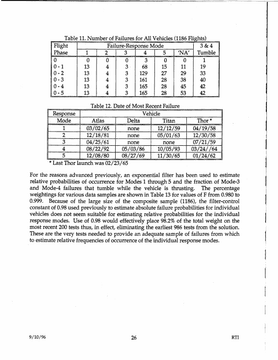
PAGE 117

report

This page is a table listing various mission IDs, launch dates, vehicle configurations, test ranges, response modes, and flight phases for aerospace missions numbered 216 through 261.

No. Mission/ID Launch Date Vehicle Configuration Test Range Response Mode Flight Phase Rep. Conf.
216 KNOCK WOOD 07/29/64 248D WR 0
217 LARGE CHARGE 08/07/64 110F WR 0
218 Big Sickle 08/14/64 7101, SLV-3A/AGENA D WR 1
219 GALLANT GAL 08/27/64 57E WR 4 2 0
220 BIG DEAL 08/31/64 36F WR 0
221 OGO-1 09/04/64 195D, LV-3A/AGENA B ER 0
222 BUTTERFLY NET 09/15/64 245D WR 0
223 BUZZING BEE 09/22/64 247D WR 0
224 Slow Pace 09/23/64 7102, SLV-3/AGENA D WR 1
225 Busy Line 10/08/64 7103, SLV-3/AGENA D WR 1
226 Boon Decker 10/23/64 353D, LV-3A/AGENA D WR 0
227 MARINER 3 11/05/64 289D, LV-3A/AGENA D ER 4 4 0
228 MARINER 4 11/28/64 288D, LV-3A/AGENA D ER 0
229 BROOK TROUT 12/01/64 210D WR 0
230 OPERA GLASS 12/04/64 300D WR 0
231 Battle Royal 12/04/64 7105, SLV-3/AGENA D WR 1
232 AC-4 12/11/64 146D, LV-3C/CENTAUR D ER 0
233 STEP OVER 12/22/64 111F WR 0
234 PILOT LIGHT 01/08/65 106F WR 0
235 PENCIL SET 01/12/65 166D WR 0
236 Beaver's Dam 01/21/65 172D/ABRES WR 4 2 & 3 0
237 Sand Lark 01/23/65 7106, SLV-3/AGENA D WR 1
238 RANGER 8 02/17/65 196D, LV-3A/AGENA B ER 0
239 DRAG BAR 02/27/65 211D WR 0
240 PORK BARREL 03/02/65 301D WR 0
241 AC-5 03/02/65 156D, LV-3C/CENT. D ER 1 1 0
242 Ship Rail 03/12/65 7104, SLV-3/AGENA D WR 1
243 ANGEL CAMP 03/12/65 154D WR 0
244 RANGER 9 03/21/65 204D, LV-3A/AGENA B ER 0
245 FRESH FROG 03/26/65 297D WR 0
246 Air Pump 04/03/65 7401, SLV-3/AGENA D WR 1
247 FLIP SIDE 04/06/65 150D WR 0
248 Dwarf Tree 04/28/65 7107, SLV-3/AGENA D WR 1
249 PROJECT FIRE 05/22/65 264D, LV-3A/AGENA D ER 0
250 Bottom Land 05/27/65 7108, SLV-3/AGENA D WR 1
251 Tennis Match 05/27/65 68D/ABRES WR 4 1 0
252 OLD FOGEY 06/03/65 177D WR 0
253 LEA RING 06/08/65 299D WR 0
254 STOCK BOY 06/10/65 302D WR 0
255 Worn Face 06/25/65 7109, SLV-3/AGENA D WR 1
256 BLIND SPOT 07/01/65 59D WR 0
257 White Pine 07/12/65 7112, SLV-3/AGENA D WR 4 & 5 2 & 3 1
258 VELA 5 & 6 07/20/65 225D, LV-3A/AGENA D ER 0
259 Water Tower 08/03/65 7111, SLV-3/AGENA D WR 1
260 PIANO WIRE 08/04/65 183D WR 0
261 SEA TRAMP 08/05/65 147F WR 0
9/10/96 108 RTI
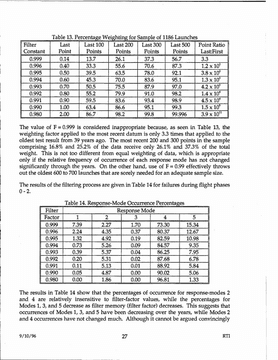
PAGE 118

report

This page is a table listing various mission IDs, launch dates, vehicle configurations, test ranges, and other technical data for space missions numbered 262 through 307.

No. Mission/ID Launch Date Vehicle Configuration Test Range Response Mode Flight Phase Rep. Conf.
262 AC-6 08/11/65 151D, LV-3C/CENTAUR D ER 0
263 TONTO RIM 08/26/65 61D WR 0
264 WATER SNAKE 09/29/65 125D WR 0
265 Log Fog 09/30/65 7110, SLV-3/AGENA D WR 1
266 Seething City 10/05/65 34D/ABRES WR 0
267 GTV-6 10/25/65 5301, SLV-3/AGENA D ER 4 3 1
268 Shop Degree 11/08/65 7113, SLV-3/AGENA D WR 1
269 WILD GOAT 11/29/65 200D WR 0
270 TAG DAY 12/20/65 85D WR 0
271 Blanket Party 01/19/66 7114, SLV-3/AGENA D WR 1
272 YEAST CAKE 02/10/66 305D WR 0
273 LONELY MT. 02/11/66 86D WR 0
274 Mucho Grande 02/15/66 7115, SLV-3/AGENA D WR 1
275 SYCAMORE RIDGE 02/19/66 73D WR 0
276 ETERNAL CAMP 03/04/66 303D WR 5 1 0
277 GTV-8 03/16/66 5302, SLV-3/AGENA D ER 1
278 Dumb Dora 03/18/66 7116, SLV-3/AGENA D WR 1
279 WHITE BEAR 03/19/66 304D WR 5 2 0
280 BRONZE Bell 03/30/66 72D WR 0
281 AC-8 04/07/66 184D, LV-3C/CENT. D ER 4T 4 0
282 OAO-1 04/08/66 5001, SLV-3/AGENA D ER 0
283 Shallow Stream 04/19/66 7117, SLV-3/AGENA D WR 1
284 CRAB CLAW 05/03/66 208D WR 4T 1 0
285 SUPPLY ROOM 05/13/66 98D WR 0
286 Pump Handle 05/14/66 7118, SLV-3/AGENA D WR 1
287 GTV-9 05/17/66 5303, SLV-3/AGENA D ER 5 1 1
288 SAND SHARK 05/26/66 41D WR 0
289 SURVEYOR-1 (AC-10) 05/30/66 290D, LV-3C/CENTAUR D ER 0
290 GTV-9A 06/01/66 5304, SLV-3/AGENA D ER 1
291 Power Drill 06/03/66 7119, SLV-3/AGENA D WR 1
292 OGO-3 06/06/66 5601, SLV-3/AGENA B ER 1
293 Mama's Boy 06/09/66 7201, SLV-3/AGENA D WR 1
294 VENEER PANEL 06/10/66 96D WR 4 2.5 0
295 GOLDEN MT. 06/26/66 147D WR 0
296 HEAVY ARTILLERY 06/30/66 298D WR 0
297 Snake Creek 07/12/66 7120, SLV-3/AGENA D WR 1
298 Stony Island 07/13/66 58D/ABRES WR NA 3 0
299 GTV-10 07/18/66 5305, SLV-3/AGENA D ER 1
300 BUSY RAMROD 08/08/66 149F WR 4 2 0
301 LUNAR ORBITER 1 08/10/66 5801, SLV-3/AGENA D ER 1
302 Silver Doll 08/16/66 7121, SLV-3/AGENA D WR 1
303 Happy Mt. 08/19/66 7202, SLV-3/AGENA D WR 1
304 GTV-11 09/12/66 5306, SLV-3/AGENA D ER 1
305 Taxi Driver 09/16/66 7123, SLV-3/AGENA D WR 1
306 SURVEYOR 2 (AC-7) 09/20/66 194D, LV-3C/CENT. D ER NA 5 0
307 Dwarf Killer 10/05/66 7203, SLV-3/AGENA D WR 1
9/10/96 109 RTI
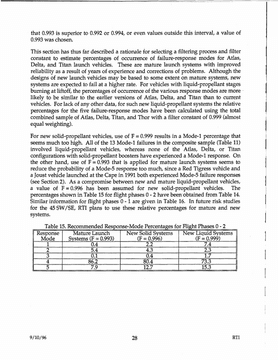
PAGE 119

report

This page is a table listing various mission IDs, launch dates, vehicle configurations, test ranges, response modes, and flight phases for aerospace missions occurring between 1966 and 1968.

No. Mission/ID Launch Date Vehicle Configuration Test Range Response Mode Flight Phase Rep. Conf.
308 LOW HILL 10/11/66 115F WR 4 1 0
309 Gleaming Star 10/12/66 7122, SLV-3/AGENA D WR 1
310 AC-9 10/26/66 174D, LV-3C/CENT. D ER NA 2 0
311 Red Caboose 11/02/66 7124, SLV-3/AGENA D WR 1
312 LUNAR ORBITER 2 11/06/66 5802, SLV-3/AGENA D ER 1
313 GTV-12 11/11/66 5307, SLV-3/AGENA D ER 1
314 Busy Mermaid 12/05/66 7125, SLV-3/AGENA D WR 1
315 ATS-B 12/06/66 5101, SLV-3/AGENA D ER 1
316 Busy Panama 12/11/66 89D/ABRES WR 0
317 Busy Peacock 12/21/66 7001, SLV-3/AGENA D WR 1
318 BUSY STEPSON 01/17/67 148F WR NA 2.5 0
319 BUSY NIECE 01/22/67 35D WR 0
320 Busy Party 02/02/67 7126, SLV-3/AGENA D WR 1
321 LUNAR ORBITER 3 02/04/67 5803, SLV-3/AGENA D ER 1
322 BUSY BOXER 02/13/67 121F WR 0
323 Giant Chief 03/05/67 7002, SLV-3/AGENA D WR 1
324 LITTLE CHURCH 03/16/67 151F WR 0
325 ATS-A 04/05/67 5102, SLV-3/AGENA D ER 1
326 BUSY SUNRISE 04/07/67 38D WR 0
327 SURVEYOR 3 (AC-12) 04/17/67 292D, LV-3C/CENTAUR D ER 0
328 Busy Tournament 04/19/67 7003, SLV-3/AGENA D WR 1
329 LUNAR ORBITER 4 05/04/67 5804, SLV-3/AGENA D ER 1
330 BUSY PIGSKIN 05/19/67 119F WR 0
331 Busy Camper 05/22/67 7127, SLV-3/AGENA D WR 1
332 Busy Wolf 06/04/67 7128, SLV-3/AGENA D WR 1
333 BUCK TYPE 06/09/67 122F WR 0
334 MARINER 5 (VENUS) 06/14/67 5401, SLV-3/AGENA D ER 1
335 ABRES (AFSC) 07/06/67 65D WR 0
336 SURVEYOR 4 (AC-11) 07/14/67 291D, LV-3C/CENTAUR D ER 0
337 ABRES (AFSC) 07/22/67 114F WR 0
338 AFSC 07/27/67 92D/ABRES WR 0
339 BREAD HOOK 07/29/67 150F WR 0
340 LUNAR ORBITER 5 08/01/67 5805, SLV-3/AGENA D ER 1
341 SURVEYOR 5 (AC-13) 09/08/67 5901C, SLV-3/CENTAUR D ER 1
342 ABRES (AFSC) 10/11/67 69D WR 0
343 ABRES (AFSC) 10/14/67 118F WR 0
344 ABRES (AFSC) 10/27/67 81F WR 4T 1 0
345 ATS-C 11/05/67 5103, SLV-3/AGENA D ER 1
346 SURVEYOR 6 (AC-14) 11/07/67 5902C, SLV-3/CENTAUR D ER 1
347 ABRES (AFSC) 11/07/67 94D WR 0
348 ABRES (AFSC) 11/10/67 113F WR 0
349 ABRES (AFSC) 12/21/67 117F WR 0
350 SURVEYOR 7 (AC-15) 01/07/68 5903C, SLV-3C/CENTAUR D ER 1
351 ABRES (AFSC) 01/31/68 94F WR 0
352 ABRES (AFSC) 02/26/68 116F WR 0
353 OGO-E 03/04/68 5602A, SLV-3A/AGENA D ER 1
9/10/96 110 RTI
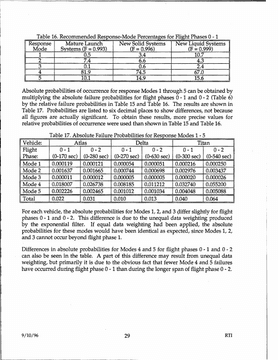
PAGE 120

report

This page is a table listing various aerospace missions, their launch dates, vehicle configurations, test ranges, and other flight parameters.

No. Mission/ID Launch Date Vehicle Configuration Test Range Response Mode Flight Phase Rep. Conf.
354 ABRES (AFSC) 03/06/68 74E WR 0
355 AFSC 04/06/68 107F/ABRES WR 0
356 ABRES (AFSC) 04/18/68 77E WR 0
357 ABRES (AFSC) 04/27/68 78E WR 0
358 ABRES (AFSC) 05/03/68 95F WR 5 1 0
359 ABRES (AFSC) 06/01/68 89F WR 0
360 ABRES (AFSC) 06/22/68 86F WR 0
361 ABRES (AFSC) 06/29/68 32F WR 0
362 AFSC 07/11/68 75F/ABRES WR 0
363 DOD (AA-27) 08/06/68 SLV-3A/AGENA D ER 1
364 ATS-D (AC-17) 08/10/68 5104C, SLV-3C/CENTAUR D ER NA 4 1
365 AFSC 08/16/68 7004, SLV-3/BURNER II WR 4 3 1
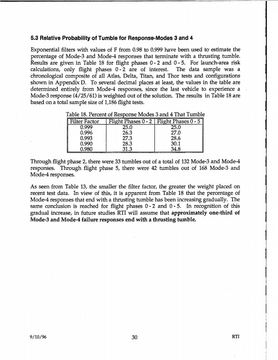
366 ABRES (AFSC) 09/25/68 99F WR 0
367 ABRES (AFSC) 09/27/68 84F WR 0
368 ABRES (AFSC) 11/16/68 56F WR 4T 2.5 0
369 ABRES (AFSC) 11/24/68 60F WR 0
370 OAO-A2 (AC-16) 12/07/68 5002C, SLV-3C/CENTAUR D ER 1
371 ABRES (AFSC) 01/16/69 70F WR 0
372 MARINER 6 (MARS) (AC-20) 02/24/69 5403C, SLV-3C/CENTAUR D ER NA 1 1
373 AFSC 03/17/69 104F/ABRES WR 0
374 MARINER 7 (MARS) (AC-19) 03/27/69 5105C, SLV-3C/CENTAUR D ER 1
375 DOD (AA-28) 04/12/69 SLV-3A/AGENA D ER 1
376 ATS-E (AC-18) 08/12/69 5402C, SLV-3C/CENTAUR D ER 1
377 ABRES (AFSC) 08/20/69 112F WR 0
378 ABRES (AFSC) 09/16/69 100F WR 0
379 ABRES (AFSC) 10/10/69 98F WR 4 1 0
380 ABRES (AFSC) 12/03/69 44F WR 0
381 ABRES (AFSC) 12/12/69 93F WR 0
382 ABRES (AFSC) 02/08/70 96F WR 0
383 ABRES (AFSC) 03/13/70 28F WR 0
384 ABRES (AFSC) 05/30/70 91F WR 0
385 ABRES (AFSC) 06/09/70 92F WR 0
386 DOD (AA-29) 06/19/70 SLV-3A/AGENA D ER 1
387 DOD (AA-30) 08/31/70 SLV-3A/AGENA D ER 1
388 OAO-B (AC-21) 11/30/70 5003C, SLV-3C/CENTAUR D ER 4 2 1
389 ABRES (AFSC) 12/22/70 105F WR 0
390 INTELSAT IV F-2 (AC-25) 01/25/71 5005C, SLV-3C/CENTAUR D ER 1
391 ABRES (AFSC) 04/05/71 85F WR 0
392 MARINER 8 (MARS) (AC-24) 05/08/71 5405C, SLV-3C/CENTAUR D ER 4T 3 1
393 MARINER 9 (MARS) (AC-23) 05/30/71 5404C, SLV-3C/CENTAUR D ER 1
394 ABRES (AFSC) 06/29/71 103F WR 0
395 AFSC 08/06/71 76F WR 0
396 ABRES (AFSC) 09/01/71 74F WR 0
397 DOD (AA-31) 12/04/71 SLV-3A/AGENA D ER 4 1 1
398 INTELSAT IV F-3 (AC-26) 12/19/71 5006C, SLV-3C/CENTAUR D ER 1
399 INTELSAT IV F-4 (AC-28) 01/22/72 5008C, SLV-3C/CENTAUR D ER 1
9/10/96 111 RTI

PAGE 121

report

This page is a table listing various space mission IDs, their launch dates, vehicle configurations, test ranges, and reporting confidence levels.

No. Mission/ID Launch Date Vehicle Configuration Test Range Response Mode Flight Phase Rep. Conf.
400 PIONEER 10 (AC-27) 03/02/72 5007C, SLV-3C/CENTAUR D ER 1
401 INTELSAT IV F-5 (AC-29) 06/13/72 5009C, SLV-3C/CENTAUR D ER 1
402 OAO-C (AC-22) 08/21/72 5004C, SLV-3C/CENTAUR D ER 1
403 AFSC 10/02/72 102F/BURNER II WR 0
404 DOD (AA-32) 12/20/72 SLV-3A/AGENA D ER 1
405 DOD (AA-33) 03/06/73 SLV-3A/AGENA D ER 1
406 PIONEER 11 (AC-30) 04/05/73 5011D, SLV-3D/CENT D-1A ER 1
407 INTELSAT IV F-7 (AC-31) 08/23/73 5010D, SLV-3D/CENT D-1A ER 1
408 ABRES (AFSC) 08/29/73 78F WR 0
409 ACE 09/30/73 108F WR 0
410 MARINER 10 (AC-34) 11/03/73 5014D, SLV-3D/CENT D-1A ER 1
411 SFT-1 03/06/74 73F WR 0
412 ACE 03/23/74 97F WR 0
413 SFT-2 05/01/74 54F WR 0
414 SFT-3 06/28/74 82F WR 0
415 NTS-1 07/13/74 69F WR 0
416 ACE 09/08/74 80F WR 0
417 ABRES (AFSC) 10/12/74 31F WR 0
418 INTELSAT IV F-8 (AC-32) 11/21/74 5012D, SLV-3D/CENT D-1A ER 1
419 INTELSAT IV F-6 (AC-33) 02/20/75 5015D, SLV-3D/CENT D-1A ER 4T 2 1
420 AFSC 04/12/75 71F WR 4 1 0
421 INTELSAT IV F-1 (AC-35) 05/22/75 5018D, SLV-3D/CENT D-1A ER 1
422 DOD (AA-34) 06/18/75 SLV-3A/AGENA ER 1
423 INTELSAT IVA F-1 (AC-36) 09/25/75 5016D, SLV-3D/CENT D-1A ER 1
424 INTELSAT IVA F-2 (AC-37) 01/29/76 5017D, SLV-3D/CENT D-1A ER 1
425 AFSC 04/30/76 F WR 0
426 COMSTAR D-1 (AC-38) 05/13/76 5020D, SLV-3D/CENT D-1A ER 1
427 COMSTAR D-2 (AC-40) 07/22/76 5022D, SLV-3D/CENT D-1A ER 1
428 DOD (AA-35) 05/23/77 SLV-3A/AGENA ER 1
429 INTELSAT IVA F-4 (AC-39) 05/26/77 5019D, SLV-3D/CENT D-1A ER 1
430 NTS-2 06/23/77 65F WR 0
431 HEAO-A (AC-45) 08/12/77 5025D, SLV-3D/CENT D-1A ER 1
432 INTELSAT IVA F-5 (AC-43) 09/29/77 5701D, SLV-3D/CENT D-1A ER 4T 1 1
433 AFSC 12/08/77 F WR 0
434 DOD (AA-36) 12/11/77 SLV-3A/AGENA D ER 1
435 INTELSAT IVA F-3 (AC-46) 01/06/78 5026D, SLV-3D/CENT D-1A ER 1
436 FLTSATCOM-A (AC-44) 02/09/78 5024D, SLV-3D/CENT D-1A ER 1
437 NDS-1 02/22/78 64F WR 0
438 INTELSAT IVA F-6 (AC-48) 03/31/78 5028D, SLV-3D/CENT D-1A ER 1
439 DOD (AA-37) 04/07/78 SLV-3A/AGENA D ER 1
440 NDS-2 05/13/78 49F WR 0
441 PIONEER (VENUS) (AC-50) 05/20/78 5030D, SLV-3D/CENT D-1A ER 1
442 SEASAT A 06/26/78 23F/AGENA D WR 0
443 COMSTAR D-3 (AC-41) 06/29/78 5021D, SLV-3D/CENT D-1A ER 1
444 PIONEER (VENUS) (AC-51) 08/08/78 5031D, SLV-3D/CENT D-1A ER 1
445 NAVSTAR III 10/06/78 47F WR 0
9/10/96 112 RTI

PAGE 122

report

This page is a table listing various space missions, their launch dates, vehicle configurations, test ranges, and other technical flight data.

No. Mission/ID Launch Date Vehicle Configuration Test Range Response Mode Flight Phase Rep. Conf.
446 TIROS N 10/13/78 29F WR 0
447 HEAO-B (AC-52) 11/13/78 5032D, SLV-3D/CENT D-1A ER 1
448 NAVSTAR IV 12/10/78 39F WR 0
449 STP-78-1 02/24/79 27F WR 0
450 FLTSATCOM-B (AC-47) 05/04/79 5027D, SLV-3D/CENT D-1A ER 1
451 NOAA-A 06/27/79 25F WR 0
452 HEAO-C (AC-53) 09/20/79 5033D, SLV-3D/CENT D-1A ER 1
453 FLTSATCOM-C (AC-49) 01/17/80 5029D, SLV-3D/CENT D-1A ER 1
454 NAVSTAR V 02/09/80 35F WR 0
455 AFSC 03/03/80 F WR 0
456 NAVSTAR VI 04/26/80 34F WR 0
457 NOAA-B 05/29/80 19F WR NA 1 0
458 FLTSATCOM-D (AC-57) 10/31/80 5037D, SLV-3D/CENT D-1A ER 1
459 INTELSAT IV F-2 (AC-54) 12/06/80 5034D, SLV-3D/CENT D-1A ER 1
460 AFSC 12/08/80 68E WR 5 1 0
461 COMSTAR D (AC-42) 02/21/81 5023D, SLV-3D/CENT D-1A ER 1
462 INTELSAT V (AC-56) 05/23/81 5036D, SLV-3D/CENT D-1A ER 1
463 NOAA-C 06/23/81 87F WR 0
464 FLTSATCOM-E (AC-59) 08/06/81 5039D, SLV-3D/CENT D-1A ER NA 1 & 5 1
465 INTELSAT V F-3 (AC-55) 12/15/81 5035D, SLV-3D/CENT D-1A ER 1
466 NAVSTAR VII 12/18/81 76E WR 2 1 0
467 INTELSAT V F-4 (AC-58) 03/05/82 5038D, SLV-3D/CENT D-1A ER 1
468 INTELSAT V F-5 (AC-60) 09/28/82 5040D, SLV-3D/CENT D-1A ER 1
469 DMSP F-6 12/20/82 60E WR 0
470 AFSC 02/09/83 H WR 1
471 NOAA-E 03/28/83 73E WR 0
472 INTELSAT V F-6 (AC-61) 05/19/83 5041D, SLV-3D/CENT D-1A ER 1
473 AFSC 06/09/83 H WR 1
474 NAVSTAR VIII 07/14/83 75E/PAM-D WR 0
475 DMSP F-7 11/17/83 58E WR 0
476 AFSC 02/05/84 H WR 1
477 INTELSAT V F-9 (AC-62) 06/09/84 5042G/CENT D-1A ER 4T 4 1
478 NAVSTAR IX 06/13/84 42E/PAM-D WR 0
479 NAVSTAR X 09/08/84 14E/PAM-D WR 0
480 NOAA-F 12/12/84 39E WR 0
481 GEOSTA-A 03/12/85 41E WR 0
482 INTELSAT V F-10 (AC-63) 03/22/85 5043G/CENT D-1A ER 1
483 INTELSAT V F-11 (AC-64) 06/30/85 5044G/CENT D-1A ER 1
484 INTELSAT V F-12 (AC-65) 09/28/85 5045G/CENT D-1A ER 1
485 NAVSTAR XI 10/08/85 55E WR 0
486 AFSC 02/09/86 H WR 1
487 NOAA-G 09/17/86 52E WR 0
488 FLTSATCOM F-7 (AC-66) 12/05/86 5046G/CENT D-1A ER 1
489 FLTSATCOM F-6 (AC-67) 03/26/87 5048G/CENT D-1A ER 4T 1 1
490 AFSC 05/15/87 H WR 1
491 DMSP F-8 06/19/87 59E WR 0
9/10/96 113 RTI

PAGE 123

report

This page is a table listing various satellite missions, their launch dates, vehicle configurations, test ranges, and reporting confidence levels.

No. Mission/ID Launch Date Vehicle Configuration Test Range Response Mode Flight Phase Rep. Conf.
492 DMSP F-9 02/02/88 54E WR 0
493 NOAA-H 09/24/88 63E WR 0
494 FLTSATCOM F-8 (AC-68) 09/25/89 5047G/CENT D-1A ER 1
495 P87-2 04/11/90 28E/ALT 3A WR 0
496 CRRES (AC-69) 07/25/90 5049 I/CENT I ER 1
497 DMSS 10 12/01/90 61E WR 0
498 BS-3H COMSAT (AC-70) 04/18/91 5050 I/CENT I ER 4T 3 1
499 NOAA-D 05/14/91 50E WR 0
500 DMSP F-11 11/28/91 53E WR 0
501 EUTELSAT (AC-102) 12/07/91 8102 II/CENT I ER 1
502 DSCS III (AC-101) 02/11/92 8101 II/CENT I ER 1
503 GALAXY 5 (AC-72) 03/14/92 5052 I/CENT ER 1
504 INTELSAT K (AC-105) 06/10/92 8105 IIA/CENT ER 1
505 DSCS III (AC-103) 07/02/92 8103 II/CENT ER 1
506 GALAXY 1R (AC-71) 08/22/92 5051 I/CENT ER 4T 3 1
507 UHF FOLLOW ON-1 (AC-74) 03/25/93 5054 I/CENT ER NA 2 & 5 1
508 DSCS III (AC-104) 07/19/93 8104 II/CENT ER 1
509 NOAA-I 08/09/93 34E WR 0
510 UHF F/O-2 (AC-75) 09/03/93 5055 I/CENT ER 1
511 DSCS III (AC-106) 11/28/93 8106 II/CENT ER 1
512 TELSTAR 4 (AC-108) 12/16/93 8201 IIAS/CENT ER 1
513 GOES-1 (AC-73) 04/13/94 5053 I/CENT ER 1
514 UHF F/O-3 (AC-76) 06/24/94 5056 I/CENT ER 1
515 DIRECT TV (AC-107) 08/03/94 8107 IIA/CENT ER 1
516 DMSP F-12 08/29/94 20E WR 0
517 INTELSAT VII (AC-111) 10/06/94 8202 IIAS/CENT ER 1
518 ORION (AC-110) 11/29/94 8109 IIA/CENT ER 1
519 NOAA-J 12/30/94 11E WR 0
520 INTELSAT 704-2 (AC-113) 01/10/95 8203 IIAS/CENT ER 1
521 EHF F/O-4 (AC-112) 01/29/95 8110 II/CENT ER 1
522 INTELSAT VII (AC-115) 03/22/95 8204 IIAS/CENT ER 1
523 DMSP F-13 03/24/95 45E WR 0
524 MSAT (AC-114) 04/07/95 8111 IIA/CENT ER 1
525 GOES-J (AC-77) 05/23/95 I/CENT ER 1
526 EHF F/O-5 (AC-116) 05/31/95 II/CENT ER 1
527 DSCS III (AC-118) 07/31/95 IIA/CENT ER 1
528 JCSAT (AC-117) 08/29/95 IIAS/CENT ER 1
529 EHF F/O-6 (AC-119) 10/22/95 II/CENT ER 1
530 SOLAR OBSERV. (AC-121) 12/02/95 IIAS/CENT ER 1
531 GALAXY IIIR (AC-120) 12/15/95 IIA/CENT ER 1
532 PALAPA-C (AC-126) 01/31/96 IIAS/CENT ER 1
533 INMARSAT-3 (AC-122) 04/03/96 IIA/CENT ER 1
534 SAX (AC-78) 04/30/96 I/CENT ER 1
535 UHF F7 (AC-125) 07/25/96 II/CENT ER 1
9/10/96 114 RTI

PAGE 124

report

This page provides detailed failure narratives for five specific Atlas missile flight tests (4A, 6A, 13A, 11A, and 15A) conducted between 1957 and 1958.

D.2.2 Atlas Failure Narratives

The following narratives provide the available details about each Atlas failure since the beginning of the Atlas program. The narratives are numbered to match the flight-sequence numbers in Section D.2.1.

1. 4A, 11 June 57, Response Mode 4T, Flight Phase 1: Flight appeared normal for 24.7 seconds when drop in fuel supply to B2 engine produced a drop in performance and shutdown. Both engines moved to hardover in pitch to compensate for thrust asymmetry. The B1 engine failed at 27 seconds. A fuel fire was observed in aft end after thrust was lost. The missile continued to rise, reaching an altitude of 9,800 feet at 38 seconds. Missile was destroyed by safety officer 50.1 seconds after liftoff. Thrust unit and other hardware impacted about 1/4 mile south of launch pad (105° flight azimuth).

2. 6A, 25 Sep 57, Response Mode 4, Flight Phase 1: Flight appeared normal until about 32.5 seconds after liftoff, when performance level of both engines dropped to 35% of normal. Both engines shut down at 37 seconds. Missile was destroyed at 63 seconds. Loss of thrust was due to loss of LOX regulator in the booster gas generator. Major components impacted about 8000 feet downrange and 1000 feet right of flight line.

5. 13A, 7 Feb 58, Response Mode 4, Flight Phase 1: The B2 turbopump and engine stopped operating about 118 seconds due either to loss of LO2 regulator reference pressure or a control-system failure. The B1 engine ceased to operate 0.3 second later. Failure was attributed to shorting of a vernier engine feedback transducer due to aerodynamic heating. Propellant sloshing that began building up at about 100 seconds led to missile instability. Vehicle broke up at 167 seconds. Impact occurred about 280 miles downrange and about 3 miles crossrange.

6. 11A, 20 Feb 58, Response Mode 4T, Flight Phase 1: Vernier engine was hardover from 51.9 seconds to 89.4 seconds, then returned to null until 104 seconds, then went hardover again. Other systems appeared normal until 109.6 seconds, when divergent oscillations began in rate-gyro outputs and engine positions. All engines reached stops by 114.3 seconds and continued thereafter to oscillate between stops until loss of thrust at 124.8 seconds. Vehicle breakup occurred one second later. Probable cause of oscillation was a component failure in flight control system. Vehicle impacted about 105 miles downrange and 8 miles right of flight line.

7. 15A, 5 Apr 58, Response Mode 4, Flight Phase 1: Booster engines shut down prematurely at 105.3 seconds (instead of planned 127 seconds) due to B1 turbopump failure. Since B1 chamber pressure drives the gas generator, the B2 turbopump and engine also stopped. Impact was 180 miles downrange and slightly left of flight line.

9/10/96 115 RTI

PAGE 125

report

This page contains a list of missile flight test summaries, detailing flight phases, malfunctions, and impact locations for various test flights conducted between 1958 and 1959.

9. 3B, 19 July 58, Response Mode 4T, Flight Phase 1: Random failure of yaw rate gyro caused violent maneuvers resulting in rupture of LO2 tank, engine shutdown, and a fire near the lube oil drain. Missile broke up about 42 seconds with impact about 2 miles downrange and 0.4 miles crossrange left.

11. 5B, 28 Aug 58, Response Mode 4, Flight Phase 2.5: Missile was normal to SECO. After SECO, failure of hydraulic system caused loss of vernier engine control. Warhead impacted close to intended target.

12. 8B, 14 Sep 58, Response Mode 4, Flight Phase 2.5: Warhead impacted close to target although control was lost after SECO due to failure of vernier-engine hydraulic system.

13. 6B, 18 Sep 58, Response Mode 4, Flight Phase 1: Except for a late-opening sustainer fuel valve, flight was apparently normal until 80.8 seconds, when the B1 turbopump failed. Performance of the B1 engine and the axial acceleration dropped sharply at about 81.7 seconds, and the B2 system shut down about 0.1 seconds later. The sustainer and vernier engines continued to operate normally until 82.9 seconds, when the missile exploded. Impact was about 25 miles downrange and about 0.6 miles right of the flight line.

14. 9B, 17 Nov 58, Response Mode 4, Flight Phase 2: The flight was terminated at 227.6 seconds by premature fuel depletion caused either by failure of the propulsion utilization system or by a tanking error. Missile impacted near the flight line about 2300 miles downrange, some 850 miles short of target.

18. 13B, 15 Jan 59, Response Mode 5, Flight Phase 1: The vehicle appeared normal for the first 50-60 seconds, at which time it was obscured by clouds. It was probably normal until about 100 seconds, but prelaunch removal of the mainframe telemetry system prevented a precise determination. Beginning about 101 seconds, various erratic pitch, yaw, and roll rates and oscillations were noted with accompanying drops in acceleration and velocity. These rates become excessive at 106.6 seconds. At 121 seconds, the nosecone telemetry system showed that yaw and pitch rates abruptly increased, and this condition existed until reentry at 281 seconds. All thrusting apparently stopped between 121 and 123 seconds. The missile impacted about 170 miles downrange and 7.5 miles left.

19. 4C, 27 Jan 59, Response Mode 5, Flight Phase 2: Since the guidance system was inoperative throughout, the flight path was controlled by the pre-programmed flight control system. Impact was about 80 miles long and 30 miles left of target point.

21. 5C, 20 Feb 59, Response Mode 4, Flight Phase 2: After a normal booster phase, missile exploded at 173 seconds (BECO at 149.2 sec) apparently due to loss of fuel-tank pressure and subsequent rupture of LOX/fuel-tank bulkhead. Impact was about 1000 miles downrange and 6 miles left.

9/10/96 116 RTI

PAGE 126

report

This page contains a list of technical flight test reports for missiles, detailing specific failures and outcomes for various flight phases between March and November 1959.

22. 7C, 18 Mar 59, Response Mode 4, Flight Phase 1: Booster engines shut down prematurely at 129.4 seconds, but booster section was not jettisoned until the near-normal time of 153 seconds. Guidance was inoperative. Since the sustainer engine could not gimbal before booster separation, the autopilot was unable to stabilize the missile after BECO. The sustainer shut down about 40 seconds before propellant depletion. The reentry vehicle spin rockets fired prematurely at 86.3 seconds after liftoff.

23. 3D, 14 Apr 59, Response Mode 4, Flight Phase 1: Performance of B2 engine dropped 36% at launch, resulting in a violent pitch as missile left the launcher. Flight control system corrected missile attitude, and flight continued at reduced thrust until a more violent explosion tore the thrust section away from the missile at 26.1 seconds. The sustainer continued operating with decreased thrust until shutdown by the safety officer at 36 seconds. Debris impacted about 3000 feet from launch point.

24. 7D, 18 May 59, Response Mode 4, Flight Phase 1: Failure in pneumatic system resulted in missile explosion at 65 seconds. A temporary failure of the thrust-structure fairing at liftoff strained the pneumatic lines and disconnects, resulting in leaks in the pneumatic system.

25. 5D, 6 June 59, Response Mode 4, Flight Phase 2: Either structural damage at booster staging or failure of the booster staging valve to close resulted in a fuel leak and explosion at 159.3 seconds. Impact occurred near the flight line about 780 miles downrange.

30. 10D (Mercury), 9 Sep 59, Response Mode 4, Flight Phase 2: Booster section failed to jettison resulting in a final velocity about 3000 ft/sec low and an impact range about 500 miles short of target.

32. 17D, 16 Sep. 59, Response Mode 4, Flight Phase 2.5: :Flight was considered a success since impact was within two miles of target point. However, failure of the vernier hydraulic package resulted in loss of missile control during the vernier solo phase.

35. 26D, 29 Oct 59, Response Mode 4, Flight Phase 2.5: Vernier solo phase was unstable in pitch due to loss of thrust from V2 vernier engine. The V2 engine lost chamber pressure during booster jettison. Impact was about 14 miles short and out of splash net.

36. 28D, 4 Nov 59, Response Mode NA, Flight Phase 2: The flight was normal, but was terminated prematurely when the range-safety impact-predictor system failed.

37. 15D, 24 Nov 59, Response Mode NA, Flight Phase 2.5: Flight was normal, except the reentry vehicle failed to arm or separate.

9/10/96 117 RTI
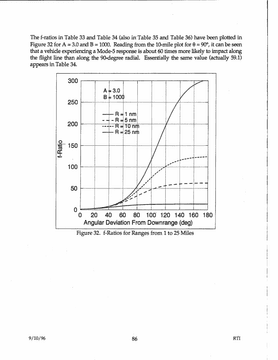
PAGE 127

report

This page contains a list of flight test summaries for various Atlas missile missions, detailing dates, flight phases, and causes of mission failures or anomalies.

38. 20D (Able IV), 26 Nov 59, Response Mode 4, Flight Phase 1: Third and fourth stages and payload broke off about 47 seconds. Atlas flight was normal and second stage ignited properly after Atlas SECO.

43. 6D (Dual Exhaust), 26 Jan 60, Response Mode 4, Flight Phase 2 and 2.5: At 175 seconds, as a result of a full-scale positive yaw command generated for five seconds, the missile stabilized on an erroneous heading. When a range-rate flag was lost 20 seconds later, the differentiated range-rate data substituted for measured data corrected the erroneous azimuth by generating a full-scale negative yaw command. The substituted data resulted in slightly erratic steering and a premature VECO signal that was not acted upon. The verniers were subsequently cutoff by the backup signal.

45. 29D (Midas I), 26 Feb 60, Response Mode 4, Flight Phase 2.5: Flight was normal until firing of the retro rockets after Atlas separation. An explosion at this time, probably due to activation of the Agena inadvertent separation destruct system, destroyed both the Atlas vehicle and the Agena.

46. 42D, 8 Mar 60, Response Mode 4, Flight Phase 2.5: Flight was considered a success although failure of the vernier hydraulic system resulted in loss of attitude control during the vernier solo phase.

47. 51 D, 10 Mar 60, Response Mode 1, Flight Phase 1: Due to combustion instability, an explosion occurred in the B1 chamber before missile movement. Missile was destroyed at 2.5 seconds after 2-inch motion when main propellants ignited.

48. 48D, 7 Apr 60, Response Mode 1, Flight Phase 1: Missile was destroyed in launch stand during launch attempt, apparently due to combustion instability in the B2 thrust chamber.

50. 23D (Lucky Dragon), 6 May 60, Response Mode 3, Flight Phase 1: An inoperative pitch gyro caused pitch instability, and resulted in destruct at 25.6 seconds.

54. 62D, 22 June 60, Response Mode 4, Flight Phase 2.5: Vernier engines were cutoff by autopilot backup when guidance discrete was not sent. Impact was 18 miles long.

56. 60D, 2 July 60, Response Mode 4, Flight Phase 2: Depletion of helium bottle pressure led to low sustainer and vernier engine thrust, and eventually early shutdown of engines. Impact was 40 miles short of target.

57. 74D (Tiger Skin), 22 July 60, Response Mode 5, Flight Phase 1: A pitchover rate that was 69% above the nominal rate resulted in vehicle breakup at 69.2 seconds.

9/10/96 118 RTI
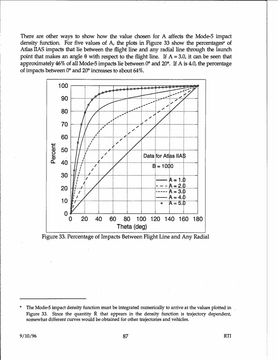
PAGE 128

report

This page contains a list of flight test reports for various missile and space launch vehicles, detailing flight phases, performance issues, and causes of failure for missions numbered 58 through 73.

58. 50D (Mercury), 29 July 60, Response Mode 4, Flight Phase 1: Flight appeared normal till 57.6 seconds when missile broke up apparently due to a rupture of the forward section of the LO2 tank.

61. 47D (Golden Journey), 12 Sep 60, Response Mode 4, Flight Phase 2: Flight was apparently normal until about 222 seconds, when missile acceleration began to decay. A LOX regulator failure caused low sustainer performance and insufficient velocity to reach target. Impact was about 535 miles short.

64. 80D (Able V/Pioneer), 25 Sep 60, Response Mode 4T, Flight Phase 2.5 and 3: Atlas performed normally except for failure of vernier engines to cut off. Flight was not successful since the Agena chamber pressure stabilized at 70% of normal shortly after ignition. Stage then apparently tumbled before cutting off 30 seconds early. Third-stage spun up and stabilized in a nose-down attitude.

65. 33D (High Arrow), 29 Sep 60, Response Mode 4, Flight Phase 1: The booster engines cut off prematurely and failed to separate from sustainer. The missile remained intact, but failed to achieve the desired range because of the added booster weight.

66. 3E, 11 Oct 60, Response Mode 5, Flight Phase 2: Sustainer hydraulic pressure began to decay at 41 seconds and dropped to zero at 62 seconds. Sustainer began tumbling at booster staging when control was essentially lost. Thrust continued for about 18 seconds moving the impact point some 270 miles farther downrange and 27 miles crossrange. The missile exploded at 155 seconds.

67. 57D (LV-3A)/Agena A (Gibson Girl), 11 Oct 60, Response Mode NA, Flight Phase 3 and 5: Atlas performance was satisfactory. An umbilical failed to release properly from the Agena at liftoff, resulting in loss of pneumatic supply to the Agena attitude control system. A satisfactory orbit was not achieved. Guidance beacon failed at 106 seconds resulting in autopilot flight.

68. 81D (Diamond Jubilee), 12 Oct 60, Response Mode 4, Flight Phase 1: Overpressurization of the LOX tank resulted in tank rupture and vehicle breakup at 71.6 seconds.

72. 4E, 29 Nov 60, Response Mode 5, Flight Phase 2: Sustainer hydraulic pressure lost at 41 seconds. Missile tumbled shortly after booster staging. Sustainer thrust terminated at about 150 seconds, some 22 seconds after BECO. During the sustainer solo phase, the impact point moved about 120 miles downrange and 44 miles crossrange.

73. 91D, 15 Dec 60, Response Mode 4, Flight Phase 1: Vehicle performed normally till about 66.7 seconds, when a blast-band failure apparently resulted in rupture of the forward section of the LOX tank. The upper stages separated at this time, but the Atlas engines continued thrusting until 71 seconds. Control was lost between

PAGE 129

report

This page contains a list of flight test reports for various missiles and vehicles, detailing launch dates, flight phases, and causes of mission failures or anomalies.

72 and 73 seconds, and a final explosion occurred at 74 seconds. Impact was about 8 miles downrange and one mile crossrange.

76. 8E, 24 Jan 61, Response Mode 5, Flight Phase 2: Missile stability was lost at about 161 seconds, some 30 seconds after BECO, probably due to failure of the servo-amplifier power supply. The sustainer engine shut down at 248 seconds, and the vernier engines about 10 seconds later. Impact occurred 1316 miles downrange and 215 miles crossrange.

77. 70D (LV-3A)/Agena A (Jawhawk Jamboree), 31 Jan 61, Response Mode NA, Flight Phase 2: Flight was considered successful although loss of rate lock at 222 seconds caused slightly erratic steering during the last 20 seconds of Atlas sustainer thrusting flight and failure of vehicle to pitch over during the vernier solo period.

80. 13E, 13 Mar 61, Response Mode 4, Flight Phase 2: Sustainer main fuel valve remained in the full open position throughout flight, resulting in fuel depletion and premature shutdown of sustainer engine at 251 seconds.

81. 16E, 24 Mar 61, Response Mode 4, Flight Phase 1.5: Due to depletion of helium-bottle pressure, booster section failed to jettison, leading to fuel depletion and impact far short of target.

82. 100D (Mercury 3), 25 Apr 61, Response Mode 3, Flight Phase 1: Flight was terminated at 40 seconds by RSO when vehicle failed to perform roll and pitch-over maneuvers, apparently due to failure of the autopilot programmer. The malfunction was attributed to a plastic coating on the connector pins within the programmer, causing an open circuit. Major debris impacted about 1800 feet downrange and 6100 feet crossrange left.

86. 27E (Sure Shot), 7 June 61, Response Mode 4, Flight Phase 1: Apparent combustion instability caused an explosion and missile destruction 3.86 seconds after liftoff.

87. 17E, 22 June 61, Response Mode 4, Flight Phase 1: Missile destroyed itself at 101.5 seconds due to failure of flight-control system. Pitch rate was about 1.55 times normal. Just before breakup at 66,000 feet altitude, missile had pitched over almost 90° due to higher than normal pitch rate, producing excessive heating and aerodynamic loads. At breakup, flight path was nearly horizontal. Impact was about 64 miles downrange.

93. 111D(Ranger-1), 23 Aug 61, Response Mode NA, Flight Phase 4: The Agena achieved a normal parking orbit. Flight continued normally until Agena second burn. During the restart sequence the fuel valve failed to open so only oxygen was pumped into the thrust chamber. Apogee of final orbit was only slightly above the normal circular parking-orbit altitude.

9/10/96 120 RTI
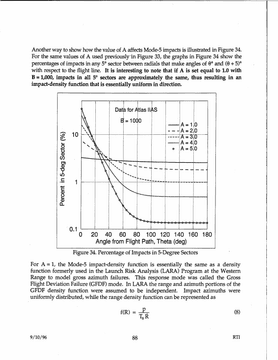
PAGE 130

report

This page contains a technical summary of flight test anomalies and outcomes for various Atlas missile and Agena vehicle launches occurring between September and December 1961.

94. 26E, 8 Sep 61, Response Mode 4, Flight Phase 2: Sustainer engine shut down prematurely during the booster jettison sequence. Most probable cause was drop in fuel flow to the gas generator. The vernier engines continued to burn for about 28 seconds after the sustainer shut down. Vernier thrust decayed at 137 seconds, guidance platform tumbled at 163 seconds. The missile remained intact until at least 470 seconds, when data were lost. Impact was about 525 miles downrange.

95. 106D (LV-3A)/Agena B (First Motion), 9 Sep 61, Response Mode 1, Flight Phase 1: Failure of an umbilical to eject allowed a commit/stop-power signal to reach the missile. Lack of electrical power 0.265 seconds after liftoff caused the vehicle to fall back on the launch pad after a rise of about 18 inches.

99. 105D (LV-3A)/Agena B (Big Town), Midas IV, 21 Oct 61, Response Mode NA, Flight Phase 2: Flight was regarded as a success, since the Agena compensated for Atlas anomalies. Atlas roll control was lost at 186 seconds, resulting in a roll rate of over 40° per second at Agena separation. Control in pitch and yaw was maintained. A LOX leak affected sustainer performance just before SECO and throughout the vernier phase.

100. 32E, 10 Nov 61, Response Mode 4T, Flight Phase 1: Sustainer engine shut down 0.7 seconds after liftoff. Although a fire appeared in the thrust section at 19 seconds, booster engines maintained stability until 24.5 seconds, when the B2 engine performance began to decay. All control was lost after this point, and the missile was destroyed by the RSO at 35 seconds. Impact was about 2500 feet downrange and 320 feet crossrange.

101. 117D (Ranger-2),18 Nov 61, Response Mode NA, Flight Phase 4: The Atlas booster functioned normally. A parking orbit was attained during the Agena first burn although roll control was not maintained due to failure of the roll gyro. When control gas was depleted, missile lost stability and began to tumble. Second Agena burn lasted only one second.

103. 108D (LV-3A)/Agena B (Round Trip), 22 Nov 61, Response Mode 4T, Flight Phase 2: Flight was not successful since vehicle failed to achieve orbit. Loss of pitch control at 244 seconds was attributed to aerodynamic heating. At Agena separation the Atlas had pitched up 145°.

108. 5F,12 Dec 61, Response Mode 5, Flight Phase 2: A failure in the inertial guidance system of 1.06 seconds duration caused the existing inertial X velocity to be inserted in the Z-velocity channel. As a result, the missile impacted 575 miles short and 30 miles left of target.

110. 6F, 20 Dec 61, Response Mode 4T, Flight Phase 2: Flight appeared normal until staging. During booster jettison, sustainer and vernier hydraulic pressure began to decay, leading to compete loss of sustainer yaw and pitch control at 229 and 232 seconds, respectively. Missile began tumbling at about 226 seconds.

9/10/96 121 RTI
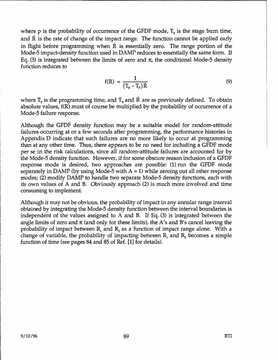
PAGE 131

report

This page contains a technical summary of flight test results for various Atlas and Agena missile launches between December 1961 and May 1962, detailing mission outcomes and specific mechanical failures.

Sustainer engine shut down at 282 seconds. Missile impacted 1300 miles downrange and 18 miles crossrange.

111. 114D (LV-3A)/Agena B (Ocean Way), 22 Dec 61, Response Mode NA, Flight Phase 2: Flight was considered successful although a failure in the flight programmer prevented the SECO signal from cutting off the sustainer engine. Sustainer burned an additional 2.5 seconds to propellant depletion producing excess Atlas velocity.

114. 121 D (Ranger 3), 26 Jan 62, Response Mode NA, Flight Phase 2 and 5: Failure of pulse beacon in guidance system at 49 seconds caused sustainer to burn to LOX depletion, resulting in a 300 ft/sec overspeed. Due to malfunction of pulse beacon at 49 seconds, no guidance steering commands or discretes were given. Booster was cut off by backup signal from accelerometer, sustainer by fuel depletion. Due to excess speed, spacecraft passed 22,000 miles in front of moon, and primary mission objective was not met. All other Atlas and Agena systems performed as planned.

116. 137D (Big John), 16 Feb 62, Response Mode NA, Flight Phase 1.5: Flight was considered successful, although RV did not separate properly.

118. 52D (Chain Smoke), 21 Feb 62, Response Mode 4, Flight Phase 1: A fire in the engine compartment resulted in shutdown of all engines at 60 seconds and vehicle explosion at 72 seconds.

119. 66E (Silver Spur), 28 Feb 62, Response Mode 4T, Flight Phase 1.5 and 2: Loss of helium-bottle pressure resulted in failure to jettison booster engines and premature vernier-engine cutoff at 131.5 seconds. Cutoff of verniers resulted in loss of roll control. Vehicle exploded at 295 seconds.

122. 11F, 9 Apr 62, Response Mode 1, Flight Phase 1: An explosion in thrust section at 0.9 seconds after about 6 feet of motion was followed by a further explosion in the propellant tanks and total missile destruction at 1.2 seconds.

123. 110D (LV-3A)/Agena B (Night Hunt), Midas, 9 Apr 62, Response Mode NA, Flight Phase 1: An autopilot malfunction prevented sufficient pitchover during booster and sustainer phase resulting in improper SECO conditions and an improper orbit.

128. 104D, 8 May 62, Response Mode 4, Flight Phase 1: Flight appeared normal until about 45 seconds when weather shield shifted. Further shocks occurred at 50 seconds with loss of weather shield. Booster-engine cutoff was initiated at 55 seconds. Missile destroyed itself at 57 seconds due to breakup of Centaur upper stage. Recorded impact was 8500 feet downrange and 8200 feet crossrange.

9/10/96 122 RTI
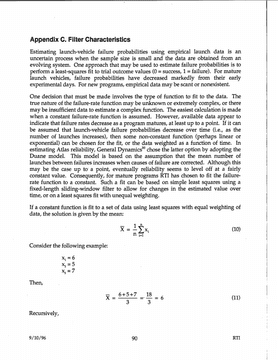
PAGE 132

report

This page contains a list of technical summaries for various missile and space flight missions (LV-3A/Agena B, 67E, 145D, 87D, 57F, 179D, 4D, 215 D, and 13F) conducted between June and November 1962.

131. LV-3A/Agena B (Rubber Gun), 17 June 62, Response Mode 4, Flight Phase 3: Although Atlas performance was satisfactory, the mission was apparently a failure. No other data available.

134. 67E (Extra Bonus), 13 July 62, Response Mode 4, Flight Phase 2 and 2.5: A LOX leak in the high-pressure line apparently froze sustainer control components. Residual sustainer thrust after cutoff continued for some 30 seconds, causing a 120-mile overshoot.

137. 145D (Mariner R-1), 22 July 62, Response Mode 5, Flight Phase 2: Booster stage and flight appeared normal until after booster staging at guidance enable at about 157 seconds. Operation of guidance rate beacon was intermittent. Due to this and faulty guidance equations, erroneous guidance commands were given based on invalid rate data. Vehicle deviations became evident at 172 seconds and continued throughout flight with a maximum yaw deviation of 60° and pitch deviation of 28° occurring at 270 seconds. The vehicle deviated grossly from the planned trajectory in azimuth and velocity, and executed abnormal maneuvers in pitch and yaw. The missile was destroyed by the RSO at 293.5 seconds, some 12 seconds after SECO.

141. 87D (Peg Board II), 9 Aug 62, Response Mode 4, Flight Phase 2.5: Failure of the sustainer/vernier hydraulic system to maintain system pressure prevented normal operation during the vernier solo phase.

142. 57F (Crash Truck), 10 Aug 62, Response Mode 5, Flight Phase 1: The roll program failed. The missile was destroyed by the RSO at 68 seconds.

144. 179D (Mariner R-2), 27 Aug 62, Response Mode NA, Flight Phase 2: Flight was successful although roll control was lost during the period from 140 seconds to 190 seconds due to erratic performance of vernier engine #2. Before and after this time interval, vernier #2 and all other Atlas and Agena systems performed normally.

146. 4D (Briar Street), 2 Oct 62, Response Mode 4, Flight Phase 2: The missile self-destructed at 183 seconds. The vernier engines shut down prematurely at 46 seconds. Subsequently, closure of the vernier bleed valves led to excessively high sustainer performance and premature shutdown at 181.3 seconds.

148. 215 D (Ranger-5), 18 Oct 62, Response Mode NA, Flight Phase 5: Flight was regarded as successful although failure in the ground control system 35 minutes after launch prevented accomplishment of primary lunar impact and study mission. The guidance rate beacon failed at 94.6 seconds but backup differentiated tracking data kept the vehicle within normal limits.

153. 13F (Action Time), 14 Nov 62, Response Mode 4, Flight Phase 1: The flight was terminated when sustainer and vernier engines shut down prematurely at

PAGE 133

report

This page contains a list of technical flight failure reports for various missile missions (131D, 64E, 160D, 39D, 102D, 64D, 193D, 83F) occurring between December 1962 and March 1963.

94.3 seconds. A thrust-section fire before 20 seconds apparently failed the lube oil system, which led to cessation of propellant flow.

156. 131D LV-3A/Agena B (Bargain Counter), 17 Dec 62, Response Mode 4T, Flight Phase 1: Mission failed because of an Atlas hydraulic failure. Missile lost stability at 77.5 seconds, then rolled clockwise, pitched down and yawed left before breaking up at about 80.5 seconds.

157. 64E (Oak Tree), 18 Dec 62, Response Mode 4T, Flight Phase 1: The B2 engine failed at 37.1 seconds as a result of lubrication loss to the pinion gear. Booster engine shutdown resulted in a violent rolling yaw maneuver that caused missile breakup followed by an explosion at about 38 seconds.

158. 160D (Fly High), 22 Dec 62, Response Mode 4, Flight Phase 2: Due to noisy data, range safety limits in the automatic cutoff system were exceeded, causing generation of an all-engines-cutoff signal. As a result, the vernier engines were cut off about 10 seconds early, and the reentry vehicle was about 12.3 miles short.

159. 39D (Big Sue), 25 Jan 63, Response Mode 4, Flight Phase 1: Propulsion system performance was unsatisfactory after 78 seconds, when booster engine performance started to decay. Booster engines shut down shortly after this, probably as a result of excessive heating in the gas-generator regulator. The sustainer operated normally until at least 106 seconds, with shutdown occurring sometime between 106 and 126 seconds. Breakup occurred about 300 seconds. Missile apparently impacted about 100 miles downrange.

164. 102D (Tall Tree 3), 9 Mar 63, Response Mode 5, Flight Phase 1: A flight-control malfunction occurred at about 15 seconds at the start of the pitch program. The missile pitched excessively, reaching 310° and an altitude of 5,000 feet at 33.5 seconds when it broke up. Debris impacted close to pad.

166. 64D (Tall Tree 1), 15 Mar 63, Response Mode 4T, Flight Phase 2: A sustainer hydraulic-system failure at 83.5 seconds resulted in loss of sustainer engine control by 86 seconds and loss of vernier control at 99 seconds. Missile control was maintained by the booster engines until booster cutoff, when lack of sustainer and vernier control caused the missile to roll clockwise, pitch up, and yaw left. Sustainer thrust decayed at 131 seconds, and the missile began tumbling at 136.6 seconds. Missile self-destructed at 146 seconds with impact point about 600 miles downrange.

168. 193D (Leading Edge), 16 Mar 63, Response Mode 4T, Flight Phase 2: Loss of B2 pitch feedback signal at 103.5 seconds resulted in loss of vehicle stability. Missile tumbled, then self-destructed at about 270 seconds.

169. 83F (Kendall Green), 21 Mar 63, Response Mode 4, Flight Phase 2.5: A defective solder joint apparently led to two instances of erroneous velocity computations in

9/10/96 124 RTI

PAGE 134

report

This page contains a list of missile flight test summaries, detailing specific malfunctions and flight outcomes for various test missions conducted in 1963.

the x and z velocity channels. As a result, the missile impacted about 12 miles short and 0.2 miles right of target.

170. 52F (Tall Tree 4), 23 Mar 63, Response Mode 4, Flight Phase 1: Missile self-destructed at about 91 seconds for unknown reasons. Impact was near the flight line about 120 miles downrange.

171. 65E (Black Buck), 24 Apr 63, Response Mode NA, Flight Phase 2.5: Vernier hydraulic-system pressure was lost at 301 seconds, resulting in loss of vernier-engine control during the vernier solo phase. The reentry vehicle impact point was not perceptibly affected by this malfunction.

176. 139D LV-3A/Agena B (Big Four), 12 Jun 63: Response Mode 4T, Flight Phase 1: Flight appeared normal until about 88.4 seconds when, due to a hydraulic failure, the vehicle made a violent right and down maneuver. The missile broke up five seconds later at 93.4 seconds.

181. 24E (Silver Doll), 26 July 63, Response Mode 4, Flight Phase 2: Spurious voltage transients caused premature pressurization of the vernier solo tanks at 101.3 seconds, and premature sustainer engine shut down just after booster separation at 141 seconds.

187. 63D (Cool Water III), 6 Sep 63, Response Mode 4, Flight Phase 1: All systems performed satisfactorily till 110 seconds, when the sustainer/vernier hydraulic pressure dropped from 3080 to 490 psig. The failure resulted in premature shutdown of the sustainer engine at 136 seconds. Booster-engine cutoff occurred normally at 140.3 seconds, and the booster was successfully jettisoned. The impact point occurred about 620 miles downrange.

188. 84D (Cool Water IV), 11 Sep 63, Response Mode 4T, Flight Phase 2.5: Flight seemed normal through SECO, although the pneumatic precharge to the vernier solo accumulator was lost at 96.6 seconds. Due to this failure, missile stability was lost near the start of the vernier solo phase. The R/V probably failed to separate.

189. 71E (Filter Tip), 25 Sep 63, Response Mode 4T, Flight Phase 2: Visual observers reported a boat-tail fire, radical oscillations in yaw, and rough running booster and sustainer engines. Failure of the sustainer hydraulic system during the staging sequence resulted in loss of missile stability at 140 seconds. Sustainer and vernier engines shut down at about 267 seconds with the impact point about 600 miles downrange.

190. 45F (Hot Rum), 3 Oct 63, Response Mode 1, Flight Phase 1: The B-1 booster-engine fuel valve failed to open during the start sequence, so the engine did not ignite. Missile toppled over and exploded.

9/10/96 125 RTI

PAGE 135

report

This page contains a list of flight test summaries for various missile and space launch missions conducted between 1963 and 1965, detailing mission outcomes and technical failures.

191. 163D (Cool Water V), 7 Oct 63, Response Mode 4, Flight Phase 1: Flight was normal up to about 73 seconds when the missile exploded. Suspected cause was intermediate bulkhead reversal/rupture due to insufficient helium pressure.

194. 136F (ABRES), 28 Oct 63, Response Mode 4T, Flight Phase 2: After a normal booster phase and staging, failure of sustainer hydraulic system resulted in loss of sustainer control and stability at 138 seconds. Sustainer and vernier engines shut down at 260 seconds, some 28 seconds early. The R/V impacted about 507 miles downrange.

196. 158D (Cool Water VI), 13 Nov 63, Response Mode 4, Flight Phase 1: The trajectory was low throughout flight. The sustainer/vernier hydraulic pressure was lost at 112.7 seconds, followed by missile self-destruct at about 118 seconds when the vacuum impact point was about 280 miles downrange and on azimuth.

202. 48E (Blue Bay), 12 Feb 64, Response Mode 4, Flight Phase 2: The booster engine shut down at 119.5 seconds, and the sustainer engine shut down prematurely at 198.8 seconds. Impact was near the flight line about 635 miles downrange.

207. 3F (High Ball), 3 Apr 64, Response Mode 1, Flight Phase 1: Missile was destroyed on the pad when the B1 booster engine failed to ignite.

212. 135D (AC-3), 30 June 64, Response Mode 4, Flight Phase 3: The Centaur engines shut down early, apparently due to a hydraulic coupling failure that led to a failure in the propellant system. Impact was about 2340 miles downrange.

219. 57E (Gallant Gal), 27 Aug 64, Response Mode 4, Flight Phase 2: Missile experienced an early SECO with no vernier burn thereafter due to a guidance-system malfunction. Impact was about 88 miles short and 0.4 miles right of target.

227. 289D (Mariner-3),5 Nov 64, Response Mode 4, Flight Phase 4: A short second burn of the Agena prevented attainment of the desired orbit, and resulted in a heliocentric orbit.

232. 146D, 11 Dec 64, Response Mode NA, Flight Phase 5: Flight was completely normal through Centaur first burn. During the coast phase, liquid hydrogen vented through the vent valve caused vehicle instability and tumbling. By second engine firing, insufficient liquid hydrogen remained at boost-pump sump to sustain normal combustion.

236. 172D/ABRES (Beaver’s Dam), 21 Jan 65: Response Mode 4, Flight Phase 2 and 3: The Atlas apparently performed normally, except that the sustainer shut down 1.35 seconds early. The OV1-1 failed to separate from the Atlas and thus failed to put the spacecraft in orbit.

9/10/96 126 RTI

PAGE 136

report

This page contains a list of flight test summaries for various aerospace vehicles, detailing specific failures and flight outcomes for missions occurring between 1965 and 1966.

240. 156D, 2 Mar 65, Response Mode 1 Flight Phase 1: At 0.36 seconds booster fuel-pump pressure dropped due to a fuel prevalve failure, booster lost thrust, fell back on launch pad, and was destroyed at 3.26 seconds.

251. 68D/ABRES (Tennis Match), 27 May 65: Response Mode 4, Flight Phase 1: A failure in the booster gas-generator loop resulted in decreasing booster performance after 116 seconds. The impact point stopped moving at 122 seconds when an explosion occurred in the thrust section. Further vehicle breakup occurred at 218 seconds. Destruct was sent at 293 seconds. Debris impacted close to the intended ground track.

257. SLV-3/Agena D (White Pine), 12 Jul 65: Response Mode 4 & 5, Flight Phase 2 & 3: Flight was normal until booster engines cutoff at 131 seconds. As a result of a circuit board failure caused by excessive vibrations, the sustainer also shutdown at BECO. The Atlas booster engines did not separate immediately from the sustainer, but did so some 50 seconds later after the event timer recycled. The Agena subsequently separated and ignited at about 198 seconds, creating wild uprange movements on the IP display by 255 seconds. Destruct was sent at 257 seconds.

267. SLV-3 (GTV-6), 25 Oct 65, Response Mode 4, Flight Phase 3: The flight was a failure although all Atlas objectives were achieved. The Agena startup appeared normal, but the engine shut down after about one second of operation, Propellants ceased flowing but the helium pressurization system continued to pressurize the propellant tanks until they burst.

276. 303D (Eternal Camp), 4 Mar 66, Response Mode 5, Flight Phase 1: Although track and rate lock were lost at 88 seconds, missile appeared normal till about 112 seconds when skyscreen operator reported that vehicle was spiraling. A hydraulic system failure occurred during the staging sequence, resulting in loss of vehicle stability at 153 seconds and sustainer engine shutdown at 194 seconds. The impact point initially appeared to stop about 800 miles downrange, well beyond the booster impact point. At about this time or shortly thereafter, telemetry indicated rapidly varying pitch, roll, and yaw rates and shutdown of sustainer and vernier engines. Final impact was estimated to be 976 miles downrange and 3° left of the nominal track.

279. 304D (White Bear), 19 Mar 66, Response Mode 5, Flight Phase 2: The reentry vehicle impacted 82 miles beyond the target point when the head suppression valve failed to close at SECO. The LOX tank thus vented through the sustainer chamber, adding impulse in the process.

281. 184D (AC-8) ,7 Apr 66, Response Mode 4T, Flight Phase 4: Flight appeared normal until second Centaur burn. Both Centaur engines started but one could not

PAGE 137

report

This page contains a list of flight test reports for various aerospace vehicles, detailing malfunctions, flight phases, and outcomes for missions occurring between May and October 1966.

maintain thrust. Thrust imbalance resulted in tumbling, followed by fuel starvation, and early thrust termination. 284. 208D (Crab Claw), 3 May 66, Response Mode 4T, Flight Phase 1: High engine-compartment temperatures were first noted at 41 seconds. The sustainer pitch-actuator feedback-loop failed open at 136 seconds, a few seconds before planned BECO. The flight appeared normal to the safety officer until about this time when roll and pitch rates increased. The IIP apparently stopped about 155 seconds, although General Dynamics reported that vehicle stability was not lost until 216 seconds. Shutdown of sustainer and vernier engines occurred at 235 seconds. Suspected cause of malfunction was excessive heating in the boat-tail section. 287. SLV-3 (GTA-9), 17 May 66, Response Mode 5, Flight Phase 1: Vehicle became unstable when B2 pitch control was lost at 121 seconds. Loss of pitch control resulted in a pitch-down maneuver much greater than 90°. Guidance control was lost at 132 seconds. After BECO, the vehicle stabilized in an abnormal attitude. Although the vehicle did not follow the planned trajectory, SECO (at 280 seconds), VECO (at 298 seconds), and Agena separation occurred normally from programmer commands. 294. 96D (Veneer Panel), 10 Jun 66, Response Mode 4, Flight Phase 2.5: The reentry vehicle undershot the target by 20 miles when the vernier engines shut down early. Failure was caused by an abnormal decay of control-bottle helium pressure. 298. 58D/ABRES (Stony Island), 13 July 66: Response Mode NA, Flight Phase 3: Flight was regarded as a success, although one of two OV's failed to orbit when it impacted the structure door which had not been opened. 300. 149F (Busy Ramrod), 8 Aug 66, Response Mode 4, Flight Phase 2: The sustainer engine shut down 27 seconds early due to fuel depletion caused by an unfavorable ratio of propellant usage during the booster stage. Verniers burned to fuel depletion. 306. 194D (AC-7), 20 Sep 66, Response Mode NA, Flight Phase 5: Atlas Centaur performance was normal, but Surveyor spacecraft lost stability on the way to the moon. 308. 115F (Low Hill), 11 Oct 66, Response Mode 4, Flight Phase 1: The missile was normal till about 85 seconds when it appeared to lose thrust and breakup. Several major pieces impacted 32 to 40 miles downrange near the intended flight line. 310. 174D (AC-9), 26 Oct 66, Response Mode NA, Flight Phase 2: Although Atlas pressurization system anomaly caused decaying sustainer engine performance and early SECO, no mission objectives were compromised. 9/10/96 128 RTI

PAGE 138

report

This page contains a list of flight test reports for various missile and launch vehicle missions (148F, 81F, 95F, 5104C, 7004, 56F, 5403C, 98F) detailing anomalies and performance outcomes.

318. 148F (Busy Stepson), 17 Jan 67, Response Mode NA, Flight Phase 2.5: Flight was normal except that reentry vehicle failed to separate.

344. 81F (ABRES/AFSC), 27 Oct 67, Response Mode 4T, Flight Phase 1: Although various anomalous events occurred early in flight, the missile appeared to follow the intended trajectory till about 24 seconds. Diverging roll oscillations actually began about 21.4 seconds, and pitch and roll stability were lost by 24.8 seconds. By 27.9 seconds, the vehicle was tumbling about 6.5 degrees per second in pitch and yaw, and 12 degrees per second in roll. By 30 seconds, the vehicle lost all thrust and began to break up. Fuel cutoff and destruct were sent at 35 and 39 seconds, respectively.

358. 95F (ABRES/AFSC), 3 May 68, Response Mode 5, Flight Phase 1: Immediately after liftoff the telemetered roll and yaw rates indicated that the missile was erratic. During the first 10 seconds of flight the missile yawed hard to the left. It then began a hard yaw to the right, crossed over the flight line and continued toward the right destruct line. Shortly thereafter the missile apparently pitched up violently and the IIP began moving back toward the beach. The missile was destructed at about 45 seconds when the altitude was about 14,000 feet and the downrange distance about 9 miles. Major pieces impacted less than a mile offshore, indicating uprange movement of the impact point during the last part of thrusting flight.

364. 5104C AC-17 (ATS-D), 10 Aug 68, Response Mode NA, Flight Phase 4: A normal parking orbit was achieved, but when Centaur restart was attempted, thrust could not be maintained because of inoperative boost pumps. Frozen H2O2 line was the apparent root cause.

365. 7004 SLV-3/Burner II/Agena D (AFSC), 16 Aug 68: Response Mode 4, Flight Phase 3: Atlas performance was normal. The vehicle failed to achieve orbit because the protective shroud surrounding the second stage failed to separate.

368. 56F (ABRES/AFSC), 16 Nov 68, Response Mode 4T, Flight Phase 2.5: Flight was normal through SECO. The missile then lost attitude control, executing a hard yaw rate turn throughout and beyond the vernier solo phase.

372. 5403C AC-20 (Mariner 6 Mars), 24 Feb 69, Response Mode NA, Flight Phase 1: Early Atlas BECO due to staging accelerometer failure was compensated for by extended Atlas sustainer and Centaur burns. Mission was successful.

379. 98F (ABRES/AFSC), 10 Oct 69, Response Mode 4, Flight Phase 1: The missile appeared normal until about 66 seconds when the sustainer engine shut down prematurely. The booster engine apparently continued normally to BECO. At about 255 seconds the payload SPDS engine ignited. Destruct was sent at 272 seconds.

9/10/96 129 RTI

PAGE 139

report

This page contains a list of historical launch vehicle failures and anomalies, detailing specific flight phases, causes of failure, and outcomes for various missions.

388. 5003C AC-21 (OAO-B), 30 Nov 70, Response Mode 4, Flight Phase 2: Since the nose fairing failed to separate, Centaur did not have enough energy to make orbit. Payload impacted in Africa.

392. 5405C AC-24 (Mariner 8 Mars), 8 May 71, Response Mode 4T, Flight Phase 3: Mission requirements were not met. The Atlas boost phase was normal. Shortly after Centaur main-engine start, pitch stabilization was lost due to failure of the rate gyro or an electrical failure in the pitch channel of the flight control system. The vehicle began an accelerated nose-down tumbling motion that subsequently resulted in early and erratic main-engine shutdown due to propellant starvation.

397. SLV-3A (Agena), 4 Dec 71, Response Mode 4, Flight Phase 1: Sustainer engine turbine damage during engine start resulted in hot gas leaks and eventual failure of thrust-section hardware. Vehicle broke up at 87 seconds.

419. 5015D AC-33 (Intelsat IV F-6), 20 Feb 75, Response Mode 4T, Flight Phase 2: The Atlas booster-section electrical disconnect failed at booster staging. The harness was pulled apart, so flight-control avionics was unable to maintain vehicle stability. Missile appeared normal until the IP stopped at 200 seconds. Precautionary destruct was sent at 414 seconds.

420. 71F (AFSC), 12 Apr 75: Response Mode 4, Flight Phase 1: Although an abnormal overpressure occurred at the base of the missile 620 msec before liftoff, the vehicle appeared normal until about 45 seconds when sustainer manifold and fuel-pump pressures began dropping. By 61 seconds, both the sustainer and vernier engines had shut down. Booster engines continued thrusting until about 123 seconds when the IIP stopped moving and radar operator reported multiple pieces. The breakup apparently resulted from an external explosion in the flame bucket that damaged the thrust section. Destruct was sent at 303 seconds when missile elevation dropped to 5°.

432. 5701D AC-43 (Intelsat IVA F-5), 29 Sep 77, Response Mode 4T, Flight Phase 1: A leak in the booster hot-gas generator at 2.3 seconds resulted in a fire in the thrust section at 36.5 seconds. The vehicle went into a violent maneuver at 54.9 seconds, failing the structure. The Atlas exploded at 55.8 seconds, leaving the Centaur intact. The Centaur was destroyed by the RSO at 61.7 seconds.

457. 19F (NOAA-B), 29 May 80: Response Mode NA, Flight Phase 1: Failure of turbopump seal allowed fuel to enter the gear box resulting in 21% low thrust by the B1 booster engine. The payload was inserted into an abnormal orbit and the mission was lost.

460. 68E, 8 Dec 80: Response Mode 5, Flight Phase 1: Flight appeared normal until 102.7 seconds when the lube oil pressure on the B2 booster engine suddenly dropped. At 120.1 seconds, the engine shut down, followed 385 msec later by guidance shutdown of the B1 engine. The asymmetric thrust during shutdown

PAGE 140

report

This page contains technical summaries of various launch vehicle failures and anomalies, including specific mission identifiers, dates, and descriptions of the mechanical or environmental causes for each incident.

caused yaw and roll rates that the flight control system could not correct. As a result, attitude control was lost and the thrusting sustainer pivoted the missile to a retrofire attitude before the vehicle could be stabilized. After the booster package was jettisoned, the missile was stabilized and decelerating in the retrofire mode by 148 seconds. The sustainer continued thrusting in this attitude until 282.9 seconds when reentry heating apparently caused sustainer shutdown and vehicle breakup.

464. 5039D AC-59 (FLTSATCOM), 6 Aug 81, Response Mode NA, Flight Phase 1 and 5: The basic mission was accomplished although three increasingly severe shock events were recorded at 56.2, 70.7, and 120.8 seconds. The structural damage sustained by the spacecraft severely limited on-orbit operations.

466. 76E (NAVSTAR VII), 18 Dec 81: Response Mode 2, Flight Phase 1: Shortly after clearing the launch tower at an altitude of about two tower heights, the thrust performance of the B1 engine began to decay. The engine was shut down completely by 7.4 seconds. The unbalanced thrust caused the missile to pitch over to the right, and travel horizontally for about one second. It then pitched toward the ground. A small explosion occurred about one-third of the way down, followed by a larger explosion when the missile impacted the ground directly behind the launch pad about 19 seconds after liftoff. Cause of the engine failure was plugging of the gas-generator fuel-cooling parts that resulted in a gas-generator burn-through.

477. 5042G AC-62 (Intelsat V), 9 Jun 84, Response Mode 4T, Flight Phase 4: Performance was normal until an abnormal shock event occurred at Atlas/Centaur separation. Subsequent data indicated that a Centaur oxygen tank leak resulted in a loss of 1483 pounds of LOX during Centaur first burn. The leak resulted in the LOX tank pressure falling below the LH2 tank pressure, which led to collapse of the intermediate bulkhead during the coast phase. Bulkhead collapse caused unexpected tumbling forces during coast. The Centaur engines restarted after coast, but burned for only 6 or 7 seconds of a planned 90-second burn.

489. 5048G AC-67 (FLTSATCOM F-6), 26 Mar 87, Response Mode 4T, Flight Phase 1: Vehicle performance was normal until 48.4 seconds, when the vehicle was struck by lightning. As a result, the guidance computer commanded a hard right turn which caused vehicle breakup due to inertial and aerodynamic loads. RSO sent destruct at 70.7 seconds.

498. 5050 AC-70 (BS-3H COMSAT), 18 Apr 91, Response Mode 4T, Flight Phase 3: Atlas performance was normal. Although both Centaur main engines began the start sequence properly, the C-1 turbo-machinery decelerated and stopped, leaving the C-1 engine thrust at the ignition level. Air entering through the stuck-open check valve liquefied and froze in the LH2 pump and gear box of the C-1

PAGE 141

report

This page contains technical summaries of two launch failures (AC-71 and AC-74) involving Centaur engines and Atlas performance.

engine, thus preventing the engine from achieving full thrust. Due to the resulting thrust imbalance, the vehicle tumbled out of control. Destruct was sent some 80 seconds after Centaur ignition.

506. 5051 AC-71 (Galaxy 1R), 22 Aug 92, Response Mode 4T, Flight Phase 3: A Centaur engine check valve stuck open allowing air into the turbopumps. Air entering through the stuck-open check valve liquefied and froze in the LH2 pump and gear box of the C-1 engine, which prevented the engine from achieving full thrust. Destruct was sent by the RSO about 193 seconds after Centaur ignition. This is the same failure experienced by AC-70 launched on 18 Apr 91.

507. 5054 AC-74 (UHF Follow On-1), 25 Mar 93, Response Mode NA, Flight Phase 2 and 5: The flight was considered successful although below normal Atlas performance resulted in a low spacecraft apogee (5000 nm vice planned 9225 nm). The perigee altitude was near nominal at 120 nm. A loose screw that allowed the oxygen regulator to go out of adjustment caused booster-engine thrust to drop to 65% of nominal at 103 seconds. The booster engines remained attached to the sustainer, which flew to propellant depletion. These events led to depletion shutdown of the Centaur stage 22 seconds early.

PAGE 142

report

This page provides a historical overview of the Delta launch-vehicle family, including its origins, technical specifications, and a summary table of various Delta configurations.

D.3 Delta Launch and Performance History

The Delta launch-vehicle family originated in 1959 with a NASA contract to Douglas Aircraft Company, now McDonnell Douglas Corporation. The Delta, using components form USAF’s Thor IRBM program and USN’s Vanguard launch-vehicle program, was operational 18 months later. On May 13, 1960, the first Delta was launched from Cape Canaveral with a 179-pound Echo-I passive communications satellite. In the intervening years, the Delta has evolved to meet the ever-increasing demands of its payloads – including weather, scientific, and communications satellites. Each Delta modification corresponded to an increase in payload capacity. Table 42 shows a summary of Delta configurations since the beginning of the program.[10]

The Delta 7925, the latest vehicle in the series, is a three-stage liquid-propellant vehicle with nine solid-propellant strap-on booster motors. For propellants, the Delta uses RP-1 and liquid oxygen in Stage 1, and nitrogen tetroxide and aerozine 50 in Stage 2. Stage 3 consists of a Payload Assist Module (PAM) with a solid-propellant motor. The strap-on boosters are Hercules graphite epoxy motors (GEMs) using HTPB-type solid propellant. At liftoff, the liquid-propellant Stage-1 engine and six of the nine GEMs are ignited. The remaining three GEMs are ignited some 65 seconds later.

Table 42. Summary of Delta Vehicle Configurations
Configuration | Description
Delta | Stg. 1: Modified Thor. MB-3 Blk I engine
| Stg. 2: Vanguard AJ10-118 propulsion system
| Stg. 3: Vanguard X-248 motor
A | Stg. 1: Engine replaced with MB-3 Blk II
B | Stg. 2: Tanks lengthened; higher energy oxidizer used
C | Stg. 3: Replaced with Scout X-258 motor
| PLF: Bulbous replaced low drag
D | Stg. 0: Added 3 Thor-developed SRMs (Castor I)
E | Stg. 0: Castor II replaced Castor I
| Stg. 1: MB-3 Blk III replaced Blk II
| Stg. 2: Propellant tank diameters increased
| Stg. 3: Replaced with USAF-developed FW-4 motor
| PLF: Fairing enlarged to 65-inch diameter
J | Stg. 3: TE-364-3 used
L, M, N | Stg. 1: Tanks lengthened, RP-1 tank diameter increased
| Stg. 3: Varied: FW-4 (L), TE-364-3 (M), none (N)
M-6, N-6 | Stg. 0: Six Castor IIs employed
900 | Stg. 0: No Castor IIs employed
| Stg. 2: Replaced with Transtage AJ10-118F engine
1604 | Stg. 0: Six Castor IIs employed
| Stg. 3: Replaced with TE-364-4

9/10/96 133 RTI

PAGE 143

report

A technical table detailing various rocket configurations and the specific engine or component changes associated with each model number.

Configuration | Description
1910, 1913, 1914 | Stg. 0: Nine Castor IIs employed
Stg. 3: Varied: none (1910), TE-364-3 (1913), TE-364-4 (1914)
PLF: 96-inch diameter replaced 65-inch
2310, 2313, 2314 | Stg. 0: Three Castor IIs employed
Stg. 1: RS-27 replaced MB-3
Stg. 2: TR-201 engine replaced AJ10-118F
Stg. 3: Varied: none (2310), TE-364-3 (2313), TE-364-4 (2314)
2910, 2913, 2914 | Stg. 0: Nine Castor IIs employed
Stg. 3: Varied: none (2910), TE-364-3 (2913), TE-364-4 (2914)
3910, 3913, 3914 | Stg. 0: Nine Castor IVs replaced Castor IIs
Stg. 3: Varied:none or PAM (3910),TE-364-3 (3913),TE-364-4 (3914)
3920, 3924 | Stg. 2: AJ10-118K engine replaced TR-201
Stg. 3: Varied: none or PAM (3920), TE-364-4 (3924)
4920 | Stg. 0: Castor IVA replaced Castor IV
Stg. 1: MB-3 replaced RS-27
5920 | Stg. 1: RS-27 replaced MB-3
6925 | Stg. 1: Tanks lengthened 12 feet
Stg. 3: STAR 48B motor used
PLF: Bulbous 114-inch diameter used
7925 | Stg. 0: GEM replaced Castor IVA
Stg. 1: RS-27A replaced RS-27

9/10/96 134 RTI

PAGE 144

report

This page provides a summary of Delta launch history through 1995, using a bar graph to distinguish between normal performance and launches involving failures or anomalous behavior.

The entire Delta history through 1995 is depicted rather compactly in bar-graph form in Figure 38. The solid-block portion of each bar indicates the number of launches during the calendar year for which vehicle performance was entirely normal, in so far as could be determined. The clear white parts forming the tops of most bars show the number of launches that were either failures or flights where the launch vehicle experienced some sort of anomalous behavior. Every launch with an entry in the response-mode column in Table 43 falls in this category. Such behavior did not necessarily prevent the attainment of some, or even all, mission objectives.

[GRAPH: Figure 38. Delta Launch Summary]

9/10/96 135 RTI

PAGE 145

report

This page provides a summary of Delta and Delta-boosted space-vehicle launch history, including a table detailing the first 30 launches with their respective dates, configurations, and failure data.

D.3.1 Delta Launch History

The data in Table 43 summarizes all Delta and Delta-boosted space-vehicle launches since the program began. A launch sequence number is provided in the first column. A launch ID and date are provided in columns 2 and 3. The fourth column indicates the vehicle configuration. The fifth column indicates the launch range. The sixth column indicates the failure-response mode (1 through 5 and NA) that RTI has determined best describes the failure that occurred. For Mode 3 or 4 failures, a suffix of 'T' indicates the vehicle tumbled. Successful launches are indicated by a blank in the Response-Mode column. The seventh column indicates the operational flight phase during which the failure occurred. The last column indicates whether the vehicle configuration is representative of those being launched today. Launches through sequence number 232 were used in the filtering process to estimate failure rate.

Table 43. Delta Launch History
No. Mission/ID Launch Date Vehicle Configuration Test Range Response Mode Flight Phase Rep. Conf.
1 ECHO I 05/13/60 DM-19 ER 4 2.5 0
2 ECHO IA 08/12/60 DM-19 ER 0
3 TIROS A2 11/23/60 DM-19 ER 0
4 P-14 03/25/61 DM-19 ER 0
5 TIROS A3 07/12/61 DM-19 ER 0
6 S-3 08/15/61 DM-19 ER 0
7 TIROS D 02/08/62 DM-19 ER 0
8 S-16 03/07/62 DM-19 ER 0
9 S-51 04/26/62 DM-19 ER 0
10 TIROS E 06/19/62 DM-19 ER NA 5 0
11 TSX-1 07/10/62 DM-19 ER 0
12 TIROS F 09/18/62 DM-19 ER 0
13 S-3A 10/02/62 DSV-3A ER 0
14 S-3B 10/27/62 DSV-3A ER 0
15 RELAY A-15 12/13/62 DSV-3B ER 0
16 SYNCOM A-25 02/13/63 DSV-3B ER 0
17 S-6 04/02/63 DSV-3B ER 0
18 TSX-2 05/07/63 DSV-3B ER 0
19 TIROS G 06/19/63 DSV-3B ER 0
20 SYNCOM A-26 07/26/63 DSV-3B ER 0
21 IMP A 11/26/63 DSV-3C ER 0
22 TIROS H 12/21/63 DSV-3B ER 0
23 RELAY A-16 01/21/64 DSV-3B ER 0
24 S-66 03/19/64 DSV-3B ER 4 3 0
25 SYNCOM A-27 08/19/64 DSV-3D ER 0
26 IMP-B 10/03/64 DSV-3C ER NA 5 0
27 S-3C 12/21/64 DSV-3C ER 0
28 TIROS I 01/22/65 DSV-3C ER NA 2 & 5 0
29 OSO-B 02/03/65 DSV-3C ER 0
30 COMSAT #1 04/06/65 DSV-3D ER 0

9/10/96 136 RTI

PAGE 146

report

This page is a table listing various space missions, their launch dates, vehicle configurations, test ranges, response modes, and flight phases.

No. Mission/ID Launch Date Vehicle Configuration Test Range Response Mode Flight Phase Rep. Conf. 31 IMP-C 05/29/65 DSV-3C ER 0 32 TIROS OT-1 07/01/65 DSV-3C ER 0 33 OSO-C 08/25/65 DSV-3C ER 4 2.5 0 34 GEOS A 11/06/65 DSV-3E ER NA 2 & 5 0 35 PIONEER A 12/16/65 DSV-3E ER 0 36 TIROS OT-3 02/03/66 DSV-3C ER 0 37 TIROS OT-2 02/28/66 DSV-3E ER 0 38 AE-B 05/25/66 DSV-3C ER NA 2 & 5 0 39 AIMP-D 07/01/66 DSV-3E ER NA 2.5 & 5 0 40 PIONEER-B 08/17/66 DSV-3E ER 0 41 TOS 10/02/66 DSV-3E WR 0 42 INTELSAT II (F-1) 10/26/66 DSV-3E ER 0 43 BIOS-A 12/14/66 DSV-3G ER 0 44 INTELSAT II (F-2) 01/11/67 DSV-3E ER 0 45 TOS 01/26/67 DSV-3E WR 0 46 OSO-E1 03/08/67 DSV-3C ER 0 47 INTELSAT II (F-3) 03/22/67 DSV-3E ER 0 48 TOS D 04/20/67 DSV-3E WR 0 49 IMP-F 05/24/67 DSV-3E WR 0 50 AIMP-E 07/19/67 DSV-3E ER 0 51 BIOS-B 09/07/67 DSV-3G ER 0 52 INTELSAT II (F-4) 09/27/67 DSV-3E ER 0 53 OSO-D 10/18/67 DSV-3C ER 0 54 TOS-C 11/10/67 DSV-3E WR 0 55 PIONEER-C 12/13/67 DSV-3E ER 0 56 GEOS-B 01/11/68 DSV-3E WR 0 57 RAE-A 07/04/68 DSV-3E WR 0 58 TOS-E 08/16/68 DSV-3L WR 0 59 INTELSAT III-A 09/18/68 DSV-3L ER 5 1 0 60 PIONEER-D 11/08/68 DSV-3E ER 0 61 HEOS-A 12/05/68 DSV-3E ER 0 62 TOS-F 12/15/68 DSV-3L WR 0 63 INTELSAT III-C 12/18/68 DSV-3L ER 0 64 OSO-F 01/22/69 DSV-3C ER 0 65 ISIS-A 01/30/69 DSV-3E WR 0 66 INTELSAT III-B 02/05/69 DSV-3L ER 0 67 TOS-G 02/26/69 DSV-3E ER 0 68 INTELSAT III-D 05/21/69 DSV-3L ER 0 69 IMP-G 06/21/69 DSV-3E WR 0 70 BIOS-D 06/29/69 DSV-3L ER 0 71 INTELSAT III-E 07/26/69 DSV-3L ER 5 3 & 5 0 72 OSO-G 08/09/69 DSV-3L ER 0 73 PIONEER-E 08/27/69 DSV-3L ER 5 1 0 74 IDCSP/A-A 11/22/69 DSV-3L ER 0 75 INTELSAT III-F 01/14/70 DSV-3L ER 0 76 TIROS-M 01/23/70 DSV-3L WR 0 9/10/96 137 RTI

PAGE 147

report

This page is a table listing space mission identifiers, launch dates, vehicle configurations, test ranges, response modes, and flight phases for missions numbered 77 through 122.

No. Mission/ID Launch Date Vehicle Configuration Test Range Response Mode Flight Phase Rep. Conf.
77 NATO-A 03/20/70 DSV-3L ER 0
78 INTELSAT III-G 04/22/70 DSV-3L ER NA 1 & 5 0
79 INTELSAT III-H 07/23/70 DSV-3L ER 0
80 IDCSP/A-B 08/19/70 DSV-3L ER 0
81 ITOS-A 12/11/70 DSV-3L WR 0
82 NATO-B 02/03/71 DSV-3L ER 0
83 IMP-I 03/13/71 DSV-3L ER 0
84 ISIS-B 04/01/71 DSV-3E WR 0
85 OSO-H 09/29/71 DSV-3L ER NA 2 & 5 0
86 ITOS-B 10/21/71 DSV-3L WR 4 2 0
87 HEOS-A2 01/31/72 DSV-3L WR 0
88 TD-1 03/11/72 DSV-3L WR 0
89 ERTS-A 07/23/72 900 WR 0
90 IMP-H 09/22/72 1604 ER 0
91 ITOS-D 10/15/72 300 WR 0
92 TELESAT-A 11/10/72 1914 ER 0
93 NIMBUS-E 12/10/72 900 WR 0
94 TELESAT-B 04/20/73 1914 ER 0
95 RAE-B 06/10/73 1913 ER 0
96 ITOS-E 07/16/73 300 WR 4T 2 0
97 IMP-J 10/26/73 1604 ER 0
98 ITOS-F 11/06/73 300 WR 0
99 AE-C 12/16/73 1900 WR 0
100 SKYNET IIA 01/19/74 2313 ER NA 4 & 5 0
101 WESTAR-A 04/13/74 2914 ER NA 1 1
102 SMS-A 05/17/74 2914 ER NA 1 & 5 1
103 WESTAR-B 10/10/74 2914 ER 1
104 ITOS-G 11/15/74 2310 WR 0
105 SKYNET-IIB 11/22/74 2313 ER 0
106 SYMPHONIE-A 12/18/74 2914 ER 1
107 ERTS-B 01/22/75 2910 WR 1
108 SMS-B 02/06/75 2914 ER 1
109 GEOS-C 04/09/75 1410 WR 0
110 TELESAT-C 05/07/75 2914 ER 1
111 NIMBUS-F 06/12/75 2910 WR 1
112 OSO-I 06/21/75 1910 ER 0
113 COS-B 08/08/75 2913 WR 1
114 SYMPHONIE-B 08/26/75 2914 ER 1
115 AE-D 10/06/75 2910 WR 1
116 GOES-A 10/16/75 2914 ER 1
117 AE-E 11/19/75 2910 ER 1
118 RCA-SATCOM-A 12/12/75 3914 ER 1
119 CTS 01/17/76 2914 ER 1
120 MARISAT-A 02/19/76 2914 ER 1
121 RCA-SATCOM-B 03/26/76 3914 ER 1
122 NATO-IIIA 04/22/76 2914 ER 1
9/10/96 138 RTI

PAGE 148

report

A table listing satellite mission data, including launch dates, vehicle configurations, test ranges, and flight phases for missions numbered 123 through 168.

No. Mission/ID Launch Date Vehicle Configuration Test Range Response Mode Flight Phase Rep. Conf.
123 LAGEOS 05/04/76 2913 WR 1
124 MARISAT-B 06/10/76 2914 ER 1
125 PALAPA-A 07/08/76 2914 ER 1
126 ITOS-E2 07/29/76 2310 WR 0
127 MARISAT-C 10/14/76 2914 ER 1
128 NATO IIIB 01/27/77 2914 ER 1
129 PALAPA-B 03/10/77 2914 ER 1
130 ESRO-GEOS 04/20/77 2914 ER NA 2.5 & 5 1
131 GOES-B 06/16/77 2914 ER 1
132 GMS 07/14/77 2914 ER 1
133 SIRIO 08/25/77 2313 ER 0
134 OTS 09/13/77 3914 ER 4 1 1
135 ISEE A/B 10/22/77 2914 ER 1
136 METEOSAT-F1 11/22/77 2914 ER 1
137 CS 12/14/77 2914 ER 1
138 IUE 01/26/78 2914 ER 1
139 L&SAT-C 03/05/78 2910 WR 1
140 BSE 04/07/78 2914 ER 1
141 OTS-2 05/11/78 3914 ER 1
142 GOES-C 06/19/78 2914 ER 1
143 ESRO-GEOS2 07/14/78 2914 ER 1
144 ISEE-C 08/12/78 2914 ER 1
145 NIMBUS-G 10/24/78 2910 WR 1
146 NATO IIIC 11/19/78 2914 ER 1
147 TELESAT-D 12/16/78 3914 ER 1
148 SCATHA 01/30/79 2914 ER 1
149 WESTAR-C 08/09/79 2914 ER 1
150 RCA-C 12/07/79 3914 ER 1
151 SMM 02/14/80 3910 ER 1
152 GOES-D 09/09/80 3914 ER 1
153 SBS-A 11/15/80 3910 PAM ER 1
154 GOES-E 05/22/81 3914 ER 1
155 DE 08/03/81 3913 WR NA 2 & 5 1
156 SBS-B 09/24/81 3910 PAM ER 1
157 SME 10/06/81 2310 WR 0
158 RCA-D 11/20/81 3910 PAM ER 1
159 RCA-C' 01/15/82 3910 PAM ER 1
160 WESTAR-IV 02/26/82 3910 PAM ER 1
161 INSAT-IA 04/10/82 3910 PAM ER 1
162 WESTAR-V 06/09/82 3910 PAM ER NA 1 1
163 L&SAT-D 07/16/82 3920 WR 1
164 TELESAT-F 08/26/82 3920 PAM ER 1
165 RCA-E 10/27/82 3924 ER 1
166 IRAS 01/26/83 3910 WR 1
167 RCA-F 04/11/83 3924 ER 1
168 GOES-F 04/28/83 3914 ER 1
9/10/96 139 RTI

PAGE 149

report

This page is a table listing various space missions, their launch dates, vehicle configurations, test ranges, and other technical parameters.

No. Mission/ID Launch Date Vehicle Configuration Test Range Response Mode Flight Phase Rep. Conf.
169 EXOSAT 05/26/83 3914 WR 1
170 GALAXY-A 06/28/83 3920 PAM ER 1
171 TELSTAR-3A 07/28/83 3920 PAM ER 1
172 RCA-G 09/08/83 3924 ER 1
173 GALAXY-B 09/22/83 3920 PAM ER 1
174 L&SAT-D' 03/01/84 3920 WR 1
175 AMPTE 08/16/84 3924 ER 1
176 GALAXY-C 09/21/84 3920 PAM ER 1
177 NATO-IIID 11/14/84 3914 ER 1
178 GOES-G 05/03/86 3914 ER 4 1 1
179 DELTA 180 09/05/86 3920 ER 1
180 GOES-H 02/26/87 3924 ER 1
181 PALAPA B2-P 03/20/87 3920 PAM ER 1
182 DELTA 181 02/08/88 3910 ER 1
183 NAVSTAR II-1 02/14/89 6925 ER 1
184 DELTA STAR 03/24/89 3920 ER 1
185 NAVSTAR II-2 06/10/89 6925 ER 1
186 NAVSTAR II-3 08/18/89 6925 ER 1
187 BSB-R1 08/27/89 4925 ER 1
188 NAVSTAR II-4 10/21/89 6925 ER 1
189 OOBE 11/18/89 5920 WR 1
190 NAVSTAR II-5 12/11/89 6925 ER 1
191 NAVSTAR II-6 01/24/90 6925 ER 1
192 LOSAT 02/14/90 6920-8 ER 1
193 NAVSTAR II-7 03/26/90 6925 ER 1
194 PALAPA B-2R 04/13/90 6925 ER 1
195 ROSAT 06/01/90 6920-10 ER 1
196 INSAT-1D 06/11/90 4925 ER 1
197 NAVSTAR II-8 08/02/90 6925 ER 1
198 BSB-R2 08/18/90 6925 ER 1
199 NAVSTAR II-9 10/01/90 6925 ER 1
200 INMARSAT-2F1 10/30/90 6925 ER 1
201 NAVSTAR II-10 11/26/90 7925 ER 1
202 NATO IVA 01/07/91 7925 ER 1
203 INMARSAT-2F2 03/08/91 6925 ER 1
204 ASC-2 04/12/91 7925 ER 1
205 AURORA II 05/29/91 7925 ER 1
206 NAVSTAR II-11 07/03/91 7925 ER 1
207 NAVSTAR II-12 02/23/92 7925 ER 1
208 NAVSTAR II-13 04/09/92 7925 ER 1
209 PALAPA B4 05/13/92 7925-8 ER 1
210 EUVE 06/07/92 6920-10 ER 1
211 NAVSTAR II-14 07/07/92 7925 ER 1
212 GEOTAIL 07/24/92 6925 ER 1
213 SATCOM C4 08/31/92 7925 ER 1
214 NAVSTAR II-15 09/09/92 7925 ER 1
9/10/96 140 RTI

PAGE 150

report

A table listing mission IDs, launch dates, vehicle configurations, test ranges, and other flight data for missions 215 through 237.

No. Mission/ID Launch Date Vehicle Configuration Test Range Response Mode Flight Phase Rep. Conf.
215 COPERNIKUS 10/12/92 7925 ER 1
216 NAVSTAR II-16 11/22/92 7925 ER 1
217 NAVSTAR II-17 12/18/92 7925 ER 1
218 NAVSTAR II-18 02/03/93 7925 ER 1
219 NAVSTAR II-19 03/30/93 7925 ER 1
220 NAVSTAR II-20 05/13/93 7925 ER 1
221 NAVSTAR II-21 06/26/93 7925 ER 1
222 NAVSTAR II-22 08/30/93 7925 ER 1
223 NAVSTAR II-23 10/26/93 7925 ER 1
224 NATO IVB 12/08/93 7925 ER 1
225 GALAXY I-R 02/19/94 7925-8 ER 1
226 NAVSTAR II-24 03/10/94 7925 ER 1
227 WIND 11/01/94 7925-10 ER 1
228 KOREASAT 08/05/95 7925 ER NA 1 & 5 1
229 RADAR SAT 11/04/95 7920-10 ER 1
230 X-RAY EXPLORER 12/30/95 7920A-10 ER 1
231 KOREASAT-2 01/14/96 7925 ER 1
232 NEAR 02/17/96 7925-8 ER 1
233 POLAR 02/24/96 7925-10 WR 1
234 GPS-7 03/27/96 7925-8 ER 1
235 MSX 04/24/96 7920-10 WR 1
236 GALAXY 1X 05/24/96 7925A ER 1
237 GPS-26 07/16/96 7925-9.5 ER 1
9/10/96 141 RTI

PAGE 151

report

This page provides a list of Delta program flight failures, detailing the specific mission, date, response mode, flight phase, and the nature of the failure for each incident.

D.3.2 Delta Failure Narratives

The following narratives provide available details about each Delta failure since the beginning of the Delta program. The narratives are numbered to match the flight-sequence numbers in Section D.3.1.

1. Echo I, 13 May 60, Response Mode 4, Flight Phase 2.5: Attitude control lost during second stage coast period. Third stage spun up, but did not fire.

10. Tiros E, 19 June 62, Response Mode NA, Flight Phase 5: The flight was considered a success, although failure of the BTL guidance system resulted in a propellant-depletion shutdown of the second stage. The apogee of the final orbit was 175 miles above the planned value and well outside the three-sigma limit of 76 miles.

24. S-66, 19 Mar 64, Response Mode 4, Flight Phase 3: Spacecraft did not attain orbit. Third-stage burn of X-248 motor was interrupted after 23 seconds of a planned 42-second burn period.

26. Imp B, 3 Oct 64, Response Mode NA, Flight Phase 5: The flight was considered a partial success, although it failed to reach the desired orbital altitude. The apogee was some 52,590 miles below the planned value of 110,000 miles, but perigee was within 3 miles of the desired value of 105 miles.

28. Tiros I, 22 Jan 65, Response Mode NA, Flight Phase 2 and 5: Loss of WECO guidance during second-stage burn caused second stage to burn to oxygen depletion. As a result, spacecraft was inserted into an elliptical rather than a circular orbit.

33. OSO-C, 25 Aug 65, Response Mode 4, Flight Phase 2.5: Third stage ignited after spin up but before separation from second-stage spin table. Payload did not orbit.

34. GEOS A, 6 Nov 65, Response Mode NA, Flight Phase 2 and 5: The flight was considered a success, although failure of the BTL guidance system during second-stage powered flight led to a propellant-depletion shutdown of the stage. Actual apogee was 436 miles too high, and well outside the three-sigma limit.

38. AE-B, 25 May 66, Response Mode NA, Flight Phase 2 and 5: Due to WECO guidance failure (ground system locked on side lobe), second stage burned to propellant depletion, some 12 seconds longer than expected. As a result, the orbital apogee was 800 miles higher than planned.

39. AIMP-D, 1 July 66, Response Mode NA, Flight Phase 2.5 and 5: Although an alternate mission was accomplished, primary objectives could not be achieved because excess velocity imparted to the spacecraft prevented insertion of the

9/10/96 142 RTI

PAGE 152

report

This page contains a list of technical flight anomalies and failures for various spacecraft missions, including Intelsat, Pioneer, OSO-H, and ITOS-B, detailing the specific causes and outcomes of each incident.

spacecraft into a lunar orbit. Possible cause was malfunction of the coast-control system after third-stage spinup and separation.

59. Intelsat III A, 18 Sep 68, Response Mode 5, Flight Phase 1: Due to loss of rate gyro, undamped pitch oscillations began at 20 seconds. Vehicle began a series of violent maneuvers at 59 seconds. During the 13-second period while these maneuvers continued, the vehicle pitched down some 270°, then up 210°, and then made a large yaw to the left. At 72 seconds the vehicle regained control and flew stably in a down and leftward direction until 100 seconds. At this time, with the main engine against the pitch and yaw stops, the destabilizing aerodynamic forces became so large that quasi-control could no longer be maintained. The first stage broke up at 103 seconds. The second stage was destroyed by the RSO at 110.6 seconds. Major pieces impacted about 12 miles downrange and 2 miles left of the flight line.

71. Intelsat III E, 26 July 69, Response Mode NA, Flight Phase 3 and 5: Unknown but anomalous third-stage performance inserted payload into an erroneous orbit. Apogee was some 17,000 miles too low and orbital inclination was 1.5° above planned 28.8°

73. Pioneer E, 27 Aug 69, Response Mode 5, Flight Phase 1: First-stage hydraulics system failed a few seconds before burnout (MECO). The vehicle pitched down, yawed left, rolled counterclockwise driving all gyros off limits, and then tumbled. Second-stage separation and ignition occurred while the vehicle was out of control. After about 20 seconds, the second stage regained control in a yaw-right, pitch-up attitude. The vehicle flew stably in this attitude for about 240 seconds until destroyed by the safety officer at T+484 seconds.

78. Intelsat III G, 22 Apr 70, Response Mode NA, Flight Phase 1 and 5: The flight was considered a success, although low first-stage velocity resulted in a propellant-depletion shutdown of the second stage. As a result, the actual apogee was some 2,220 miles below the planned value of 195,400 miles, and well outside three-sigma limits.

85. OSO-H, 29 Sep 71, Response Mode NA, Flight Phase 2 and 5: Stage-2 hydraulic-system failure caused faulty control during second-stage burn. Spacecraft injected initially into an elliptical orbit, but was later maneuvered into a more satisfactory orbit although perigee was still about 93 miles below the planned value.

86. ITOS-B (WTR), 21 Oct 71, Response Mode 4, Flight Phase 2: Contamination in the oxygen vent valve apparently prevented its proper operation throughout flight. This led to bulkhead rupture during second-stage burn and loss of vehicle control.

9/10/96 143 RTI

PAGE 153

report

This page contains a list of technical flight anomalies and mission outcomes for various satellite launches between 1973 and 1986.

96. ITOS-E (WTR), 16 July 73, Response Mode 4T, Flight Phase 2: Pump-motor failure during second-stage burn at 490 seconds resulted in loss of hydraulic pressure, loss of attitude control, and vehicle tumbling.

100. Skynet IIA, 19 Jan 74, Response Mode NA, Flight Phase 4 and 5: Flight was within normal limits until impact point passed through Africa gate. During the second burn of the second stage, a short circuit in the second-stage electronics package resulted in an improper spacecraft orbit. The satellite reentered the earth's atmosphere five days later on 24 Jan 74.

101. WESTAR-B, 13 Apr 74, Response Mode NA, Flight Phase 1: One solid-rocket motor carried to MECO, but mission was a complete success.

102. SMS-A, 17 May 74, Response Mode NA, Flight Phase 1 and 5: Mission was a partial success, although low first-stage velocity resulted from a liquid oxygen pressure line failure, and a booster shroud that snagged before fully jettisoning. Apogee was some 1,767 miles below the planned value, and well outside three-sigma limits.

130. ESRO-GOES, 20 Apr 77, Response Mode NA, Flight Phase 2.5 and 5: Due possibly to a short circuit in the second stage or failure in one of the two explosive bolts that hold the stage 2/3 clamp band together, the third stage separated prematurely from the second stage while spinning at only two rpms instead of the normal 97 rpms. As a result, coning during third-stage burn resulted in a spacecraft apogee nearly 13,000 miles low, and far outside three-sigma limits.

134. OTS, 13 Sep 77, Response Mode 4, Flight Phase 1: Core vehicle exploded at 57 seconds due to a burn through on the forward end of the #1 Castor IV motor.

155. DE, 3 Aug 81, Response Mode NA, Flight Phase 2 and 5: Flight was considered a success, although a 260-pound deficiency in fuel loading led to a premature propellant-depletion shutdown of the second burn of the second stage and degradation of final orbit. The inertial velocity at SECO was 240 ft/sec lower than planned. Final apogee was some 855 miles too low and well outside three-sigma limits.

162. WESTAR-V, 9 June 82, Response Mode NA, Flight Phase 1: Booster performance was low but mission was a success. Apogee and perigee were within three-sigma limits.

178. GOES-G, 3 May 86, Response Mode 4, Flight Phase 1: An electrical short in a control circuit in first-stage relay box caused premature main-engine shutdown at 71 seconds. Vehicle then tumbled and was broken up by aerodynamic forces. RSO sent destruct at approximately 91 seconds.

9/10/96 144 RTI

PAGE 154

report

This page contains a technical report entry (item 228) regarding a malfunction during the Koreasat launch on August 5, 1995, where a strap-on GEM motor failed to separate.

228. Koreasat, 5 Aug 95, Response Mode NA, Flight Phase 1 and 5: One of three air-ignited strap-on GEMs did not separate because of a malfunction in the separation explosive transfer system. Failure to drop a GEM motor resulted in depletion of second-stage propellants. Although perigee was close to nominal, the apogee was 3,450 nm below the planned value and far outside the 3-sigma limits.

9/10/96 145 RTI

PAGE 155

report

This page provides a historical overview of the Titan family of launch vehicles, detailing their development from the 1950s through the 1980s and their role in the U.S. space program.

D.4 Titan Launch and Performance History

The Titan family of launch vehicles was established in 1955, when the Air Force awarded the Martin Company a contract to build a heavy-duty space system. Titan I was the nation's first two-stage ICBM and the first to be silo-based. It proved many structural and propulsion techniques that were later incorporated into Titan II. The Titan II was a heavy-duty missile using storable propellants that became a man-rated space booster for NASA's Gemini program. Today the Titan II is returning as a space-launch vehicle with the old ICBMs converted to deliver payloads to orbit. Titan III was the outgrowth of propulsion technology developed in both Titan II and Minuteman ballistic-missile programs.

Today's Titan vehicles (II, III, and IV) are derived from the earlier Titans. In 1984, the DOD called for a space-launch system that would complement the Space Shuttle to ensure access to space for certain national-security payloads. The Titan IV program began as a short-term program for ten launches from Cape Canaveral Air Station. However, after the Challenger accident in 1986, the program has grown to 41 vehicles. With the off-loading of DOD payloads from Shuttle, Titan IV has become DOD's main access to space for many of its heavy payloads. Design of the Titan II Space Launch Vehicle (SLV) began at the same time as that for Titan IV. Titan II SLV was developed from refurbished Titan II ICBMs incorporating technology and hardware from the Titan III program.

PAGE 156

report

This page provides a historical summary of the development of the Titan III commercial launch vehicle following the 1986 Challenger accident and includes a table detailing various Titan vehicle configurations.

Shortly after the Challenger accident in 1986, when the US government decided to offload commercial payloads from the Space Shuttle, Martin Marietta announced plans to develop a Titan III commercial launch vehicle with its own funds. The commercial Titan III is derived from the Titan 34D with a stretched second stage and a bulbous shroud for dual or dedicated payloads. The first commercial Titan III was launched with two communications satellites in December 1989. Table 44 shows a summary of Titan space-vehicle configurations since Gemini.[10]

Table 44. Summary of Titan Vehicle Configurations
Configuration | Description
II Gemini | Titan II ICBM converted to a man-rated vehicle
IIIA | Same as Titan II Gemini except stretched stages 1 and 2, and an integral Transtage upper stage
IIIB | Same as IIIA except Agena upper stage instead of Transtage
34B | Same as IIIA except stretched stage 1
IIIC | Same as IIIA with added 5-segment SRMs
IIID | Same as IIIC except no upper stage
IIIE | Same as IIID except Centaur upper stage and 14-foot diameter PLF
34D | Same as 34B with added 5½-segment SRMs. Uses either Transtage or IUS upper stage
II SLV | Refurbished II ICBM with 10-foot diameter PLF
III Commercial | Same as 34D except stretched stage 2, single or dual carrier, enhanced liquid-rocket engines, and 13.1-foot diameter PLF. Can use PAM-D2, Transtage, or TOS upper stage
IV | Same as 34D except stretched stages 1 and 2, 7-segment SRM or 3-segment SRMU, and 16.7-foot diameter PLF. Can use IUS or Centaur upper stage

9/10/96 147 RTI

PAGE 157

report

This page provides a summary of Titan launch history through 1995, using a bar graph to distinguish between normal performance and launches involving failures or anomalies.

The entire Titan history through 1995 is depicted rather compactly in bar-graph form in Figure 39. The solid-block portion of each bar indicates the number of launches during the calendar year for which vehicle performance was entirely normal, in so far as could be determined. The clear white parts forming the tops of most bars show the number of launches that were either failures or flights where the launch vehicle experienced some sort of anomalous behavior. Every launch with an entry in the response mode column in Table 45 falls in this category. Such behavior did not necessarily prevent the attainment of some, or even all, mission objectives.

[GRAPH: Figure 39. Titan Launch Summary]

9/10/96 148 RTI

PAGE 158

report

This page provides a summary of Titan and Titan-boosted space-vehicle launch history, including a table detailing the first 30 launches with their respective configurations, dates, and failure modes.

D.4.1 Titan Launch History

The data in Table 45 summarizes all Titan and Titan-boosted space-vehicle launches since the program began. A launch sequence number is provided in the first column. A launch ID and date are provided in columns 2 and 3. The fourth column indicates the vehicle configuration. The fifth column indicates the launch range. The sixth column indicates the failure-response mode (1 through 5 and NA) that RTI has determined best describes the failure that occurred. For Mode 3 or 4 failures, a suffix of 'T' indicates the vehicle tumbled. Successful launches are indicated by a blank in the Response-Mode column. The seventh column indicates the operational flight phase during which the failure occurred. The last column indicates whether the vehicle configuration is representative of those being launched today. Launches through sequence number 337 were used in the filtering process to estimate failure rate.

Table 45. Titan Launch History

No. Mission/ID Launch Date Vehicle Configuration Test Range Response Mode Flight Phase Rep. Conf.
1 Weapons System (WS) 12/20/58 I (A-1) ER 0
2 WS 02/03/59 I (A-2) ER 0
3 WS 02/06/59 I (A-3) ER 0
4 WS 02/25/59 I (A-5) ER 0
5 WS 04/03/59 I (A-4) ER 0
6 WS 05/04/59 I (A-6) ER 0
7 WS 08/14/59 I (B-5) ER 1 1 0
8 WS 12/12/59 I (C-3) ER 1 1 0
9 WS 02/02/60 I (B-7A) ER 0
10 WS 02/05/60 I (C-4) ER 4T 1 0
11 WS 02/24/60 I (G-4) ER 0
12 WS 03/08/60 I (C-1) ER 4 2 0
13 WS 03/22/60 I (G-5) ER 4 2.5 0
14 WS 04/08/60 I (C-5) ER 4 2 0
15 WS 04/21/60 I (G-6) ER 0
16 WS 04/28/60 I (C-6) ER 0
17 WS 05/13/60 I (G-7) ER 0
18 WS 05/27/60 I (G-9) ER 0
19 WS 06/24/60 I (G-10) ER 0
20 WS 07/01/60 I (J-2) ER 2 1 0
21 WS 07/28/60 I (J-4) ER 4 1 0
22 WS 08/10/60 I (J-7) ER 4 2 0
23 WS 08/30/60 I (J-5) ER 0
24 WS 09/28/60 I (J-8) ER 0
25 WS 09/29/60 I (G-8) ER 4 1 0
26 WS 10/07/60 I (J-3) ER 0
27 WS 10/24/60 I (J-6) ER 0
28 WS 12/20/60 I (J-9) ER 4 2 0
29 WS 01/20/61 I (J-10) ER 4 2 0
30 WS 02/10/61 I (J-11) ER 0

9/10/96 149 RTI

PAGE 159

report

This page is a table listing mission IDs, launch dates, vehicle configurations, test ranges, response modes, and flight phases for missions numbered 31 through 76.

No. Mission/ID Launch Date Vehicle Configuration Test Range Response Mode Flight Phase Rep. Conf.
31 WS 02/20/61 I (J-13) ER 0
32 WS 03/03/61 I (J-12) ER 4 2 0
33 WS 03/28/61 I (J-14) ER 0
34 WS 03/31/61 I (J-15) ER 4 1 0
35 SILVER SADDLE 05/03/61 I WR 0
36 WS 05/23/61 I (J-16) ER 0
37 WS 06/24/61 I (M-1) ER 4T 2 0
38 WS 07/20/61 I (J-18) ER 0
39 WS 07/25/61 I (M-2) ER 0
40 WS 08/03/61 I (J-19) ER 0
41 WS 09/06/61 I (J-17) ER 0
42 WS 09/07/61 I (M-3) ER 5 2 0
43 BIG SAM 09/23/61 I (SM-2) WR 0
44 WS 09/28/61 I (J-20) ER 0
45 WS 10/06/61 I (M-4) ER 5 2 0
46 WS 10/24/61 I (J-21) ER 0
47 WS 11/21/61 I (J-22) ER 0
48 WS 11/29/61 I (M-5) ER 0
49 WS 12/13/61 I (J-23) ER 0
50 WS 12/15/61 I (M-6) ER 4 2 0
51 DOUBLE MARTINI 01/20/62 I (SM-4) WR 4 2 0
52 WS 01/29/62 I (M-7) ER 0
53 BLUE GANDER 02/23/62 I (SM-18) WR 4 2 0
54 WS (first Titan II) 03/16/62 II (N-2) ER 0
55 SILVER TOP 05/04/62 I (SM-34) WR 0
56 WS 06/07/62 II (N-1) ER 4 2 0
57 WS 07/11/62 II (N-6) ER 0
58 WS 07/25/62 II (N-4) ER 4 2 0
59 WS 09/12/62 II (N-5) ER 0
60 TIGHT BRACELET 10/06/62 I (SM-35) WR 0
61 WS 10/12/62 II (N-9) ER 0
62 WS 10/26/62 II (N-12) ER 0
63 YELLOW JACKET 12/05/62 I (SM-11) WR 4T 2 0
64 WS 12/06/62 II (N-11) ER 4 1 0
65 WS 12/19/62 II (N-13) ER 0
66 WS 01/10/63 II (N-15) ER 4 2 0
67 TEN MEN 01/29/63 I (SM-8) WR 0
68 WS 02/06/63 II (N-16) ER 4 2 0
69 AWFUL TIRED 02/16/63 II WR 4T 1 0
70 WS 03/21/63 II (N-18) ER 4T 2.5 0
71 YOUNG BLOOD 03/30/63 I (SM-3) WR 0
72 HALF MOON 04/04/63 I WR 0
73 RAMP ROOSTER 04/13/63 I (SM-1) WR 0
74 WS 04/19/63 II (N-21) ER 4 2 0
75 DINNER PARTY 04/27/63 II WR 0
76 MARES TAIL 05/01/63 I WR 2 1 0
9/10/96 150 RTI

PAGE 160

report

This page is a table listing mission IDs, launch dates, vehicle configurations, test ranges, response modes, and flight phases for missions numbered 77 through 122.

No. Mission/ID Launch Date Vehicle Configuration Test Range Response Mode Flight Phase Rep. Conf.
77 WS 05/09/63 II (N-14) ER 4 2 0
78 FLYING FROG 05/13/63 II (N-19) WR 0
79 WS 05/24/63 II (N-17) ER 0
80 WS 05/29/63 II (N-20) ER 4 1 0
81 THREAD NEEDLE 06/20/63 II (N-22) WR 5 2 0
82 SILVER SPUR 07/16/63 I (SM-24) WR 4 2 0
83 HIGH RIVER 08/15/63 I (SM-7) WR 0
84 WS 08/21/63 II (N-24) ER 0
85 POLAR ROUTE 08/30/63 I (SM-56) WR 4 2.5 0
86 DAILY MAIL 09/17/63 I (SM-83) WR 0
87 TAR TOP 09/23/63 II (N-23) WR 0
88 WS 11/01/63 II (N-25) ER 0
89 FIRE TRUCK 11/09/63 II (N-27) WR 4T 1 0
90 FACT RIDE 11/14/63 I (SM-68) WR 0
91 WS 12/12/63 II (N-29) ER 0
92 USEFUL TASK 12/16/63 II (N-28) WR 0
93 WS 01/15/64 II (N-31) ER 0
94 RED SAILS 01/23/64 II (N-26) WR 0
95 SAFE CONDUCT 02/17/64 II WR 0
96 WS 02/26/64 II (N-32) ER 0
97 APPLE PIE 03/13/64 II (N-30) WR 0
98 WS 03/23/64 II (N-33) ER 0
99 SV: GEMINI GT-1 04/08/64 II (G-1) ER 0
100 WS 04/09/64 II (N-34) ER 0
101 COBRA SKIN 07/30/64 II (B-28) WR 0
102 DOUBLE TALLEY 08/11/64 II (B-9) WR 0
103 GENTLE ANNIE 08/13/64 II (B-7) WR 0
104 SV (first Titan III) 09/01/64 IIIA (65-210)/Trans. ER 4 4 0
105 BLACK WIDOW 10/02/64 II (B-1) WR 0
106 HIGH RIDER 11/04/64 II (B-32) WR 0
107 WEST WIND I 12/08/64 I (SM-85) WR 5 1 0
108 SV 12/10/64 IIIA (65-209)/Trans. ER 0
109 WEST WIND III 01/14/65 I (SM-33) WR 4 2 0
110 SV: GEMINI GT-2 01/19/65 II (G-2) ER 0
111 SV: LES-1 02/11/65 IIIA (65-211)/Trans. ER 0
112 WEST WIND II 03/05/65 I (SM-80) WR 4 2 0
113 SV: GEMINI GT-3 03/23/65 II (G-3) ER 0
114 ARTIC SUN 03/24/65 II (B-60) WR 0
115 BEAR HUG 04/16/65 II (B-45) WR 0
116 CARD DECK 04/30/65 II (B-54) WR 4 1 0
117 SV: LES-2 05/06/65 IIIA (65-214)/Trans. ER 0
118 FRONT SIGHT 05/21/65 II (B-51) WR 0
119 SV: GEMINI GT-4 06/03/65 II (G-4) ER 0
120 GOLD FISH 06/14/65 II (B-22) WR 4 2.5 0
121 SV: DUMMY PAYLOAD 06/18/65 IIIC (65-215)/Trans. ER 1
122 BUSY BEE 06/30/65 II (B-30) WR 0

PAGE 161

report

This page is a table listing various mission IDs, launch dates, vehicle configurations, test ranges, response modes, and flight phases for missions numbered 123 through 168.

No. Mission/ID Launch Date Vehicle Configuration Test Range Response Mode Flight Phase Rep. Conf.
123 LONG BALL 07/21/65 II (B-62) WR 0
124 MAGIC LAMP 08/16/65 II (B-6) WR 0
125 SV: GEMINI GT-5 08/21/65 II (G-5) ER 0
126 NEW ROLE 08/25/65 II (B-19) WR 0
127 BOLD GUY 09/21/65 II (B-58) WR 4 2 0
128 SV: OV-2, LCS-5 10/15/65 IIIC (65-212)/Trans. ER NA 4 & 5 1
129 POWER BOX 10/20/65 II (B-33) WR 0
130 RED WAGON 11/27/65 II (B-20) WR 0
131 CROSS FIRE 11/30/65 II (B-4) WR 5 2 0
132 SV: GEMINI GT-7 12/04/65 II (G-7) ER 0
133 SV: GEMINI GT-6A 12/15/65 II (G-6) ER 0
134 SV: LES-3,4, OSCAR 4 12/21/65 IIIC (66-001)/Trans. ER NA 5 1
135 SEA ROVER 12/22/65 II (B-73) WR 4T 2 0
136 WINTER ICE 02/03/66 II (B-87) WR 0
137 BLACK HAWK 02/17/66 II (B-61) WR 0
138 SV: GEMINI GT-8 03/16/66 II (G-8) ER 0
139 CLOSE TOUCH 03/25/66 II (B-16) WR 0
140 GOLD RING 04/05/66 II (B-50) WR 0
141 LONG LIGHT 04/20/66 II (B-55) WR 0
142 SILVER BULLET 05/24/66 II (B-91) WR 4 2.5 0
143 SV: GEMINI GT-9A 06/03/66 II (G-9) ER 0
144 SV: IDCSP 06/16/66 IIIC (66-004)/Trans. ER 1
145 SV: GEMINI GT-10 07/18/66 II (G-10) ER 0
146 GIANT TRAIN 07/22/66 II (B-95) WR 0
147 DAILY MAIL 07/29/66 IIIB/AGENA D (23B) WR 1
148 SV-IDCSP 08/26/66 IIIC (66-005)/Trans. ER 4T 0 1
149 SV: GEMINI GT-11 09/12/66 II (G-11) ER 0
150 BLACK RIVER 09/16/66 II (B-40) WR 0
151 BUSY SCHEME 09/28/66 IIIB/AGENA D (23B) WR 1
152 SV-OAR/OV 11/03/66 IIIC (66-002)/Trans. ER 1
153 SV: GEMINI GT-12 11/11/66 II (G-12) ER 0
154 BUBBLE GIRL 11/24/66 II (B-68) WR 0
155 BUSY SKYROCKET 12/14/66 IIIB/AGENA D (23B) WR 1
156 SV-IDCSP/LES/DATS 01/18/67 IIIC (66-006)/Trans. ER 1
157 BUSY PALEFACE 02/24/67 IIIB/AGENA D (23B) WR 1
158 GIFT HORSE 03/17/67 II (B-76) WR 0
159 GLAMOUR GIRL 04/12/67 II (B-81) WR 4T 2 0
160 BUSY TAILOR 04/26/67 IIIB/AGENA D (23B) WR 4 2 1
161 SV-VELA/RSCH 04/28/67 IIIC (66-003)/Trans. ER 1
162 BUSY PLAYMATE 06/20/67 IIIB/AGENA D (23B) WR 1
163 BUGGY WHEEL 06/23/67 II (B-70) WR 0
164 SV-IDCSP 07/01/67 IIIC (66-007)/Trans. ER 1
165 AFSC 08/16/67 IIIB/AGENA D (23B) WR 1
166 GLOWING BRIGHT 09/11/67 II (B-21) WR 0
167 AFSC 09/19/67 IIIB/AGENA D (23B) WR 1
168 AFSC 10/25/67 IIIB/AGENA D (23B) WR 1
9/10/96 152 RTI

PAGE 162

report

This page is a table listing various mission IDs, launch dates, vehicle configurations, test ranges, and other flight data for missions numbered 169 through 214.

No. Mission/ID Launch Date Vehicle Configuration Test Range Response Mode Flight Phase Rep. Conf.
169 AFSC 12/05/67 IIIB/AGENA D (23B) WR 1
170 AFSC 01/18/68 IIIB/AGENA D (23B) WR 1
171 GLORY TRIP 4T 02/28/68 II (B-88) WR 0
172 AFSC 03/13/68 IIIB/AGENA D (23B) WR 1
173 GLORY TRIP 10T 04/02/68 II (B-36) WR 0
174 AFSC 04/17/68 IIIB/AGENA D (23B) WR 1
175 AFSC 06/05/68 IIIB/AGENA D (23B) WR 1
176 GLORY TRIP 8T 06/12/68 II (B-82) WR 0
177 SV-IDCSP 06/13/68 IIIC (66-009)/Trans. ER 1
178 AFSC 08/06/68 IIIB/AGENA D (23B) WR 1
179 GLORY TRIP 18T 08/21/68 II (B-53) WR 0
180 AFSC 09/10/68 IIIB/AGENA D (23B) WR 1
181 SV-LES/OV 09/26/68 IIIC (65-213)/Trans. ER 1
182 AFSC 11/06/68 IIIB/AGENA D (23B) WR 1
183 GLORY TRIP 26T 11/19/68 II (B-3) WR 0
184 AFSC 12/04/68 IIIB/AGENA D (23B) WR 1
185 AFSC 01/22/69 IIIB/AGENA D (23B) WR 1
186 SV-TAC COM 02/09/69 IIIC-17/Trans. ER 1
187 AFSC 03/04/69 IIIB/AGENA D (23B) WR 1
188 AFSC 04/15/69 IIIB/AGENA D (23B) WR 1
189 GLORY TRIP 39T 05/20/69 II WR 0
190 SV-VELA/OV 05/23/69 IIIC-15/Trans. ER 1
191 AFSC 06/03/69 IIIB/AGENA D (23B) WR 1
192 AFSC 08/23/69 IIIB/AGENA D (23B-1) WR 1
193 AFSC 10/24/69 IIIB/AGENA D (23B-2) WR 1
194 AFSC 01/14/70 IIIB/AGENA D (23B-3) WR 1
195 SV-VELA 04/08/70 IIIC-18/Trans. ER 1
196 AFSC 04/15/70 IIIB/AGENA D (23B-4) WR 1
197 AFSC 06/25/70 IIIB/AGENA D (23B-5) WR 1
198 AFSC 08/18/70 IIIB/AGENA D (23B-6) WR 1
199 AFSC 10/23/70 IIIB/AGENA D (23B-7) WR 1
200 SV-DOD 11/06/70 IIIC-19/Trans. ER NA 3.5 & 5 1
201 AFSC 01/21/71 IIIB/AGENA D (23B-8) WR 1
202 AFSC 03/20/71 IIIB/AGENA D (33B-1) WR 1
203 AFSC 04/22/71 IIIB/AGENA D (23B-9) WR 1
204 SV-DOD 05/05/71 IIIC-20/Trans. ER 1
205 AFSC 06/15/71 IIID (23D-1) WR 1
206 M1-17 06/20/71 II (B-12) WR 0
207 AFSC 08/12/71 IIIB/AGENA D (24B-1) WR 1
208 M2-1 08/27/71 II (B-100) WR 0
209 AFSC 10/23/71 IIIB/AGENA D (24B-2) WR 1
210 SV-DOD 11/02/71 IIIC-21/Trans. ER 1
211 AFSC 01/20/72 IIID (23D-2) WR 1
212 AFSC 02/16/72 IIIB/AGENA D (33B-2) WR 4 3 1
213 SV-DOD 03/01/72 IIIC-22/Trans. ER 1
214 AFSC 03/17/72 IIIB/AGENA D (24B-3) WR 1
9/10/96 153 RTI

PAGE 163

report

This page is a table listing various space mission identifiers, launch dates, vehicle configurations, test ranges, and reliability confidence ratings from 1972 to 1976.

No. Mission/ID Launch Date Vehicle Configuration Test Range Response Mode Flight Phase Rep. Conf.
215 AFSC 05/20/72 IIIB/AGENA D (24B-4) WR 1
216 M2-10 05/24/72 II (B-46) WR 0
217 AFSC 07/07/72 IIID (23D-5) WR 1
218 AFSC 09/01/72 IIIB/AGENA D (24B-5) WR 1
219 AFSC 10/10/72 IIID (23D-3) WR 1
220 M2-14 10/11/72 II (B-78) WR 0
221 AFSC 12/21/72 IIIB/AGENA D (24B-6) WR 1
222 AFSC 03/09/73 IIID (23D-6) WR 1
223 AFSC 05/16/73 IIIB/AGENA D (24B-7) WR 1
224 SV-DSP 06/12/73 IIIC-24/Trans. ER 1
225 AFSC 06/26/73 IIIB/AGENA D (24B-9) WR 1
226 AFSC 07/13/73 IIID (23D-7) WR 1
227 AFSC 08/21/73 IIIB/AGENA D (33B-3) WR 1
228 AFSC 09/27/73 IIIB/AGENA D (24B-8) WR 1
229 M2-27 10/05/73 II WR 0
230 AFSC 11/10/73 IIID (23D-8) WR 1
231 SV-DSCS 12/13/73 IIC-26/Trans. ER 1
232 SV-VIKING 02/11/74 IIIE/CENT. D-1T (TC-1) ER 4 3 1
233 AFSC 02/13/74 IIIB/AGENA D (24B-10) WR 1
234 M2-31 03/01/74 II WR 0
235 AFSC 04/10/74 IIID (23D-9) WR 1
236 SV-ATS-F 05/30/74 IIC-9/Trans. ER 1
237 AFSC 06/06/74 IIIB/AGENA D (24B-11) WR 1
238 AFSC 08/14/74 IIIB/AGENA D (24B-12) WR 1
239 AFSC 10/29/74 IIID (23D-4) WR 1
240 SV-HELIOS-A (TC-2) 12/10/74 IIIE/CENT-1T (23E-2) ER 1
241 SOFT-1 01/09/75 II WR 0
242 AFSC 03/09/75 IIIB/AGENA D (34B-1) WR 1
243 AFSC 04/18/75 IIIB/AGENA D (24B-14) WR 1
244 SV-DSCS 05/20/75 IIC-7/Trans. ER NA 2.5 1
245 AFSC 06/08/75 IIID (23D-10) WR 1
246 DG-2 08/07/75 II WR 0
247 SV-Viking/Mars (TC-4) 08/20/75 IIIE/CENT. D-1T (23E-4) ER 1
248 SV-Viking/Mars (TC-3) 09/09/75 IIIE/CENT. D-1T (23E-3) ER 1
249 AFSC 10/09/75 IIIB/AGENA D (24B-10) WR 1
250 AFSC 12/04/75 IIID (23D-13) WR 1
251 DG-4 12/04/75 II WR 0
252 SV-DSP 12/14/75 IIC-29/Trans. ER NA 5 1
253 SV-HELIOS-B (TC-5) 01/15/76 IIIE/CENT. D-1T (23E-5) ER 1
254 SV-LES/SOLRAD 03/14/76 IIC-30/Trans. ER 1
255 AFSC 03/22/76 IIIB/AGENA D (23B-18) WR 1
256 AFSC 06/02/76 IIIB/AGENA D (34B-5) WR 1
257 SV-DSP 06/25/76 IIC-28/Trans. ER 1
258 ITF-1 06/27/76 II WR 0
259 AFSC 07/08/76 IIID (23D-14) WR 1
260 AFSC 08/06/76 IIIB/AGENA D (34B-6) WR 1
9/10/96 154 RTI

PAGE 164

report

This page is a table listing mission data, including mission ID, launch date, vehicle configuration, test range, response mode, and flight phase for missions numbered 261 through 306.

No. Mission/ID Launch Date Vehicle Configuration Test Range Response Mode Flight Phase Rep. Conf.
261 AFSC 09/15/76 IIIB/AGENA D (24B-17) WR NA 2 1
262 AFSC 12/19/76 IIID (23D-15) WR 1
263 SV-DSP 02/06/77 IIIC-23/Trans. ER 1
264 AFSC 03/13/77 IIIB/AGENA D (24B-19) WR 1
265 SV-DSCS 05/12/77 IIIC-32/Trans. ER 1
266 AFSC 06/27/77 IIID (23D-17) WR 1
267 SV-VOYAGER (TC-7) 08/20/77 IIIE/CENT. D-1T (23E-7) ER 1
268 SV-VOYAGER (TC-6) 09/05/77 IIIE/CENT. D-1T (23E-6) ER NA 2 1
269 AFSC 09/23/77 IIIB/AGENA D (24B-23) WR 1
270 AFSC 02/24/78 IIIB/AGENA D (34B-2) WR 1
271 AFSC 03/16/78 IIID (23D-20) WR 1
272 SV-DSCS 03/25/78 IIIC-35/Trans. ER 4T 2 1
273 SV-DOD 06/10/78 IIIC-33/Trans. ER 1
274 AFSC 06/14/78 IIID (23D-18) WR 1
275 AFSC 08/04/78 IIIB/AGENA D (34B-7) WR 1
276 SV-DSCS 12/13/78 IIIC-36/Trans. ER 1
277 AFSC 03/16/79 IIID (23D-21) WR 1
278 AFSC 05/28/79 IIIB/AGENA D (24B-25) WR 1
279 SV-DSP 06/10/79 IIIC-23C-13/Trans. ER 1
280 SV-DOD 10/01/79 IIIC-23C-16/Trans. ER 1
281 SV-DSCS 11/21/79 IIIC-23C-19/Trans. ER 1
282 AFSC 02/06/80 IIID (23D-19) WR 1
283 AFSC 06/18/80 IIID (23D-16) WR 1
284 AFSC 12/13/80 IIIB/AGENA D (34B-3) WR 1
285 AFSC 02/28/81 IIIB/AGENA D (24B-24) WR 1
286 SV-DOD 03/16/81 IIIC-23C-22/Trans. ER 1
287 AFSC 04/24/81 IIIB/AGENA D (34B-8) WR 1
288 AFSC 09/03/81 IIID (23D-22) WR 1
289 SV-DOD 10/31/81 IIIC-23C-21/Trans. ER 1
290 AFSC 01/21/82 IIIB/AGENA D (24B-26) WR 1
291 SV-DOD 03/06/82 IIIC-23C-20/Trans. ER 1
292 AFSC 05/11/82 IIID (23D-24) WR 1
293 SV-DSCS 10/30/82 34D-01/IUS ER 1
294 AFSC 11/17/82 IIID (23D-23) WR 1
295 AFSC 04/15/83 IIIB/AGENA D (24B-27) WR 1
296 AFSC 06/20/83 34D-5 WR 1
297 AFSC 07/31/83 IIIB/AGENA D (34B-9) WR 1
298 SV-DOD 01/31/84 34D-10/Trans. ER 1
299 SV-DOD 04/14/84 34D-11/Trans. ER 1
300 AFSC 04/17/84 IIIB/AGENA D (24B-28) WR 1
301 AFSC 06/25/84 34D-4 WR 1
302 AFSC 08/28/84 IIIB/AGENA D (34B-4) WR 1
303 AFSC 12/04/84 34D-6 WR 1
304 SV-DOD 12/22/84 34D-13/Trans. ER 1
305 AFSC 02/07/85 IIIB/AGENA D (34B-10) WR 1
306 AFSC 08/28/85 34D-7 WR 4T 1 1
9/10/96 155 RTI

PAGE 165

report

This page is a table listing mission IDs, launch dates, vehicle configurations, test ranges, and flight data for various space missions from 1986 to 1996.

No. Mission/ID Launch Date Vehicle Configuration Test Range Response Mode Flight Phase Rep. Conf.
307 AFSC 04/18/86 34D-9 WR 4 0 1
308 AFSC 02/11/87 IIIB/AGENA D (34B-11) WR 1
309 AFSC 10/26/87 34D-15 WR 1
310 SV-DOD 11/29/87 34D-8/Trans. ER 1
311 SV-DOD 09/02/88 34D-3/Trans. ER NA 5 1
312 AFSC 09/05/88 II/SLV (23G-1) WR 1
313 AFSC 11/06/88 34D-14 WR 1
314 SV-DOD 05/10/89 34D-16/Trans. ER 1
315 SV (first T-IV) 06/14/89 IV-1/IUS ER NA 1 1
316 SV-DOD 09/04/89 34D-2/Trans. ER 1
317 AFSC 09/05/89 II/SLV (23G-2) WR 1
318 SV-JAPAN/UK 01/01/90 III ER 1
319 SV-INTELSAT VI 03/14/90 III ER NA 2.5 & 5 1
320 SV-DOD 06/08/90 IV-4 ER 1
321 SV-INTELSAT VI 06/23/90 III ER 1
322 SV-DOD 11/13/90 IV-6/IUS ER 1
323 AFSC 03/08/91 IV WR 1
324 AFSC 11/17/91 IV WR 1
325 AFSC 04/25/92 II/SLV WR 1
326 SV-MARS OBS. 09/25/92 III ER 1
327 AFMC 11/28/92 IV WR 1
328 AFMC 08/02/93 IV (K-11) WR 4 0 1
329 LANDSAT 6 10/05/93 II/SLV WR 4 2 1
330 CLEMENTINE 01/25/94 II/SLV WR 1
331 SV-MILSTAR 02/07/94 TIV-CENTAUR (K-10) ER 1
332 SV-DOD 05/03/94 TIV-CENTAUR (K-7) ER 1
333 SV-DOD 08/27/94 TIV-CENTAUR (K-9) ER 1
334 SV-DOD 12/22/94 IV-IUS (K-14) ER 1
335 SV-DOD 05/14/95 TIV-CENTAUR (K-23) ER 1
336 SV-DOD 07/10/95 TIV-CENTAUR (K-19) ER 1
337 SV-MILSTAR 11/06/95 TIV-CENTAUR (K-21) ER 1
338 DOD 04/24/96 TIV-CENTAUR (K-16) ER 1
339 DOD 07/02/96 TIV-NUS (K2) ER 1
9/10/96 156 RTI

PAGE 166

report

This page provides a list of narrative descriptions for various Titan I missile flight failures occurring between 1959 and 1960.

D.4.2 Titan Failure Narratives

The following narratives provide available details about each Titan failure since the beginning of the Titan I program in 1959. The narratives are numbered to match the flight-sequence numbers in Section D.4.1.

7. B-5, 14 Aug 59, Response Mode 1, Flight Phase 1: Umbilicals were prematurely pulled from missile resulting in engine shutdown and impact on pad.

8. C-3, 12 Dec 59, Response Mode 1, Flight Phase 1: Missile destroyed itself just before liftoff.

10. C-4, 5 Feb 60, Response Mode 4T, Flight Phase 1: While pitch program was in progress, a structural failure occurred in transition section. Nose cone broke off, and missile lost aerodynamic stability. Shortly after, an explosion and fire destroyed the missile.

12. C-1, 8 Mar 60, Response Mode 4, Flight Phase 2: Failure of gas-generator valve to open prevented Stage-II ignition.

13. G-5, 22 Mar 60, Response Mode 4, Flight Phase 2.5: Premature shut down of vernier engines resulted in impact 38 miles short of target.

14. C-5, 8 Apr 60, Response Mode 4, Flight Phase 2: Although Stage-I performance was low, Stage II successfully separated and ignited. All data were lost about 50 seconds later, apparently due to malfunction of Stage II turbopump.

20. J-2, 1 Jul 60, Response Mode 2, Flight Phase 1: Shortly after launch, hydraulic power to engine actuators was lost so control could not be maintained. The missile veered northwest and pitched down (Flight azimuth was 105.97°). Missile was destroyed by RSO 11 seconds after liftoff.

21. J-4, 28 July 60, Response Mode 4, Flight Phase 1: Stage I thrusting flight was terminated prematurely at 101 seconds (Nominal, 136 seconds). Stage II engine did not start, apparently because the auxiliary turbopumps did not receive sufficient head pressure to effect a successful start.

22. J-7, 10 Aug 60, Response Mode 4, Flight Phase 2: Stage II engine shutdown 0.17 seconds early and solo vernier operation did not occur. Impact was 107 miles short of target.

25. G-8, 29 Sep 60, Response Mode 4, Flight Phase 1: Stage I shut down prematurely when a low-level sensor malfunctioned and ceased to be locked out. Stage II performed properly but shutdown prematurely due to propellant depletion. The impact was some 3600 miles short of the 8700-mile target point.

9/10/96 157 RTI

PAGE 167

report

This page contains a list of technical flight test failures for various missile missions (J-9 through N-4) occurring between 1960 and 1962.

28. J-9, 20 Dec 60, Response Mode 4, Flight Phase 2: No Stage-II ignition due to failure of gas generator to start.

29. J-10, 20 Jan 61, Response Mode 4, Flight Phase 2: No Stage-II operation due to erroneous signal that appeared at umbilical disconnect. Impact some 420 miles downrange.

32. J-12, 3 Mar 61, Response Mode 4, Flight Phase 2: Stage-II terminated prematurely after 54-second burn, apparently due to failure of pump drive assembly. Impact was 730 miles downrange.

34. J-15, 31 Mar 61, Response Mode 4, Flight Phase 1: Booster shut down prematurely at 74 seconds. Missile subsequently tumbled and broke up.

37. M-1, 24 Jun 61, Response Mode 4T, Flight Phase 2: Stage II engine shut down prematurely after 12 seconds of operation due to loss of Stage II hydraulic power. Loss of hydraulic power occurred during Stage I flight, so failure led to loss of control of sustainer and vernier actuators, producing excessive missile motion and tumbling.

42. M-3, 7 Sep 61, Response Mode 5, Flight Phase 2: A transient in guidance computer at 218.35 seconds (SECO at 297.7 seconds) caused impact 20 miles short and 2.8 miles left of target.

45. M-4, 6 Oct 61, Response Mode 5, Flight Phase 2: A one-bit error in the W velocity accumulation caused impact 86 miles short and 14 miles right of target.

50. M-6, 15 Dec 61, Response Mode 4, Flight Phase 2: Start signal for Stage II was not generated. Stage II did not ignite.

51. I, 20 Jan 62, Response Mode 4, Flight Phase 2: Missile self-destructed, apparently after Stage 2 failed to ignite. A backup automatic fuel-cutoff signal was sent at 248 Seconds.

53. I, 23 Feb 62, Response Mode 4, Flight Phase 2: Missile self-destructed, apparently after Stage 2 failed to ignite. A backup automatic fuel cutoff signal was sent at 240 Seconds.

56. N-1, 7 Jun 62, Response Mode 4, Flight Phase 2: Sustainer engine performance was subnormal due to reduced oxidizer flow through the gas generator. RSO terminated flight after a prolonged sustainer burn. Impact only 1100 miles downrange.

58. N-4, 25 July 62, Response Mode 4, Flight Phase 2: After about 60 seconds of Stage II burn, a fuel leak between the thrust chamber valve and the injector resulted in a

PAGE 168

report

This page contains a list of technical flight failure reports for various missile tests (Titan I and others) conducted between 1962 and 1963.

50% reduction of sustainer thrust for remainder of Stage II operation. Impact was 2888 miles short of target.

63. I (Yellow Jacket), 5 Dec 62, Response Mode 4T, Flight Phase 2: Missile was command destructed at 250 seconds. No other data available.

64. N-11, 6 Dec 62, Response Mode 4, Flight Phase 1: Stage I shut down 11.4 seconds early. As a result, no inertial velocity-dependent discretes were issued and Stage II shut down prematurely, apparently due to an oxidizer bootstrap-line failure.

66. N-15, 10 Jan 63, Response Mode 4, Flight Phase 2: Stage II flight was terminated by backup SECO approximately 34 seconds after ignition because low thrust caused velocity to fall below performance criteria. Cause of low thrust was reduced oxidizer flow through the gas-generator injector. Impact only 556 miles downrange.

68. N-16, 6 Feb 63, Response Mode 4, Flight Phase 2: Oxidizer depletion prior to normal SECO resulted in impact 71 miles short of target.

69. N-7 (Awful Tired), 16 Feb 63, Response Mode 4T, Flight Phase 1: Missile self-destructed at 56 seconds at an altitude of 18,000 feet due to loss of roll control. Failure was caused by improper umbilical release at launch and subsequent loss of vehicle electrical control.

70. N-18, 21 Mar 63, Response Mode 4T, Flight Phase 2.5: Although vernier ignition was normal, vernier #2 received no commands, and gimbaled erratically 2.8 seconds later. R/V attitude was incorrect at separation so that impact was 4 to 5 miles short of target.

74. N-21, 19 Apr 63, Response Mode 4, Flight Phase 2: Stage II engine shut down prematurely due to oxidizer bootstrap-line failure.

76. Titan I (Mares Tail), 1 May 63, Response Mode 2, Flight Phase 1: The missile was erratic from liftoff as one engine either failed at liftoff or shutdown immediately thereafter. The missile rose about 50 feet, then fell uprange from the launch pad about 7.5 seconds after liftoff.

77. N-14, 9 May 63, Response Mode 4, Flight Phase 2: Oxidizer depletion due to a leak resulted in premature Stage II shutdown and impact short of target.

80. N-20, 29 May 63, Response Mode 4, Flight Phase 1: A fuel leak in Stage I engine compartment at ignition caused a fire that spread through the engine compartment. Stage I destroyed itself at 52 seconds. Stage II was destroyed by RSO.

9/10/96 159 RTI

PAGE 169

report

This page contains a list of flight test summaries for various Titan missile missions conducted between 1963 and 1965, detailing specific malfunctions and flight outcomes.

81. Titan II (Thread Needle), 20 June 63, Response Mode 5, Flight Phase 2: Flight appeared normal until BECO at about 146 seconds. The staging event seemed abnormally long, due to low second-stage thrust that remained considerably below normal thereafter because of reduced oxidizer flow through the gas-generator injector. The vehicle nevertheless followed closely to the intended ground track, albeit well behind schedule. At about 480 seconds (and some three minutes behind schedule), the missile began a slow turn to the left. A SECO indication was noted about 10 seconds later. Destruct was sent at 532 seconds after all track was lost.

82. Titan I (Silver Spur), 16 July 63, Response Mode 4, Flight Phase 2: The flight was normal through first-stage cutoff. Separation occurred but the second-stage failed to ignite.

85. Titan I (Polar Route), 30 Aug 63, Response Mode 4, Flight Phase 2.5: The flight appeared normal through the first and second-stage thrusting periods. At SECO the vernier engines also shut down, apparently due to shutdown of the gas generator.

89. II (Fire Truck), 9 Nov 63, Response Mode 4T, Flight Phase 1: Missile tumbled out of control at 130 seconds, then broke up.

104. IIIA (65-210), 1 Sep 64, Response Mode 4, Flight Phase 4: Nominal mission through first transtage burn. Transtage propellant-tank pressurization system failed with resultant reduction in thrust. Vehicle impacted about 2700 miles downrange.

107. Titan I (West Wind I), 8 Dec 64, Response Mode 5, Flight Phase 1: A first-stage power-level malfunction combined with guidance deviations caused the missile to drift far to the left, then over-correct far to the right, passing north of Midway Is. No other data available.

109. Titan I (West Wind III), 14 Jan 65, Response Mode 4, Flight Phase 2: First-stage flight was apparently normal, but second stage failed to ignite.

112. Titan I (West Wind II), 5 Mar 65, Response Mode 4, Flight Phase 2: Missile impacted on azimuth about 80 miles short of target due to propellant depletion.

116. Titan I (Card Deck), 30 Apr 65, Response Mode 4, Flight Phase 1: Flight appeared normal until around 100 seconds when the IP slowed and then stopped due to a turbopump failure. The missile self-destructed at about 115 seconds with the impact point about 115 miles offshore.

120. Titan II (Gold Fish), 14 Jun 65, Response Mode 4, Flight Phase 2.5: Vehicle apparently failed during the vernier solo phase due to loss of a vernier nozzle.

9/10/96 160 RTI

PAGE 170

report

This page contains a list of flight failure reports for various Titan II and IIIC missile missions between 1965 and 1967, detailing the specific technical causes for each incident.

127. Titan II (Bold Guy), 21 Sep 65, Response Mode 4, Flight Phase 2: After a normal first-stage flight, the second stage was shut down immediately after start by an erroneous guidance command.

128. IIIC (65-212), 15 Oct 65, Response Mode NA, Flight Phase 4 and 5: Normal mission through transtage second ignition and burn. One chamber of transtage engine failed to shutdown completely, resulting in a pitch-up deviation, loss of control, vehicle tumbling, and an unplanned orbit.

131. Titan II (Cross Fire), 30 Nov 65, Response Mode 5, Flight Phase 2: Trouble apparently began between 208 and 214 seconds when the rate and track beacons were lost. The radar tracked till about 360 - 380 seconds, indicating a ballistic-type trajectory veering to the right. Loss of control was due to a fuel leak at the crossover manifold.

134. IIIC (66-001), 21 Dec 65, Vehicle 8, Response Mode NA, Flight Phase 5: Nominal mission through transtage second burn shutdown. Attitude control system engine failed to shutdown following vernier burn with resulting fuel depletion and loss of attitude control.

135. Titan II (Sea Rover), 22 Dec 65, Response Mode 4T, Flight Phase 2: Flight was apparently normal until some point well into second-stage burn. Track then indicated erratic movement left of nominal, then right of nominal, but with little downrange movement of the IP. Automatic fuel cutoff was sent at 396 seconds. Failure resulted from improper rigging of sustainer actuator that exceeded control-system capability.

142. Titan II (Silver Bullet), 24 May 66, Response Mode 4, Flight Phase 2.5: Flight was normal except that R/V did not separate, causing a 20-mile uprange miss.

148. IIIC (66-005), 26 Aug 66, Vehicle 12, Response Mode 4T, Flight Phase 0: Payload fairing failed during Stage-0 powered flight. The failure at 79 seconds resulted in violent maneuvering and self destruct (ISDS).

159. Titan II (Glamour Girl), 12 Apr 67, Response Mode 4T, Flight Phase 2: First-stage flight was normal. About 15 seconds after second-stage ignition, failure of the yaw-rate gyro resulted in violent roll and pitch maneuvers. Missile impacted about 660 miles downrange.

160. IIIB/Agena D (Busy Tailor), 26 Apr 67, Response Mode 4, Flight Phase 2: Flight appeared normal through first-stage cutoff and separation. About 15 seconds into the second stage, a fuel-line blockage resulted in a drop in chamber pressure that reduced the thrust to about half its normal level. As a result, the velocity eventually stopped increasing. The IP moved slightly farther downrange and remained on azimuth until loss of signal at 300 seconds. Impact was about 600 miles downrange.

9/10/96 161 RTI

PAGE 171

report

This page contains a list of historical launch vehicle anomalies and flight performance summaries for various Titan and Agena missions between 1970 and 1985.

200. IIIC-19, 6 Nov 70, Vehicle 19, Response Mode NA, Flight Phase 3.5 and 5: All booster systems performed essentially as planned. Transtage experienced a guidance anomaly during coast prior to second burn resulting in an improper orbit.

212. IIIB/Agena D (AFSC), 16 Feb 72, Response Mode 4, Flight Phase 3: After an apparently normal Titan III B boost phase, the Agena failed to ignite. The payload impacted about 1500 miles downrange.

232. Titan IIIE, #E1, 11 Feb 74, Response Mode 4, Flight Phase 3: All Titan booster functions and Centaur separation were properly performed. Centaur stage failed to ignite.

244. TIIIC-25, 20 May 75, Vehicle 25, Response Mode NA, Flight Phase 2.5: All systems performed satisfactorily through Stage II/III separation. About 230 milliseconds after staging discrete was issued, the IMU power supply failed. Transtage then tumbled and the first transtage burn failed to occur leaving transtage and attached payload in the parking orbit.

252. TIIIC-29, 14 Dec 75, Vehicle 29, Response Mode NA, Flight Phase 5: All launch vehicle objectives were met. However, satellite propulsion system malfunctioned putting satellite in uncontrollable position with no possibility of restoring mission capability.

261. IIIB/Agena D (AFSC), 15 Sep 76, Response Mode 4, Flight Phase 2: The stage-2 engine failed to respond to shutdown commands and thus burned to propellant depletion. Cause was thought to be a hard contaminant that blocked the fuel valve.

268. 23E-6/Centaur D-1T, 5 Sep 77, Response Mode NA, Flight Phase 2: Flight was regarded as a success, although the second-stage velocity was low, probably due to a detached line diffuser lodged on top of the prevalve.

272. TIIIC-17, 25 Mar 78, Vehicle 35, Response Mode 4T, Flight Phase 2: Vehicle performance was satisfactory until 16.4 seconds beyond Stage-2 start. At this time the Stage-2 hydraulic system began and continued over-pressurizing until the system burst after 125 seconds of Stage-2 operation. The pressure then dropped to zero, the vehicle tumbled out of control, and guidance shut down the second stage after detecting negative acceleration. The RSO sent arm at 629 seconds and destruct at 630 seconds.

306. 34D (AFSC), 28 Aug 85, Response Mode 4T, Flight Phase 1: The first-stage engine suffered three separate major anomalies: (1) during subassembly-2 (S/A-2) start transient (110 sec), a large oxidizer leak of 165 lb/sec occurred in the oxidizer suction line; (2) at 213 seconds, an internal fuel leak of 30 lb/sec occurred in S/A-1 downstream of the combustion chamber and created a vehicle side force; (3) the

9/10/96 162 RTI

PAGE 172

report

This page contains a list of historical launch vehicle failures and anomalies, detailing specific technical malfunctions for various missions including Titan and Landsat 6.

S/A-1 shut down at 213 sec due to failure of its turbopump assembly. The vehicle continued flight till 221 seconds when erratic attitude rates were noted. At 229 seconds, the impact point stopped. At 257 seconds, the pressure dropped to zero in the stage-1 thrust-chamber assembly 2. At the same time, stages 1 and 2 separated as stage 2 ignited. After this time, stage-2 attitude rates were erratic. Destruct was sent by the RSO at 273 seconds.

307. 34D (AFSC), 18 Apr 86, Response Mode 4, Flight Phase 0: At about 8.8 seconds after liftoff, the insulation and case of SRM No. 2 debonded resulting in case rupture immediately thereafter. The core vehicle was destroyed by fragments from the ruptured motor. Auto-destruct was activated on SRM-1 at 9.0 seconds.

311. 34D-3/Transtage, 2 Sep 88, Response Mode NA, Flight Phase 5: Transtage pressurization system failed due to damage to the upper portion of the transtage fuel tank and pressurization lines. A leak of 1,340 pounds occurred during park orbit, and a large helium-tank gas leak occurred during transtage first burn. Not enough helium was left in system to allow start of second burn. The payload was left in a geostationary transfer orbit.

315. Titan IV-1/IUS, 14 June 89, Response Mode NA, Flight Phase 1: Late in Stage-1 burn, one of the engines failed and shut down. The other engine was able to gimbal sufficiently to maintain control until propellant depletion. Trajectory inaccuracies were compensated for during Stage-2 burn, and the mission was a success.

319. Commercial Titan, 14 Mar 90, Response Mode NA, Flight Phase 2.5 and 5: Boost phase was satisfactory. The payload separation system was designed for two satellites and had two discrete outputs from the missile guidance computer (MGC), but for this mission it carried only a single satellite. The wiring team miswired the harness, which connected the MGC payload-separation discretes to the payload separation device, so the satellite never received the separation signal. PKM and satellite did not separate from Stage II resulting in low-earth elliptical orbit. Ground controllers were able to separate satellite hours later but PKM remained attached to Stage II.

328. IV, 2 Aug 93, Response Mode 4, Flight Phase 0: A leak occurred in SRM#1 at 99.9 seconds that rapidly enveloped the vehicle in propellant gases. Approximately 1.6 seconds later the vehicle blew up and disintegrated, apparently due to activation of the inadvertent-separation destruct system. Destruct was transmitted at 104.5 seconds.

329. II/SLV (Landsat 6), 5 Oct 93, Response Mode 4, Flight Phase 2: Following a successful Titan-II second-stage burn and after payload separation, the apogee-kick motor failed to ignite and circularize the highly-elliptical orbit. The Landsat payload and Titan II followed a ballistic trajectory back into the atmosphere where burnup occurred.

9/10/96 163 RTI

PAGE 173

report

This page provides a summary of Thor launch history, including a bar graph showing normal performance versus failures/anomalies, and an explanation of the data structure in Table 46.

D.5 Thor Launch and Performance History (Not Including Delta)

The entire Thor history is depicted rather compactly in bar-graph form in Figure 40. The solid-black portion of each bar indicates the number of launches during the calendar year for which vehicle performance was entirely normal, in so far as could be determined. The clear white parts forming the tops of most bars show the number of launches that were either failures or flights where the launch vehicle experienced some sort of anomalous behavior. Every launch with an entry in the response mode column of Table 46 falls in this category. Such behavior did not necessarily prevent the attainment of some, or even all, mission objectives.

[GRAPH: Number of Thor Missions vs Launch Year]

Figure 40. Thor Launch Summary

D.5.1 Thor and Thor-Boosted Launch History

The data in Table 46 summarize all Thor and Thor-boosted space-vehicle launches since the program began. A launch sequence number is provided in the first column. A launch ID and date are provided in columns 2 and 3. The fourth column indicates the vehicle configuration. The fifth column indicates the launch range. The sixth column indicates the failure-response mode (1 through 5 and NA) that RTI has determined best describes the failures that occurred. For Mode 3 or 4 failures, a suffix of 'T' indicates the vehicle tumbled. Successful launches are indicated by a blank in the Response-

9/10/96 164 RTI

PAGE 174

report

This page contains Table 46, which lists the launch history of Thor missiles, including mission IDs, launch dates, vehicle configurations, and flight phases.

Mode column. The seventh column indicates the operational flight phase during which the failure occurred. The last column indicates whether the vehicle configuration is representative of those being launched today.

Table 46. Thor Launch History

No. Mission/ID Launch Date Vehicle Configuration Test Range Response Mode Flight Phase Rep. Conf.
1 Weapons System (WS) 01/25/57 101 ER 1 1 0
2 WS 04/19/57 102 ER 4 1 0
3 WS 05/21/57 103 ER 1 1 0
4 WS 08/30/57 104 ER 4T 1 0
5 WS 09/20/57 105 ER 4 1 0
6 WS 10/03/57 107 ER 1 1 0
7 WS 10/11/57 108 ER 4 1 0
8 WS 10/24/57 109 ER 0
9 WS 12/07/57 112 ER 5 1 0
10 WS 12/19/57 113 ER 4 1.5 0
11 WS 01/28/58 114 ER 5 1 0
12 WS 02/28/58 120 ER 4 1 0
13 WS 04/19/58 121 ER 1 1 0
14 WS 04/23/58 ABLE I (116) ER 4 1 0
15 WS 06/04/58 115 ER 0
16 WS 06/13/58 122 ER 0
17 WS 07/11/58 ABLE I (118) ER 0
18 WS 07/12/58 123 ER 4 1 0
19 WS 07/23/58 ABLE I (119) ER 0
20 WS 07/26/58 126 ER 4 1 0
21 WS 08/06/58 117 ER 0
22 PIONEER 08/17/58 ABLE I (127) ER 4 1 0
23 PIONEER-I 10/11/58 ABLE I (130) ER NA 2 & 5 0
24 WS 11/05/58 138 ER 5 1 0
25 PIONEER-II 11/08/58 ABLE I (129) ER 4 3 0
26 WS 11/26/58 140 ER 5 1 0
27 WS 12/05/58 145 ER 4 1 0
28 WS 12/16/58 146 ER 4 1 0
29 WS 12/30/58 149 ER 2 1 0
30 WS 01/23/59 ABLE II(128) ER 4 1.5 0
31 WS 01/30/59 154 ER 4 1 0
32 WS 02/28/59 ABLE II (131) ER 4 2 0
33 WS 03/21/59 ABLE II (132) ER 0
34 WS 03/21/59 158 ER 0
35 WS 03/26/59 162 ER 0
36 WS 04/07/59 ABLE II (133) ER 0
37 WS 04/22/59 176 ER 0
38 WS 04/24/59 164 ER 0
39 WS 05/12/59 187 ER 0
40 WS 05/21/59 ABLE II (135) ER 0
41 WS 05/22/59 184 ER 0

9/10/96 165 RTI

PAGE 175

report

This page is a table listing various space missions (WS, Explorer, Transit, Pioneer, Tiros, Courier, Big Shot, Composite, Anna, Asset) with their launch dates, vehicle configurations, and test parameters.

No. Mission/ID Launch Date Vehicle Configuration Test Range Response Mode Flight Phase Rep. Conf.
42 WS 06/11/59 ABLE II (137) ER 0
43 WS 06/25/59 198 ER 0
44 WS 06/29/59 194 ER NA 1.5 0
45 WS 07/21/59 203 ER 3 1 0
46 WS 07/24/59 202 ER 0
47 WS 08/05/59 208 ER 0
48 EXPLORER 6 08/07/59 ABLE III (134) ER 0
49 WS 08/14/59 204 ER 0
50 WS 08/27/59 216 ER 0
51 WS 09/12/59 217 ER 0
52 TRANSIT 1A 09/17/59 ABLE (136) ER 4 2.5 0
53 WS 09/22/59 222 ER 0
54 WS 10/06/59 235 ER 0
55 WS 10/13/59 221 ER 0
56 WS 10/28/59 230 ER 0
57 WS 11/03/59 238 ER 0
58 WS 11/19/59 244 ER 0
59 WS 12/01/59 254 ER 4T 1 0
60 WS 12/17/59 255 ER 0
61 WS 01/14/60 256 ER 0
62 WS 02/09/60 259 ER 0
63 WS 02/29/60 263 ER 0
64 PIONEER-5 03/11/60 ABLE (219) ER 0
65 TIROS I 04/01/60 ABLE (148) ER 0
66 TRANSIT-1B 04/13/60 ABLE-STAR (257) ER NA 1 & 5 0
67 TRANSIT-2A 06/22/60 ABLE-STAR (281) ER NA 2 & 5 0
68 COURIER-1A 08/18/60 ABLE-STAR (262) ER 4T 1 0
69 COURIER-1B 10/04/60 ABLE-STAR (293) ER 0
70 TRANSIT-3A 11/30/60 ABLE-STAR (283) ER 4 1 0
71 TRANSIT-3B 02/21/61 ABLE-STAR (313) ER NA 4 & 5 0
72 TRANSIT-4A 06/28/61 ABLE-STAR (315) ER 0
73 TRANSIT-4B 11/15/61 ABLE-STAR (305) ER 0
74 BIG SHOT-1 (sub-orb.) 01/15/62 337 ER 0
75 COMPOSITE-1 01/24/62 ABLE-STAR (311) ER 5 2 0
76 WS 05/02/62 177 ER 0
77 ANNA-1A 05/10/62 ABLE-STAR (314) ER 4 2 0
78 BIG SHOT-II (sub-orb.) 07/18/62 338 ER 0
79 ANNA-1B 10/31/62 ABLE-STAR (319) ER 0
80 ASSET ASV-1 09/18/63 232 ER 0
81 ASSET ASV-2 03/24/64 240 ER 4 2 0
82 ASSET ASV-3 07/22/64 250 ER 0
83 ASSET AEV-1 10/27/64 260 ER 0
84 ASSET AEV-2 12/08/64 SLV II (247) ER 0
85 ASSET ASV-4 02/23/65 248 ER 0
9/10/96 166 RTI

PAGE 176

report

This page provides a list of failure narratives for Thor and Thor-boosted missile launches occurring between January 1957 and January 1958.

D.5.2 Thor and Thor-Boosted Failure Narratives

The following narratives provide information about flight failure of Thor weapons system and Thor-boosted space vehicle launches beginning with the first Thor launch in January 1957. The narratives are numbered to match the flight-sequence numbers in Section D.5.1.

1. 101, 25 Jan 57, Response Mode 1, Flight Phase 1: Failure of fuel-system valve resulted in loss of thrust. Missile fell back on pad after reaching an altitude of only 9 inches.

2. 102, 19 Apr 57, Response Mode 4, Flight Phase 1: Missile was apparently performing normally until destroyed by the RSO at 34.7 seconds. Erroneous DOVAP beat-beat plot showed missile heading uprange.

3. 103, 21 May 57, Response Mode 1, Flight Phase 1: Missile was destroyed on the pad at T - 5 minutes. A faulty fuel-tank regulator and relief valve resulted in over-pressurizing and bursting of fuel tank.

4. 104, 30 Aug 57, Response Mode 4T, Flight Phase 1: Spurious signals in the main-engine yaw feedback circuit resulted in missile breakup shortly after 92 seconds.

5. 105, 20 Sep 57, Response Mode 4, Flight Phase 1: Premature propellant depletion resulted in impact some 400 miles short of target.

6. 107, 3 Oct 57, Response Mode 1, Flight Phase 1: Main fuel valve closed 1.25 seconds after liftoff. Missile fell back on pad after reaching an altitude of about 17 feet.

7. 108, 11 Oct 57, Response Mode 4, Flight Phase 1: Due to a mechanical failure, an abnormal main-engine shutdown (one second early) resulted in loss of the vernier solo phase.

9. 112, 7 Dec 57, Response Mode 5, Flight Phase 1: An electrical-system failure at 107 seconds produced an abnormal loading on the missile converter. The missile began deviating at 110 seconds and finally broke up at about 224 seconds (well after MECO at 156 seconds). Missile impacted 200 miles downrange and 40 miles left of flight line.

10. 113, 19 Dec 57, Response Mode 4, Flight Phase 1.5: Flight was regarded as successful although there was no vernier solo operation and impact was 6 miles from target.

11. 114, 28 Jan 58, Response Mode 5, Flight Phase 1: Guidance system failure at 95 seconds resulted in erroneous steering commands causing the vehicle to yaw left and pitch down. Divergence began about 110 seconds and continued until the

9/10/96 167 RTI

PAGE 177

report

This page contains a list of flight test failures and anomalies for various missile missions conducted in 1958.

vehicle was destroyed by the RSO at 152 seconds. Missile impacted about 60 miles downrange.

12. 120, 28 Feb 58, Response Mode 4, Flight Phase 1: Failure of fuel line caused premature main engine shutdown at 109.7 seconds.

13. 121, 19 Apr 58, Response Mode 1, Flight Phase 1: Failure of fuel system resulted in loss of thrust shortly after liftoff. Missile fell back on pad after reaching an altitude of about 4 feet.

14. 116 (Able I), 23 Apr 58, Response Mode 4, Flight Phase 1: A turbopump failure at 146.2 seconds resulted in main-engine shutdown and an explosion.

18. 123, 11 July 58, Response Mode 4, Flight Phase 1: Although the flight was regarded as a success, the main engine failed to respond to the guidance shutdown command due to a wiring failure. When the main engine was shut down 0.43 seconds later by a backup command, the vernier engines also shut down. A large overshoot resulted from the late shutdown.

20. 126, 26 July 58, Response Mode 4, Flight Phase 1: An inadvertent closing of the main-engine liquid-oxygen valve terminated thrust at 58.4 seconds. Missile components were recovered about 5 miles downrange.

22. 127 (Able I), 17 Aug 58, Response Mode 4, Flight Phase 1: A turbopump failure led to main engine shutdown at about 74 seconds. An explosion followed with impact about 10 miles downrange.

23. 130 (Pioneer I), 11 Oct 58, Response Mode NA, Flight Phase 2 & 5: Low upper-stage thrust reduced the planned orbital altitude from 250,000 nm to 90,000 nm.

24. 138, 5 Nov 58, Response Mode 5, Flight Phase 1: Shortly after liftoff the missile began drifting uprange and to the left, reaching a maximum uprange drift of 150 feet. It continued diverging to the left of the nominal flight path until a pitch-gyro failure caused an excessive pitch down. Shortly thereafter at 34.6 seconds, command destruct occurred.

25. 129 (Able I), 8 Nov 58, Response Mode 4, Flight Phase 3: After a normal boost phase, the third-stage (Allegheny Ballistic X-248-A3) solid-propellant motor failed to ignite.

26. 140, 26 Nov 58, Response Mode 5, Flight Phase 1: Erratic performance of the guidance-system inverter at 111.4 seconds resulted in erroneous accelerometer scale factors and a 37 mile overshoot of target. Flight was regarded as a success.

27. 145, 5 Dec 58, Response Mode 4, Flight Phase 1: Although the flight was considered successful, below-normal thrust throughout flight resulted in fuel

9/10/96 168 RTI

PAGE 178

report

This page contains a list of flight test reports for various missile and satellite launches between 1958 and 1960, detailing specific technical failures and outcomes for each mission.

depletion before to reaching cutoff conditions. Impact was 28 miles short of target.

28. 146, 16 Dec 58, Response Mode 4, Flight Phase 1: Although flight was considered a success, the main-engine fuel valve remained partially open for 14 seconds after MECO command was given. This resulted in a 6-mile overshoot.

29. 149, 30 Dec 58, Response Mode 2, Flight Phase 1: A momentary ground in the electrical system at liftoff caused the guidance system to assume control at this time rather than the planned 108.5 seconds. Guidance immediately commanded a maximum pitch rate to place the missile in its proper orientation for 108.5 seconds. By 22 seconds the missile has pitched through 46°. As it attempted to maintain stability, a reverse pitch subsequently developed, but by 46.4 seconds the missile was tumbling to the right. Destruct was sent at 52.5 seconds.

30. 128 (Able II), 22 Jan 59, Response Mode 4, Flight Phase 1.5: An electrical failure prevented second-stage (Aerojet General AJ10-42) separation and ignition.

31. 154, 30 Jan 59, Response Mode 4, Flight Phase 1: Improper propellant mixture and low thrust resulted in fuel depletion before cutoff conditions were reached.

32. 131 (Able II), 28 Feb 59, Response Mode 4, Flight Phase 2: Flight appeared normal until 195 seconds when all track was lost. As a result, the RSO sent cutoff at 218 seconds and destruct at 222 seconds.

44. 194, 29 June 59, Response Mode NA, Flight Phase 1.5: Flight was normal except that reentry vehicle did not separate and retro rockets did not fire.

45. 203, 21 July 59, Response Mode 3, Flight Phase 1: The liftoff pin failed to extract so the pitch and roll programs were not initiated. Missile was destroyed at 45 seconds at an altitude of about 18,000 feet.

52. 136 (Transit 1A), 17 Sep 59, Response Mode 4, Flight Phase 2.5: First and second stages performed normally until stage 2/3 separation. Failure of the stage-2 retro system apparently led to a collision of the stages. As a result, the third stage failed to ignite.

59. 254, 1 Dec 59, Response Mode 4T, Flight Phase 1: A hydraulic-system failure resulted in premature closure of the main-engine liquid-oxygen valve. The hydraulic-system pressure decayed almost linearly from 8 seconds to 146 seconds when missile control was lost. Impact was 322 miles short of target.

66. 257 (Transit 1B), 13 Apr 60, Response Mode NA, Flight Phase 1 and 5: The flight was a partial success although satellite was placed in a lower-than-planned orbit. MECO velocity was 315 ft/sec below normal. Noisy data rejected by the guidance computer resulted in pitch-plane steering errors and the unplanned orbit.

9/10/96 169 RTI

PAGE 179

report

This page contains a list of technical flight performance summaries for various aerospace missions (Transit, Courier, Composite, ANNA, and Asset) between 1960 and 1964.

67. 281 (Transit 2A), 22 June 60, Response Mode NA, Flight Phase 2 and 5: Although boost phase was normal, anomalous performance during second-stage burn produced an orbit with apogee of 570 miles and perigee of 341 miles instead of the planned 500-mile circular orbit.

68. 262 (Courier 1A), 18 Aug 60, Response Mode 4T, Flight Phase 1: Hydraulic pressure began a steady decay beginning about 18 seconds after liftoff. Severe transients were noted at 129.3 seconds. Uncontrolled yaw, pitch, and roll maneuvers began about 133 seconds. Between 138 and 143 seconds the missile turned through three full revolutions in pitch. The upper stages separated at 140.4 seconds and the first stage broke up about 142.8 seconds. The second stage remained intact and was beacon tracked until 400 seconds.

70. 283 (Transit 3A), 30 Nov 60, Response Mode 4, Flight Phase 1: The first stage shut down 11.2 seconds prematurely at 151.85 seconds when the MECO cutoff circuit was armed. Since velocity at that time was about 2500 ft/sec below the normal cutoff velocity, portions of the first stage impacted in Cuba. The second stage separated and performed normally until shut down by the RSO at MECO plus 159.9 seconds to prevent overflight of South America.

71. 313 (Transit 3B), 21 Feb 61, Response Mode NA, Flight Phase 4 and 5: Second burn of second stage failed to occur. This resulted in an orbit with perigee of 539 miles and apogee of 92 miles instead of the planned 500-mile circular orbit.

75. 311 (Composite I), 24 Jan 62, Response Mode 5, Flight Phase 2: Flight was within acceptable limits until second-stage ignition. Probably because of rupture of the lower oxidizer manifold, normal thrust levels never developed. About 50 milliseconds after ignition, severe thrust chamber motion developed and the second stage began to tumble. Telemetry indicated that the first tumble period was about 29 seconds. Propellant depletion occurred at MECO plus 212 seconds. The nominal first-burn duration was 378 seconds.

77. 314 (ANNA 1A), 10 May 62, Response Mode 4, Flight Phase 2: After a successful Thor flight, an electrical malfunction prevented separation and second-stage ignition.

81. 240 (Asset-2), 24 Mar 64, Response Mode 4, Flight Phase 2: The second stage either failed to ignite or burned for only one second.

9/10/96 170 RTI

PAGE 180

report

This page is a list of references cited in a report regarding launch vehicle data and safety.

References

1. Montgomery, R. M., and Ward, J. A., “Computations of Hit Probabilities From Launch-Vehicle Debris”, RTI/4666/02F, September 19, 1990.

2. Eastern Test Range Directorate of Safety Post-Test Report, Test D1000, 18 June 1991.

3. Ward, James A., “Baseline Launch-Area Risks for Atlas and Delta Launches”, RTI/5180/60/40F, September 30, 1995.

4. “Spacelift Effective Capacity: Part 1 - Launch Vehicle Projected Success Rate Analysis”, Draft, Booz•Allen & Hamilton, Inc., 19 February 1992, prepared for the Air Force Space Command Launch Services Office.

5. “Launch Options for the Future: Special Report”, Office of Technology Assessment, July 1988.

6. Silke, Kevin, “Reliability Growth Model Overview”, General Dynamics Reliability Bulletin 92-02.

7. “Eastern Range Launches, 1950 - 1954, Chronological Summary”, 45th Space Wing History Office.

8. “Eastern Range Launches, Chronological Summary”, 45th Space Wing History Office, Extension updating the launch summary through 30 December 1995.

9. “Vandenberg AFB Launch Summary”, Headquarters 30th Space Wing, Office of History, Launch Chronology, 1958 - 1995.

10. Isakowitz, Steven J., (updated by Jeff Samella), International Reference Guide to Space Launch Systems, Second Edition, published and distributed by AIAA in 1995.

11. Smith, O. G., “Launch Systems for Manned Spacecraft”, Draft, July 23, 1991.

12. “Comparison of Orbit Parameters - Table 1”, prepared by McDonnell Douglas Space Systems Company, Delta launches through 4 Nov 95.

13. Missiles/Space Vehicle Files, 45th Space Wing, Wing Safety, Mission Flight Control and Analysis (SEO), 1957 through 1995.

14. Missile Launch Operations Logs, 30th Space Wing, copies provided via ACTA, Inc., (Mr. James Baeker), 1963 through 1995.

9/10/96 171 RTI

PAGE 181

report

This page contains a list of bibliographic references (items 15-22) related to space launch vehicle flight history and failure reports.

15. "Titan IV, America's Silent Hero", published by Lockheed Martin in Florida Today, 13 Nov 95.

16. "Atlas Program Flight History" (through April 1965), General Dynamics Report EM-1860, 26 April 1965.

17. Fenske, C. W., "Atlas Flight Program Summary", Lockheed Martin, April 1995.

18. Brater, Bob, "Launch History", Lockheed Martin FAX to RTI, March 13, 1996.

19. Several USAF Accident/Incident Reports for Atlas and Titan failures.

20. Quintero, Andrew H., "Launch Failures from the Eastern Range Since 1975", Aerospace memo, February 25, 1996, provided to RTI by Bill Zelinsky.

21. Set of "Titan Flight Anomaly/Failure Summary" since 1959, received from Lockheed Martin, April 4, 1996.

22. Chang, I-Shih, "Space Launch Vehicle Failures (1984 - 1995)", Aerospace Report No. TOR-96(8504)-2, January 1996.

9/10/96 172 RTI